Monday, 24 June 2024

Vision Pro Gets Its First Native City Builder Game Next Month

https://ift.tt/f1jdBkJ

Apple Vision Pro isn’t exactly brimming with XR games yet, although starting next month you’ll be able to jump into a classic city builder that has been updated to include full mixed reality support.

Magic Fuel Games is releasing Cityscapes: Sim Builder (2023) for Vision Pro soon, bringing with it a new immersive view so you can manage your city as the god-like mayor you always wanted to be. It’s slated to arrive on July 3rd via Apple Arcade.

“They’ll use their hands to lay down roads, build neighborhoods, and ultimately grow their city into a thriving, profitable, and sustainable place to live,” Apple says in a press statement.

Cityscapes: Sim Builder has been available across all Apple devices since its initial iOS launch in mid-2023, taking the Apple Arcade Game of the Year as well as an Apple Design Award finalist.

While we still think the platform could benefit from more ports (and proper motion controllers) this follows the release of a few top mixed reality games that make use of the headset’s hand-tracking, including Game Room, WHAT THE GOLF?, Super Fruit Ninja, Where Cards Fall, Crossy Road Castle, and Solitaire Stories. 

The post Vision Pro Gets Its First Native City Builder Game Next Month appeared first on Road to VR.


from Road to VR https://ift.tt/24ajMgR
via IFTTT

Friday, 21 June 2024

‘Batman: Arkham Shadow’ Development Started in Late 2020, Rocksteady Alums Among the Dev Team

https://ift.tt/RoNYlEK

Batman: Arkham Shadow is the next big first-party title from Meta, headed exclusively to Quest 3 later this year. In an interview with the founder of the studio behind the game, we learned more about the origin of the title, the team behind it, and which of the original Batman: Arkham games it’s most closely aligned with.

Batman: Arkham Shadow has a lot to live up to. Not only Camouflaj’s last game—Iron Man VR, which we called “VR’s first great superhero game”—but also the legacy of the core Batman: Arkham games, which to many represent not just some of the best superhero games ever made, but some of the best games, period.

So when studio founder Ryan Payton says he’s “confident [Batman: Arkham Shadows] will be the best game we’ve shipped to date,” he’s putting a lot on the line.

But there’s reason to believe that Camouflaj can pull it off. The studio now has years of experience in VR game design, and has proven itself able to create fun and comfortable mechanics that many thought couldn’t work well in VR, like high speed flying using repulsor jets on your hands in Iron Man VR.

The studio also has the backing of Meta itself, which acquired Camouflaj in late 2022. What’s more, as we learn in our interview with Payton, Camouflaj picked up two Rocksteady alums, both of which worked on the original Batman: Arkham games.

Below is our interview with Payton, which covers the studio’s transition into Meta, it’s learnings from developing Iron Man VR, and how the studio is positioning itself to deliver on the fantasy of being not just Batman, but specifically the Batman that players came to love in the Arkham games.

Batman: Arkham Shadows Interview with Camouflaj Founder Ryan Payton

Q: How has the transition been after the Meta acquisition?

A: Being part of Meta has been absolutely terrific. I’m reminded every day that my core thesis for Camouflaj joining Meta has thus far proven true: becoming a first-party studio has further enabled Camouflaj to pursue our goals of creating high quality, meaningful games. Our next release, Batman: Arkham Shadow, has definitely benefited from Camouflaj being part of the larger Meta organization, which is exciting for us as developers, and is great for players, too.

Q: How was Batman chosen as the topic of your next game?

A: When we were wrapping development work on Marvel’s Iron Man VR back in 2020, Meta called us and said they loved the game and would really love to see what Camouflaj could do with something of even greater size, scope, and ambition. We explored a few options but quickly settled on Batman, which then kicked off a six-month discussion with Warner Bros. Interactive about not only creating a big, exclusive Batman title for Meta Quest 3, but one that is an official entry in the storied Arkham franchise.

Since day one WB and DC have been terrific partners. They’ve provided guidance where necessary while also yielding a surprising degree of freedom for Camouflaj to explore areas of the Arkham franchise that have yet to be developed, encouraging us to put our stamp on those moments. We’ve struck, in my opinion, the perfect balance between IP partner and development studio to enable us to make something special.

As a lifelong Batman fan and admirer of the Arkham games, this project has been a dream come true. Batman: Arkham Shadow is the manifestation of all the strengths and learnings Camouflaj has developed over the past eight years developing VR games. I’m confident it will be the best game we’ve shipped to date.

Q: How long has Batman: Arkham Shadows been in development in earnest?

A: Development began in earnest sometime in Q3 of 2020, so it will have been about a four-year journey once we wrap development later this year.

Q: How did you approach the game’s overarching direction? There are expectations from the previous Arkham games, but given that this is a VR game, surely there are some unique considerations—were there any aspects that felt ‘essential’ in the game? Any that had to be thrown out because they didn’t fit in VR?

A: We initially went to WB with a back-of-the-napkin list of core Arkham features we felt were essential to getting right in VR. At the top of that list was the freeflow, rhythm-based combat that the team at Rocksteady revolutionized with Arkham Asylum. We also spoke about the importance of nailing the feeling of being Batman, with his graceful moments, the ability to grapple up to perches, run and slide through vent covers, and silently take down enemies from the shadows.

Early in the negotiations with WB we showed up with two pivotal prototypes: one focused on combat, and the other on locomotion. Thankfully they were impressed with what we delivered, and thus development work on Batman: Arkham Shadow commenced. From there we went further down the check list of classic Arkham elements we knew we needed to function great in VR including exploration, boss battles, investigations, gadgets, puzzles, collectibles, and character-driven cinematics.

When players get their hands on Batman: Arkham Shadow later this year, I think they’ll be impressed with the degree at which we’ve not only faithfully translated all the classic Arkham elements into VR, but how fresh and exciting it all feels.

Q: What, if anything, learned during the development of Iron Man VR has informed the design of Batman: Arkham Shadows?

A: Mechanically Iron Man VR and Batman: Arkham Shadow are very different games, which has been a challenge in its own right. One thing I think we’ve proven to excel at as a studio is creating highly polished VR mechanics that feel comfortable despite how fast-moving our games tend to be. When we first showed off Iron Man VR, people doubted our ability to make flying as Iron Man feel fast and comfortable, and yet the team pulled it off. With Arkham Shadow, we knew grappling up to high perches and then gliding down onto unsuspecting enemies, in VR, could be a challenge from a comfort perspective, not to mention how intense Arkham’s freeflow combat is. Yet again, however, I suspect the public will be surprised at how great everything feels when they get their hands on Arkham Shadow later this year. This is all truly a testament to the incredible colleagues I have here at Camouflaj.

Q: What, if anything, from Iron Man VR was not as successful as you would have liked, and you either scrapped or majorly reworked it to make things better for Batman: Arkham Shadows?

A: During the development of Arkham Shadow, we supported the amazing development team at Endeavor One to bring Iron Man VR to Quest 2 in time for holiday 2022. Although some of our engineers were concerned that it would be a distraction from our core work on Arkham Shadow, it ultimately ended up being an incredibly positive experience as it provided valuable insights in terms of how to push the Quest hardware. Supporting the development effort in bringing Iron Man VR to Quest ensured Arkham Shadow wouldn’t be our first Quest-focused game. From there we applied those learnings, allowing Arkham Shadow to take full advantage of all the strengths of Meta Quest 3.

Q: How has the development and design of Batman: Arkham Shadows been similar or different from Iron Man VR?

A: I don’t think it’s an exaggeration to say that the development of Arkham Shadow couldn’t be more different than how we built anything prior. We learned a lot developing our previous titles, and knew we needed to evolve as a team—to take it to the next level.

Throughout developing Iron Man VR I had a nagging feeling there was a better way, and then I came across a gentleman named Bill Green who had left Rocksteady after shipping all the Arkham titles over there. I was able to convince him to join Camouflaj, and since then Bill has truly transformed the way we develop games. Bill was able to convince Sophie Leal-Bolea to also join Camouflaj, who was a designer on both Arkham Origins and Arkham Knight, who has also been an incredible boon to the team.

Since Bill and Sophie joined, we’ve incorporated many of their lessons and transformed the way we make games here. Tangibly it means our designers and artists fully embrace the nature of highly iterative work, and develop pipelines and tools to support drastically uprooting areas that aren’t working for the game and story, and being equipped to make improvements in a matter of days. (The same changes that, back on Iron Man VR, would have taken us weeks if not months.) Bill and Sophie’s approach has supercharged the way we make games here, and I couldn’t be more thankful.

Ultimately it all comes down to the end user experience, so my hope is that players will find that, like the previous Arkham games, the world of Arkham Shadow feels expertly crafted and a joy to explore. We have some incredibly fun Arkham Asylum-inspired dungeons, in particular, I can’t wait to see players explore.

Q: As far as ‘game type’ goes, what are you aiming for? A straightforward linear narrative adventure?

A: Above all, the structure of Arkham Shadow is inspired by the first game in the series: Arkham Asylum. This means the game isn’t open world, but it affords a high degree of freedom for players to explore a courtyard-like area that connects the game’s dungeons. Players are free to return to dungeons in order to unlock secrets once they obtain a new gadget. I absolutely love that game loop, and it feels appropriate for the setting of the game, which we have yet to fully lift the veil on…

– – — – –

Batman: Arkham Shadow is due out Fall 2024. Do you think it will live up to the bar set by its predecessors? Sound off in the comments below!


The post ‘Batman: Arkham Shadow’ Development Started in Late 2020, Rocksteady Alums Among the Dev Team appeared first on Road to VR.


from Road to VR https://ift.tt/X5BLzoJ
via IFTTT

Thursday, 20 June 2024

Immersive Puzzler ‘Infinite Inside’ to Release on Vision Pro & All Major Headsets Next Month

https://ift.tt/ZX0Wg13

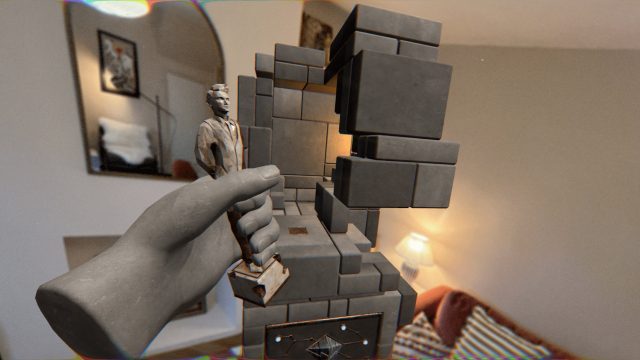
Maze Theory today announced that its upcoming immersive puzzle-adventure game Infinite Inside is set to arrive next month, coming to all major headsets.

Initially released as a demo on Quest earlier this year, the full game is set to arrive on July 12th across Vision Pro, Quest 2/3, Pico, SteamVR headsets and PSVR 2.

On mixed reality-supported devices (re: not PC VR or PSVR 2), Infinite Inside is said to blend VR and MR, making these “multi-dimensions a fundamental part of the storytelling and gameplay.”

Check out the trailer below:

When Infinite Inside launches next month, Maze Theory says it will feature five “peaceful and soothing labyrinths filled with mysteries,” environmental storytelling, and “challenging and accessible” puzzles.

Here’s how the studio describes the action:

When the enigmatic ancient artifact known as the ‘Plinth’ mysteriously materialises in your home, it opens a portal to a tranquil, dream-like world, filled with impossible architecture and hidden secrets waiting to be discovered. Guided by the echoes of past explorers, you will collect shards, solve three-dimensional puzzles, and assemble keys to unlock the mysteries of a secret society committed to maintaining the balance of Order and Chaos.

Can you solve the puzzles and reveal the truth about the society, the legacy of the Plinth, and ultimately, your own place in this mystical world?

Maze Theory, a subsidiary of Saltwater Games, is the London-based team behind a slew of XR games, including Peaky Blinders: The Kings Ransom, Doctor Who: The Edge of Time and Doctor Who: The Lonely Assassins.

Infinite Inside marks one of Maze Theory’s (and likely the industry’s) broadest releases to date, covering nearly all major VR/MR platforms. You can find it on Steam, Quest, PSVR 2, and Pico. An App Store link for the Vision Pro version should arrive closer to launch, so make sure to keep your eyes peeled.

The post Immersive Puzzler ‘Infinite Inside’ to Release on Vision Pro & All Major Headsets Next Month appeared first on Road to VR.


from Road to VR https://ift.tt/NIRkWh4
via IFTTT

New Meta Accelerator Aims to Fund Quest Developers Building ‘Lifestyle Apps’ Using MR, AI, & Hand-tracking

https://ift.tt/pdYAZh0

Meta announced a new developer accelerator aimed at kickstarting ‘Lifestyle’ apps for Quest which make use of mixed reality, AI and hand-tracking.

Meta says in the announcement selected participants of its new ‘Meta Quest Lifestyle App Accelerator’ can apply for seed-stage grant funding, as well as product resources and mentoring from Meta and participating VC partners, which include a16z, Anorak Ventures, BITKRAFT Ventures, Boost VC, and Lightspeed.

“The program focuses on fun, delightful consumer experiences with novel, engaging, and retentive mechanics that leverage the unique capabilities of Meta Quest in emerging lifestyle categories such as Fashion, Beauty, Home Design, Shopping, Cooking, DIY, Arts & Crafts, and more,” the company says.

One such example cited by Meta is Zac Reid’s PianoVision, which uses mixed reality to teach users how to play piano.

Aimed at small teams, the six-month program will include three paid milestones to help teams prototype their concepts, as well as up to three Quest 3 dev kits for teams in supported countries. Notably, selected participants will retain full ownership of their IP, code, assets, design, and distribution rights, Meta says.

“We’re looking for founders who want to build companies dedicated to MR apps in Lifestyle categories that drive engagement with Meta Quest users. Whether your company has a long track record of publishing apps or is just getting off the ground, our Meta Quest Lifestyle App Accelerator could be a great fit if you’re working on a brand-new Meta Quest lifestyle app that is big enough to be a standalone business.”

Who shouldn’t apply: companies at Series B or later, and studios marketing activations, B2B apps targeting schools or professionals, video games, media consumption, fitness & wellness, or sports. Interested teams should check out the full eligibility requirements and developer FAQ first to make sure they qualify.

Submissions are now open, with the cut-off date scheduled for October 15th, 2024. Meta will select participating teams on December 31st, 2024, with the program officially running from December 2024 to May 2025.

The post New Meta Accelerator Aims to Fund Quest Developers Building ‘Lifestyle Apps’ Using MR, AI, & Hand-tracking appeared first on Road to VR.


from Road to VR https://ift.tt/aBqUcVF
via IFTTT

Wednesday, 19 June 2024

Oculus Founder’s New XR Headset Built Around “military requirements” but Also “used for non-military stuff”

https://ift.tt/XfJtNaU

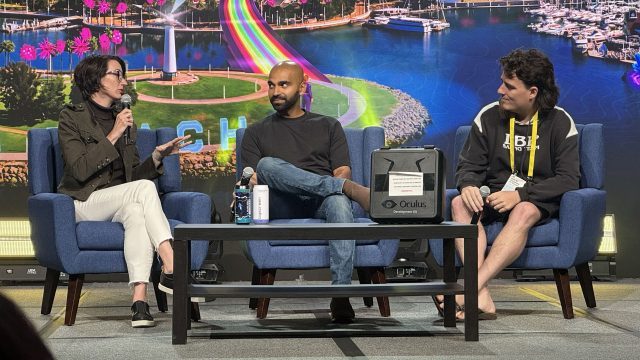
This week at AWE 2024, Oculus founder Palmer Luckey spoke briefly about a new XR headset he’s developing. Though the headset would see Luckey returning to the XR space, this one is being built with military, rather than consumer, uses in mind.

Luckey confirmed earlier this month that he intends to build a new XR headset, but revealed almost no details about the project.

During a panel discussion today at AWE 2024, he offered just a bit more, saying the headset’s design is “being driven by military requirements, but also going to be used for non-military stuff. It’s really cool, it’s really something.”

Though Luckey was on stage with Bigscreen Beyond creator Darshan Shankar, the two didn’t indicate any joint work together.

Luckey said he’s announcing the project now because trying to keep it secret means fewer opportunities to find key collaborators and suppliers.

His mention of the upcoming headset’s military requirements suggests the project originates from within his current company, Anduril, a tech-focused military contractor.

Although “military requirements” can often be seen as synonymous with “incredibly expensive,” Luckey has grown Anduril into a multi-billion dollar company on the premise that major military contractors charge too much and deliver more slowly than they ought too.

Considering the headset’s angle, it seems unlikely that a military-focused headset would plug into any consumer XR ecosystems like Horizon OS or SteamVR. That leaves it up in the air whether the headset will be built on a proprietary platform—and how it will support the “non-military stuff” that Luckey mentioned. Likely that “stuff” refers to enterprise-focused use-cases like training, education, and design.

Luckey founded Oculus in 2012, the company whose Rift headset was the spark that rebooted the modern era of VR. As a rapidly growing startup, Oculus attracted the attention of Meta (at the time Facebook), which acquired the company in 2014 for more than $2 billion. Luckey continued in VR under Meta’s roof for several years but was eventually pushed out of the company due to backlash to his politics. After leaving Meta, Luckey went on to found Anduril, a tech-defense startup which itself went on to achieve a multi-billion valuation. Though Luckey hasn’t been active in XR since leaving Meta, he’s continued to be looked to as a thought leader in the space.

The post Oculus Founder’s New XR Headset Built Around “military requirements” but Also “used for non-military stuff” appeared first on Road to VR.


from Road to VR https://ift.tt/TGjzsvS
via IFTTT

Tuesday, 18 June 2024

‘Gorilla Tag’ Has Topped $100M in Revenue, Making it One of VR’s Most Successful Games

https://ift.tt/ECVdY03

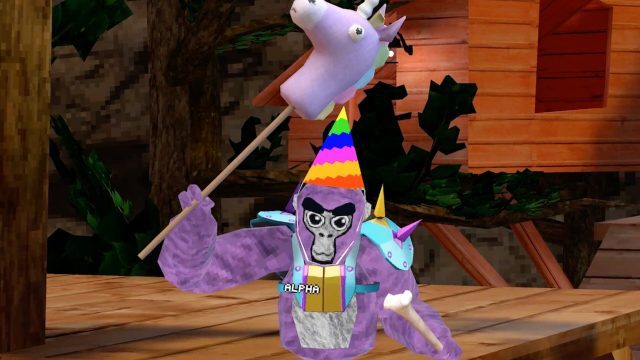
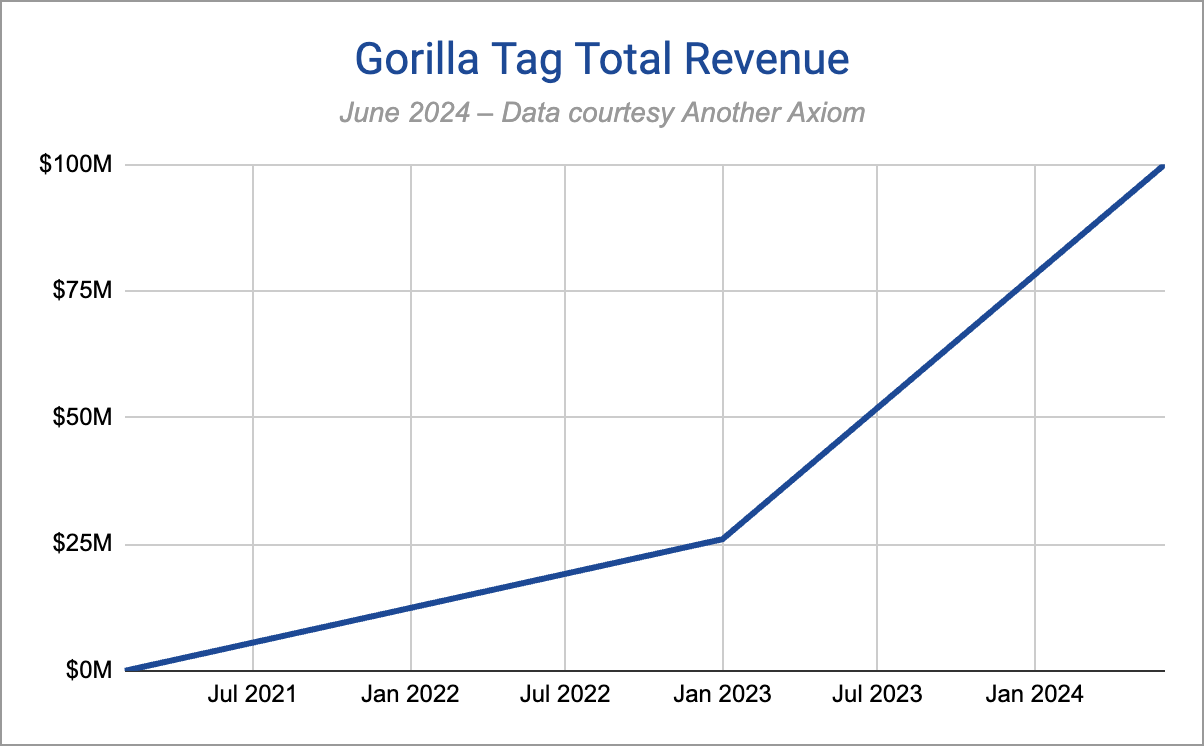
VR studio Another Axiom today announced that its breakout title, Gorilla Tag, has surpassed $100 million in revenue. The company shared other key metrics about its player population that shine light on the state of the VR market.

Not long after its launch back in early 2021 it became clear there was something special about Gorilla Tag. It’s minimalistic ‘tag’ gameplay, unique arm-based locomotion, and novel social architecture made for simple social fun. And it turns out, people really like simple social fun.

This week the studio behind the game, Another Axiom, offered up some key metrics for Gorilla Tag that show just how large it has become. Here’s the quick and dirty:

  • $100 million in total revenue

  • 10 million lifetime players
  • 3 million monthly active users
  • 1 million daily active users

Gorilla Tag’s revenue comes primarily through in game cosmetics which allow for try-ons and a social shopping experience.

These figures make Gorilla Tag one of the most successful and most popular VR games to date. Not only are lots of people playing the game, Another Axiom also revealed the average playtime is nearly 60 minutes. That’s doubly impressive considering how physical of a game it can be.

As for what’s next? The studio isn’t leaving Gorilla Tag behind, but it’s busy at work on a spiritual successor to Lone Echo, the game which inspired Gorilla Tag’s movement in the first place.

The post ‘Gorilla Tag’ Has Topped $100M in Revenue, Making it One of VR’s Most Successful Games appeared first on Road to VR.


from Road to VR https://ift.tt/UOfomvC
via IFTTT

Quest ‘Augments’ Feature for Concurrent AR Apps Needs More Time to Cook, Says Meta CTO

https://ift.tt/KcFmlif

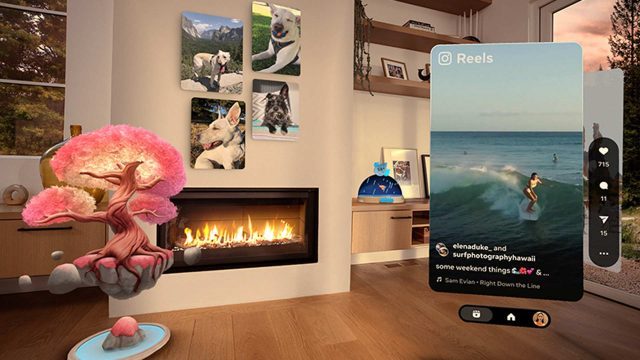
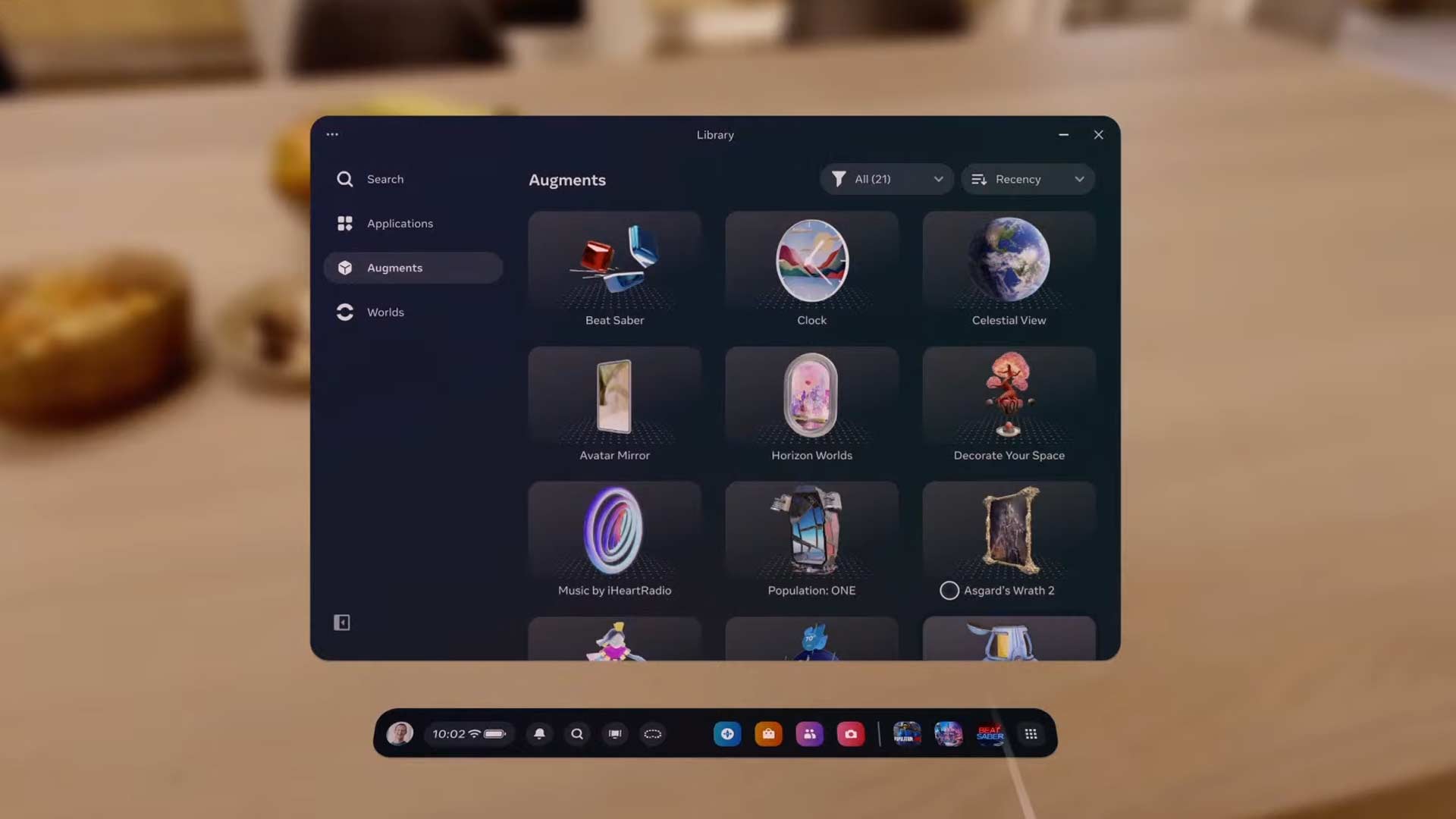
Last year Meta announced the so-called Augments feature, planned for Quest 3, which would allow persistent mini AR apps to live in the world around you. Now, eight months after the headset hit store shelves, Meta’s CTO explains why the feature has yet to ship.

Augments was announced as a framework for developers to build mini AR apps that could not just live persistently in the space around you, but also run concurrently alongside each other—similar to how most apps work on Vision Pro today.

Image courtesy Meta

And though Meta had shown a glimpse of Augments in action when it was announced last year, it seems the company’s vision (and desire to market that vision) got ahead of its execution.

This week Meta CTO Andrew “Boz” Bosworth responded to a question during an Instagram Q&A about when the Augments feature would ship. He indicated the feature as initially shown wasn’t meeting the company’s expectation.

We were playing with [Augments] in January and we decided it wasn’t good enough. It was too held back by some system architecture limitations we had; it ended up feeling more like a toy and it didn’t really have the power that we think it needed to deliver on the promise of what it was.

So we made a tough decision there to go back to the drawing board, and basically [it needed] a completely different technical architecture. Starting from scratch basically. Including actually a much deeper set of changes to the system to enable what we wanted to build there. I think we made the right call—we’re not going to ship something we’re not excited about.

But it did restart the clock, and so [Augments is] going to take longer than we had hoped to deliver. I think it’s worth while, I think it’s the right call. But that’s what happened.

We’re only two-and-a-half months out from Meta Connect 2024, which would be the one-year anniversary of the Augments announcement. That’s where we likely to hear more about the feature, but at this point it’s unclear if it could ship by then.

The post Quest ‘Augments’ Feature for Concurrent AR Apps Needs More Time to Cook, Says Meta CTO appeared first on Road to VR.


from Road to VR https://ift.tt/yp67tq5
via IFTTT
Related Posts Plugin for WordPress, Blogger...