Monday, 29 June 2020

Mortal Blitz: Combat Arena Is A F2P Multiplayer PSVR Shooter

https://ift.tt/eA8V8J

Skonec Entertainment’s Mortal Blitz series lives on; Mortal Blitz: Combat Arena is coming to PSVR soon.

The latest game in the shooter franchise was announced last week during the Bitsummit Gaiden stream. Sony’s Shuhei Yoshida introduced the title, as you can see in the (Japanese) video below. Mortal Blitz: Combat Arena is an online shooter in which up to four players teleport around nodes on a map, trying to shoot each other in the face.

Each point on a map is guarded with shields that will degrade as other players shoot at them. You’ll have to balance getting a great vantage point with maintaining cover. There are, apparently “hundreds” of customization options for weapons and items, ranging from machine guns to rocket launchers and stat-boosters. There will also be a single-player component with missions, but it’s not clear how this will look right now. The game supports both the DualShock 4 and the rifle-shaped Aim controller.

Mortal Blitz: Combat Arena will be free-to-play, with an opening beta launching in August. A full release is planned for September. Keep in mind these dates are only confirmed for Japan right now; it’s not clear if the game will be releasing in the US and Europe, too.

We were first introduced to Mortal Blitz all the way back in 2017 with a ho-hum single-player shooter campaign similar to the Time Crisis series. There have also been two iterations for VR arcades in the east that never made their way over here.

Will you be checking out Mortal Blitz: Combat Arena if and when it releases in these parts? Let us know in the comments below!

The post Mortal Blitz: Combat Arena Is A F2P Multiplayer PSVR Shooter appeared first on UploadVR.


from UploadVR https://ift.tt/3imtLsm
via IFTTT

With DOJ charges, former VC Mike Rothenberg could now be facing serious jail time

https://ift.tt/goU3rj

While many in Silicon Valley might prefer to forget about investor Mike Rothenberg roughly four years after his young venture firm began to implode, his story is still being written, and the latest chapter doesn’t bode well for the 36-year-old.

While Rothenberg earlier tangled with the Securities & Exchange Commission and lost, it was a civil matter, if one that could haunt him for the rest of his life.

Now, the U.S. Department of Justice has brought two criminal wire fraud charges against him, charges that he made two false statements to a bank, and money laundering charges, all of which could result in a very long time in prison depending on how things play out.

How long, exactly? The DOJ says the the two bank fraud charges and the two false statement to a bank charges “each carry a maximum of 30 years in prison, not more than five years supervised release, and a $1,000,000 fine,” while the money laundering charges “carry a penalty of imprisonment of not more than ten years, not more than three years of supervised release, and a fine of not more than twice the amount of the criminally derived property involved in the transaction at issue.”

The damage done in the brief life of his venture outfit — even while understood in broad strokes by industry watchers – is rather breathtaking. As laid out by the DOJ, Rothenberg raised and managed four funds between the inception of his firm, Rothenberg Ventures, in 2013 and 2016, and his criminal activities began almost immediately.

According to the DOJ’s charges, after closing that initial fund, he partially funded his own capital commitment to the second fund by making false statements about his wealth to his bank while refinancing his home mortgage and while obtaining a $300,000 personal loan, some of which he poured in the fund.

That’s bank fraud. Yet according to the DOJ, that was merely Rothenberg’s opening gambit.

The following year, in 2015, Rothenberg “took excess money in venture capital fees from one of the funds he was raising and managing” and because he then “faced a shortfall at the end of the year that he did not wish to report to his investors,” he found an illegal workaround. Specifically, alleges the DOJ, he “engaged in a scheme to defraud a bank by making false statements and misrepresentations to the bank in order to obtain a $4 million line of credit to pay back the fund from which he had taken excess fees.” The idea, says the DOJ, was to “deceive his investors into believing the fund was well-managed,” which apparently worked at the time.

Of course, in reality, Rothenberg was digging an ever bigger hole for himself, suggests the DOJ. Meanwhile, he seemingly had appearances to keep up. Which could be why in February 2016,  according to the allegations laid out by the DOJ, he “engaged in a scheme to defraud an investor with respect to a $2 million investment that it believed it was making directly into a virtual reality content production company operating as River Studios that Rothenberg contended he wholly owned.”

The DOJ says that that instead, Rothenberg used most of it for purposes having nothing to do with that production company.

Rothenberg also — judging by the DOJ’s report — began to throw caution to the wind, perhaps because he thought he might get away with it or because he was increasingly desperate.

To wit, its complaint alleges that five months after defrauding that first investor, in July 2016, Rothenberg “engaged in a scheme to defraud as many as five separate investors when he induced them to wire a total of $1.35 million under the premise of investing in the untraded stock of a privately-held software company.” The complaint charges Rothenberg with “knowingly engaging in a scheme to defraud one investor by representing to that organization that its money would be used to purchase the software company’s shares. According to the complaint, on the same day the money was wired, Rothenberg took the money from the bank account designed to make the investment and sent it to RVMC’s main operating bank account, from which it was used for many purposes.”

No stock in the software company was ever purchased, according to the DOJ’s investigation. The agency says Rothenberg also “induced investments in his RVMC-managed funds under the premise he would use the money for investments in ‘frontier edge’ technologies and take only certain limited fees for the management of the funds.” Instead, he “took more fees than to which he was entitled and invested far less of the money he raised than the operating agreements disclosed to the investors contemplated.”

Altogether, says the DOJ, it has collected evidence that Rothenberg fraudulently obtained at least $18.8 million.

We’ve reached out to Rothenberg — who has consistently denied any wrongdoing — for comment. It isn’t the only bad news he has faced lately, in any case.

Just seven months ago, in December, Rothenberg was ordered to pay more than $31 million in connection with the misappropriation of investor money relating to an SEC complaint that alleged he misappropriated millions of dollars from his firm’s funds, then used the money to support personal business ventures.

In October 2018, Rothenberg also agreed to be barred from the securities industry with a right to reapply after five years.

All have been incredible developments in what was already a nearly unbelievable story of apparent hubris and its consequences. Rothenberg had entered the venture scene with a splash, landing a feature story in TechCrunch, in early 2013, and touting his connections and his youth — he was 27 at the time — as advantages he enjoyed over older VCs who might not have a shot at the same companies.

Two years later, BusinessWeek dubbed him Silicon Valley’s “party animal,” as his firm became renowned in the Bay Area for “throwing bashes for entrepreneurs,” including expensive parties at San Francisco’s Oracle Park baseball field (known at the time as AT&T Park). Rothenberg, a self-described former math Olympian who attended Stanford before getting an MBA from Harvard Business School, said at the time, “The way we build a scalable network is by hosting a lot of events.”

He seemed to dismiss questions about how they were paid for, but he did tell BusinessWeek that he provided some of the earliest funding to Robinhood, the stock-trading app that was most recently valued at $7.6 billion and whose cofounders and CEOs attended Stanford at the same time as Rothenberg.

It was an auspicious start, in short. Alas, by the summer of 2016, the firm’s employees were scattering to the winds, and investigators were beginning to take notes.


from TechCrunch https://ift.tt/2NJsVaJ
via IFTTT

Sunday, 28 June 2020

John Legend Performs Live In VR To Raise Awareness Towards Mass Incarceration

https://ift.tt/2NzzFYZ

The GRAMMY award-winning artist just set a new standard for live VR performances.

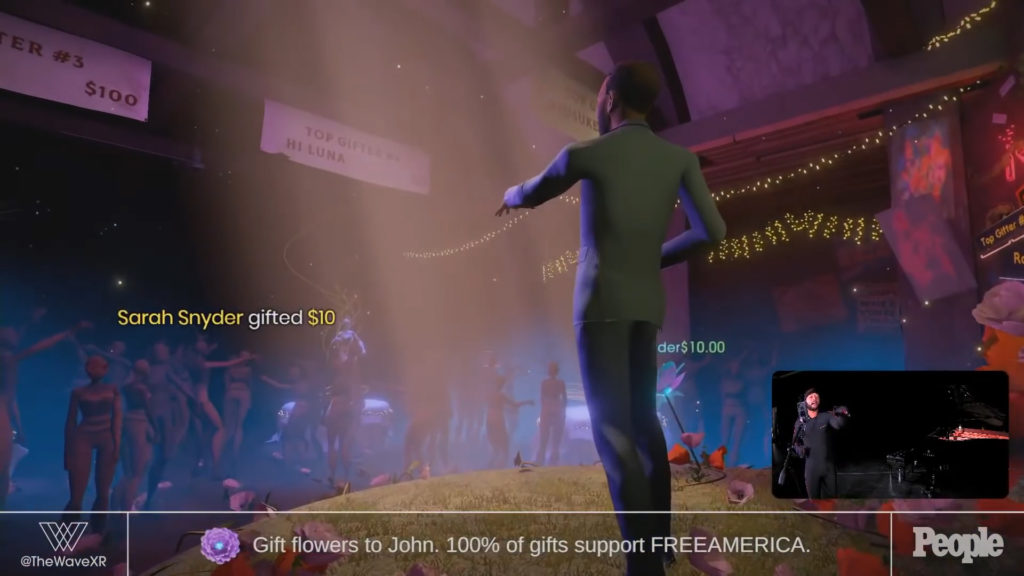
Fresh off their huge $30 Million funding announcement, virtual music platform Wave hosted an amazing live VR concert last week featuring GRAMMY award-winning singer-songwriter John Legend in an effort to help awareness and support for Legend’s FREE AMERICA campaign, with the goal of transforming the U.S. criminal justice system and ending mass incarceration for African Americans.

During the 17 minute live virtual musical extravaganza, Legend performed a number of his biggest hits such as “Ooh Laa” and “Love Me Now.” He also performed songs from his latest album, Bigger Love. 

Between songs Legend would chat with an audience made up of VR users tuning in via Wave as well as people watching from a livestream on Twitter and YouTube. Those in the audience could donate to the cause from their respective platforms, at which point their names would appear around Legend in the form of flowers, comets, and various other environmental elements.

Legend’s avatar moved gracefully has he moved about the virtual stage, his digital movements matching that of his real body with incredible detail. Even his passionate facial expressions were matched in real-time, adding an additional layer of intimacy and emotion to the performance. 

Legend conducted his performance live in-studio wearing an Xsens MVN Animate Motion Capture System. This is the same motion capture solution used on blockbuster films like Star Wars: Rise of Skywalker, Avengers: Infinity War, and The Wolverine, as well as hit games such as Creed: Rise to Glory and Counter Strike. 

This same technology is also being used in industries such as health to measure human machine interactions and the kinematic and kinetic analysis of locomotion (better known as gait analysis), as well as sports science to explore better and safer workout regiments for athletes, trainers, or those looking to hit basic health goals.

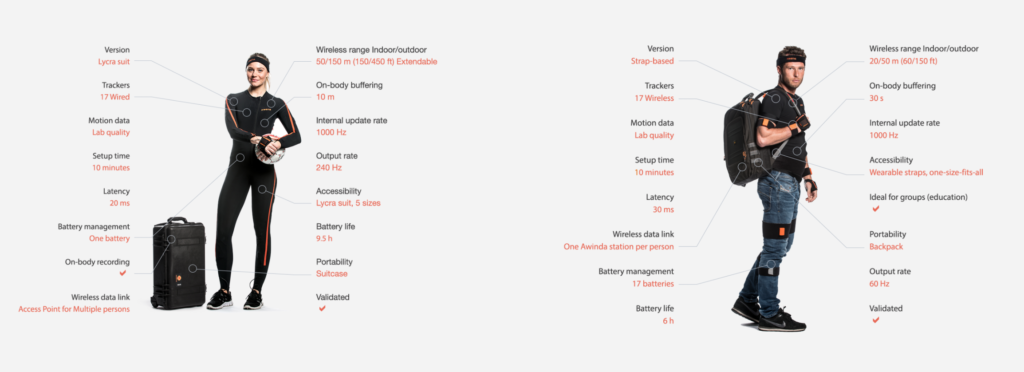
Looking at the video posted on John Legend’s YouTube page that shows both real-world and VR footage, it looks like he’s wearing Xsens’ MVN Link suit.

The MVN Link suit features embedded sensors and is used primarily for high dynamic movement situations, such as fast running, live on-stage entertainment, and live streaming. Data from the suit is then transferred to a computer through a WiFi connection at a high frame rate. The most impressive part of the suit is its on-body recording capabilities. This means you can capture data without a computer and then upload the data later; and because it’s a wireless system, the user has total freedom to move how they want.

Xsens also offers an additional mocap solution referred to as the MVN Awinda. Unlike the MVN Link, this wireless system is composed of a top shirt made of lycra along with straps that users wear on their arms and legs to capture data, allowing them to wear the suit above their normal clothes. This makes the suit easier to take on and off in case you want to capture data from different people. The information is captured at a lower frame rate, which makes the suit perfect for jobs that aren’t as high dynamic or complex.

To transfer the data from the suit to a computer, Xsens uses a software called MVN Animate, which allows you to record, view and analyse the data in real-time. That data is then instantly turned into a robotic avatar (lovingly called Mo by the Xsens team) that can be viewed on a computer or through a mobile device using the Xsens MVN Remote app. 

The data can then be exported into all typical formats used to create visual effects such as FBX and BVH, and can be streamed directly into Unity, Unreal, and Autodesk, where you can then add custom visual details.

You can see a much more detailed breakdown of how the suit works, here. 

During Legend’s live virtual concert experience, he steps away from the mic and sits down at a piano to play his hit, “All of Me.” The Xsens suit lets you bring in up to 4 real-world props into the virtual scene, including a piano!

In the end John Legend’s A Night for Bigger Love Wave concert was an incredible moment for VR and live music in general.

Wave has already produced numerous Waves (what Wave calls live shows) with a number of artists around the globe, and have more Waves lined up on their calendar. 

If you want more information or if you would like to donate to Legend’s FREE AMERICA campaign, click here. 

Image Credit: Wave

The post John Legend Performs Live In VR To Raise Awareness Towards Mass Incarceration appeared first on VRScout.


from VRScout https://ift.tt/31ovgA4
via IFTTT

Kat Walk C VR Treadmill Reaches Over $1.2 Million On Kickstarter

https://ift.tt/eA8V8J

Kat Walk C, the latest attempt at bringing a VR treadmill to the living room, is off to a great start with its Kickstarter crowd-funding campaign.

The device launched its campaign last week with a $100,000 funding goal. At the time of writing, the campaign has reached $1.2 million in funding with over a month to go before it closes out on July 31st. The Early Bird special deals that offered the treadmill from anywhere between $699 to $899 have all been claimed, with the price now starting at $999. The company behind the device plans to release more discounted tiers, though.

Kat Walk C is similar to other VR treadmills. The kit is a large peripheral that has users standing in a dish, wearing a special pair of shoes, strapping into a harness and then physically walking in VR games and experiences. The idea is to immerse you even further in a VR experience and combat the ongoing issue of locomotion in VR. The device supports PC VR and PSVR headsets and, according to Kat VR, can be used in any game with a free locomotion setting.

There are other VR treadmill options out there, though they’ve largely failed in their mission to bring the concept to people’s homes. Virtuix was there early with its Omni treadmill, for example, but recently refocused its efforts on VR arcades. Kat VR itself offers a number of other treadmills and solutions for enterprise customers.

Currently, the Kat Walk C is expected to be delivered to Kickstarter backers in October of this year. Would you be interested in having a VR treadmill in your home? Let us know in the comments below!

The post Kat Walk C VR Treadmill Reaches Over $1.2 Million On Kickstarter appeared first on UploadVR.


from UploadVR https://ift.tt/3i7CNsV
via IFTTT

Google Figured Out How To Stream 6DoF Video Over The Internet

https://ift.tt/38ge5Ck

Researchers from Google developed the first end-to-end 6DoF video system which can even stream over (high bandwidth) internet connections.

Current 360 videos can take you to exotic places and events, and you can look around, but you can’t actually move your head forward or backward positionally. This makes the entire world feel locked to your head, which really isn’t the same as being somewhere at all.

Google’s new system encapsulates the entire video stack; capture, reconstruction compression, and rendering- delivering a milestone result.

The camera rig features 46 synchronized 4K cameras running at 30 frames per second. Each camera is attached to a “low cost” acrylic dome. Since the acrylic is semi-transparent, it can even be used as a viewfinder.

Each camera used has a retail price of $160, which would total to just north of $7,000 for the rig. That may sound high, but it’s actually considerably lower cost than bespoke alternatives. 6DoF video is a new technology just starting to become viable.

The result is a 220 degree “lightfield” with a width of 70cm- that’s how much you can move your head. The resulting resolution is 10 pixels per degree, meaning it will probably look somewhat blurry on any modern headset with the exception of the original HTC Vive. As with all technology, that will improve over time.

But what’s really impressive is the compression and rendering. A light field video can be streamed over a reliable 300 Mbit/sec internet connection. That’s still well beyond average internet speeds, but most major cities now offer this kind of bandwidth.

How Does It Work?

In 2019 Google’s AI researchers developed a machine learning algorithm called DeepView. With an input of 4 images of the same scene, from slightly different perspectives, DeepView can generate a depth map and even generate new images from arbitrary perspectives.

This new 6DoF video system uses a modified version of DeepView. Instead of representing the scene through 2D planes, the algorithm instead uses a collection of spherical shells. A new algorithm reprocesses this output down to a much smaller number of shells.

Finally, these spherical layers are transformed into a much lighter “layered mesh”, which sample from a texture atlas to further save on resources (this is a technique used in game engines, where textures for different models are stored in the same file, tightly packed together.)

You can read the research paper and try out some samples in your browser on Google’s public page for the project.

Light field video is still an emerging technology in the early stages, so don’t expect YouTube to start supporting light field videos in the near future. But it does looks clear that one of the holy grails of VR content, streamable 6DoF video, is now a solvable problem.

We’ll be keeping a close eye on this technology as it starts to transition from research to real world products.

The post Google Figured Out How To Stream 6DoF Video Over The Internet appeared first on UploadVR.


from UploadVR https://ift.tt/3i7vrpj
via IFTTT

7 Great Non-VR Games With Must-Play VR Support

https://ift.tt/eA8V8J

Virtual Reality might be one of gaming’s most immersive ways to play but it remains a niche platform.

[UploadVR regularly commissions freelance writers to review products, write stories, and contribute op-ed pieces to the site. This article is an opinion-based listicle from the perspective of the writer.]

That’s mostly attributable to a high price barrier. Though efforts from Sony such as PlayStation VR and Facebook’s Oculus Quest have helped, the price still helps  explain why AAA publishers are reluctant to invest in fully-fledged original experiences. As a result, much of the time, VR is incorporated as an optional experience within existing non-VR titles instead.

On the other side, developers have also adapted VR games to more conventional platforms, providing them a larger audience. Whether it’s launching with both options, porting to VR-less platforms, or patching in a desktop mode, the inclusion of both methods can make great experiences more widely accessible. 

With some developers seeking to unify both audiences, here are some of the best examples we’ve seen yet for great non-VR games with must-play VR support.


7 Great Non-VR Games With Must-Play VR Support


Eve: Valykrie (PC / PC VR and PS4 / PSVR)

Read / Watch Our Review

CCP Games have seen huge success with EVE Online. Released in 2003, EVE became renowned for its vast scale, seeing players compete for virtual supremacy and bringing some fascinating stories with it. Looking to branch out their universe, CCP then released VR title Eve: Valkyrie back in 2016, a multiplayer dogfighter with heavy emphasis on PvP missions. Over a year later, Valkyrie’s Warzone update was released, bringing a desktop mode that removed previous VR requirements. It’s campaign was sadly short-lived but bringing some enjoyable gameplay, it’s an exhilarating experience worth revisiting for quick space thrills.


Detached (PC / PC VR)

Read Our Coverage

Several studios have tried recreating the intensity of floating through outer space via virtual reality and back in 2017, Anshar Studios’ Detached was among them. Featuring PvP multiplayer as well as a separate campaign, it’s an incredibly lonely experience that saw you separated from your ship, left to explore an abandoned space station to survive. Its zero gravity antics proved nauseating in places and, trying to broaden its user base, Anshar developed a non-VR version in 2018, easing the experience but losing that immersion. With benefits to both formats, Detached proved an enjoyable title that’s worth looking into.


Five Nights At Freddy’s: Help Wanted (Switch Non-VR, PC / PC VR, PS4 / PSVR, and Quest)

Watch Our Livestream

When Five Nights At Freddy’s launched in 2014, few expected it to become the hit sensation we see today. Originally developed by Scott Cawthon, this horror series saw you playing an overnight security guard at Freddy Fazbear’s Pizza, trying to survive against a group of deadly animatronic characters. Spawning six main sequels, FNAF expanded into VR last year with Help Wanted, featuring 50 minigames based off its previous entries. It saw positive reception and quickly became a best-selling VR title but, not wanting to leave any fans out, developers released a non-VR release six months later, landing on PS4, PC and Switch.


The Invisible Hours (PC / PC VR and PS4 / PSVR)

Read Our Review

Tequila Works made a name for themselves most recently with Groundhog Day: Like Father Like Son but back in 2017, they were hard at work releasing The Invisible Hours. Invited to a mysterious mansion by Nikola Telsa, each guest holds a murky past, many of whom are looking to make amends. Playing as disgraced detective Gustaf Gustav, we find Tesla has been murdered by another guest and it’s up to you to discover the truth. Receiving strong reviews, Tequila Works soon developed a non-VR version, releasing a free patch six months later and it proved just as satisfying. 


The Persistence (PC / PC VR and PS4 / PSVR)

Read / Watch Our Review

The Persistence recently became a multiplatform release but two years ago, developers Firesprite made waves on PSVR with their former exclusive. Finding your spaceship stranded in deep space and overrun by demonic creatures, you played the crew’s sole survivor, Zimri Elder, trying to make it through this horrific onslaught. Incorporating FPS and roguelike mechanics, death is a minor obstacle, finding Zimri cloned back to life each time and no two playthroughs are identical, changing the spaceship layout on each run. Now withVR optional on PC/PS4, it’s a great choice for horror fans.


Tetris Effect (PS4 / PSVR, PC / PC VR, and Quest)

Read Our Review

Tetris should require no introduction to most. With differently shaped blocks known as Tetrominos falling downward, you aim to clear lines by filling them up, earning points for speed. Since arriving in 1984, Tetris has seen many different releases, but news of a VR version surprised many in 2018. Helmed by Rez producer Tetsuya Mizuguchi, TetrisEffect retained the classic gameplay formula but split stages into three cinematic sections, activated by clearing a set number of lines. Bringing us stunning visuals and an excellent soundtrack, it launched with support for both VR and non-VR and comes highly recommended.


VRChat (PC / PC VR and Quest)

Read Our Coverage

It’s been three years since VRChat first launched but even now this free-to-play title retains a significant following. Featuring gameplay reminiscent of Second Life, VRChat is a user-driven experience, allowing players to create their own worlds, avatars and custom content. It may be surprising considering the name but VRChat isn’t limited to virtual reality, including a desktop mode so anyone can join, albeit with control limitations. Not every world caters to desktop users but ultimately, this experience comes down to you. Whether you’re looking to socialize, play some games or something else, there’s plenty of fun to be found.


There are undoubtedly countless others that we could have included. What are some of your picks for the best VR games that also have non-VR support?

The post 7 Great Non-VR Games With Must-Play VR Support appeared first on UploadVR.


from UploadVR https://ift.tt/2BPkOqp
via IFTTT

Flipside Studio offers VR production tool for animation

https://ift.tt/2Zk7AKD

Flipside Studio is leaving Early Access. It's a tool for directors and actors to work in VR.
Flipside Studio is a new virtual production tool that enables actors and directors to capture and create animated content entirely in VR.Read More

from VentureBeat https://ift.tt/2VsBkDM
via IFTTT
Related Posts Plugin for WordPress, Blogger...