Charge up your lightsabers beat sabers and get ready for some new music! The first-ever paid DLC Music Pack is coming to Beat Saber next month in March 2019 according to the official Beat Saber Twitter. It seems like it will be coming to both PC and PSVR at the same time.
Earlier today the account tweeted that “development” on the PSVR edition of the Music Pack was complete and that it’s almost ready to go, with the priority shifting to the PC version:
#DevNews: Another milestone in the Music Pack development for PS VR has been reached and we’re almost ready to go! Now, our priority is to finish the development for PC and prepare everything for the release. Excited!
Then, in a follow-up tweet reply to someone, the account stated that the Music Pack will be releasing in March. They didn’t say when in March, so maybe as early as this weekend if we’re lucky. All the way back in November they announced the Music Pack (with 10 songs) was in active development. In fact, over 30 new songs are being planned right now.
Until now all of the previous songs released since the original collection of just 10 have been for free. First there was Angel Voices that came to the PC version shortly after Early Access launch, then the PSVR version launched with a handful of exclusive songs which eventually came to PC, an EDM song released and came to Beat Saber on the same day, and then the viral hit k-pop song about League of Legends, K/DA Popstars, hit both platforms at the same time.
Hopefully we find out more about the first paid DLC Music Pack soon. Let us know your thoughts down in the comments below!
Biometric algorithms enable your body to speak through immersive technology. Is this the next phase of human-machine integration?
“It’s pretty common knowledge that body language plays a big role in how we communicate in real-life, and the fact is that behavioral studies have been validating the correlation between the body and mind for decades.”explains Amir Bozorgzadeh, Cofounder and CEO at Virtuleap.“In the setting of spatial computing, the whole game elevates as all of our intuitions about non-verbal expression are suddenly given a voice.”
Virtuleap is a Lisbon-based startup, a Boost VC Tribe 11 company and a member of the CMS equIP startup program. They initially began developing their API to cater towards accessibility needs, broadening the user base of immersive content adapting for inclusiveness and maximum user comfort; like an increase of color contrast or adjustment of font size through individual user preferences.
That human-centric inclusive angle gradually evolved into incorporating scientific approaches such as neuropsychology and fractal analysis, which has now become what the team considers to be first the native metrics for human-centric research, design, and marketing for the spatial computing era.
The team leveraged modern neuroscience research to create mathematical models that infer emotional states based on your subliminal and unconscious body postures, gestures, and motion in immersive environments. For the next phase of development, theyare now looking to stress-test the algorithms by feeding the machine learning with data from a consumer-facing app. The result is the Attention Lab – an Oculus Go “edutainment” app which recently launched in beta – featuring a series of games and challenges that track user interaction.
Image Credit: Virtuleap
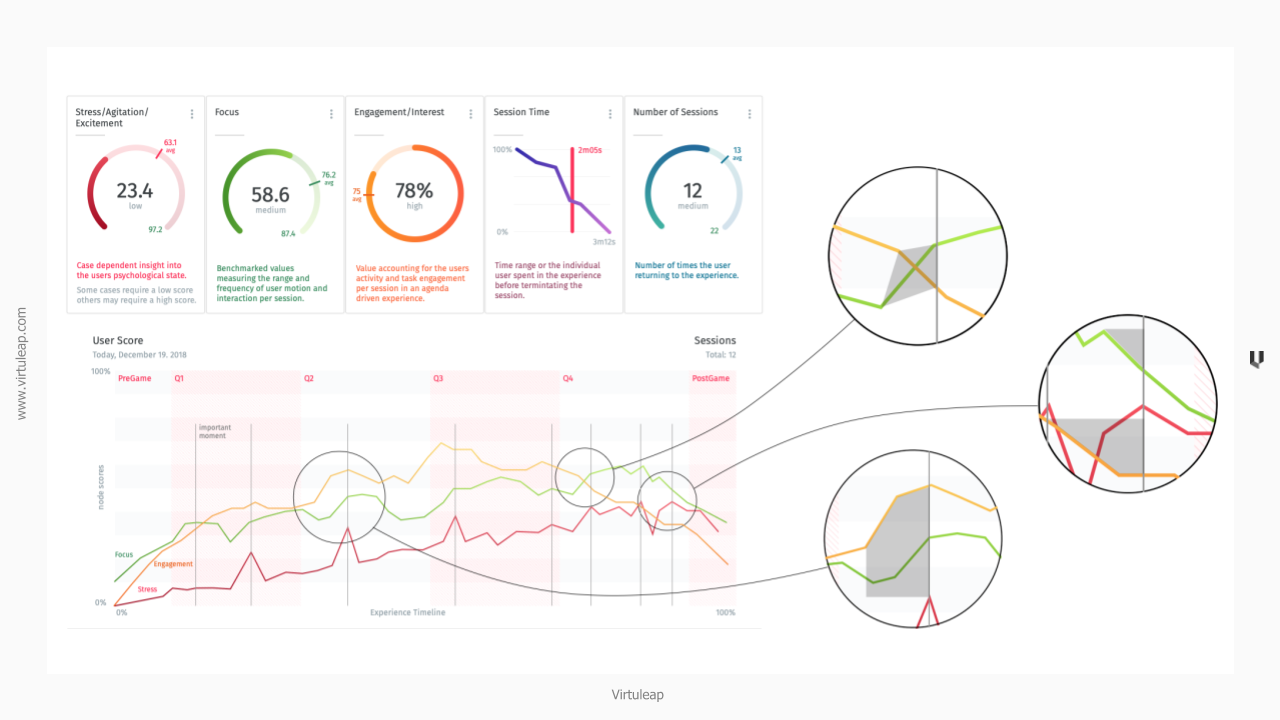
According toBozorgzadeh, the concept is a mix of popular VR apps such as Valve’s The Lab and Owlchemy Labs’ Job Simulator, and non-VR games like Lumosity and Cognifit, which are focused on cognition and user attention. Itfeatures a series of gamified experiments that capture user cognition in VR.Each experience is powered by a series of biometric algorithms that translate subliminal body postures, gestures, and motion in VR, AR, and 3D environments into meaningful insights about the human condition.
“While players get to enjoy challenging their cognitive abilities, such as memory and concentration, the real benefit of the Attention Lab is access to an unprecedented depth of self-knowledge and psychographics that is enabled thanks to the new data points captured by spatial computing devices.”
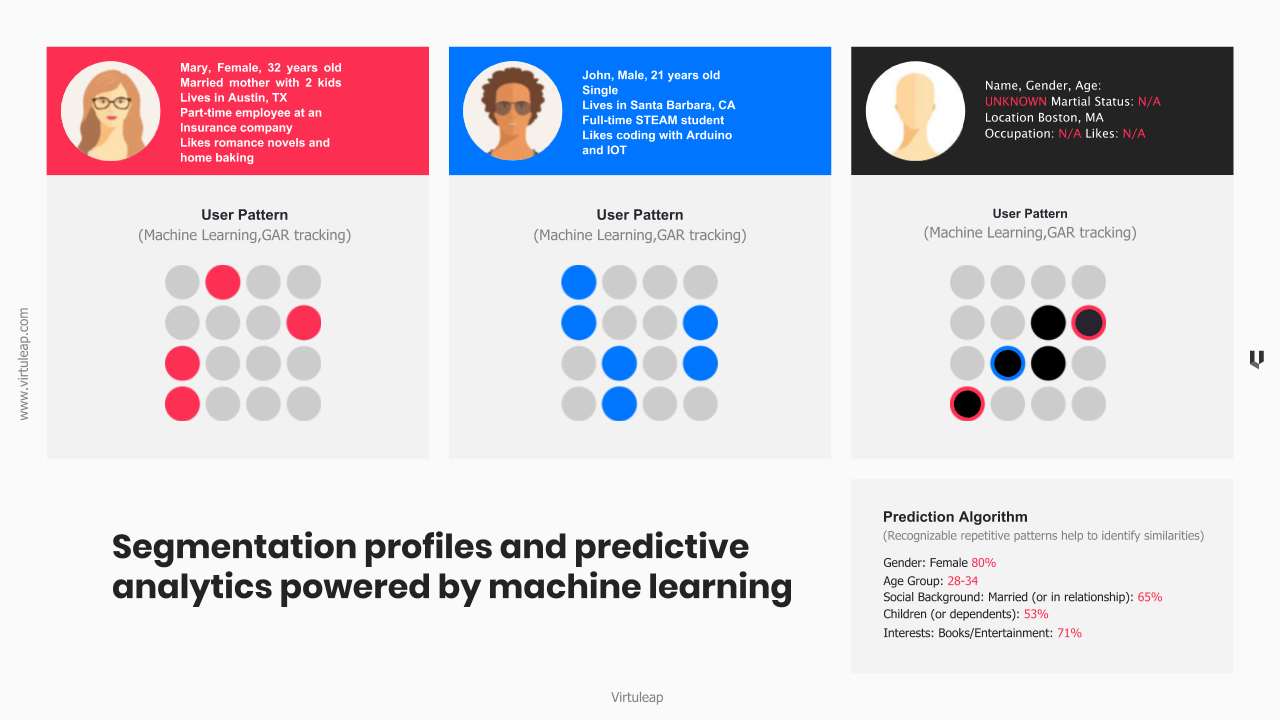
With machine learning, the mathematical models will become more accurate over time by allowing the API to track and map physical, physiological and psychological “segmentation” profiles in order to build a database that can generate predictive analytics. For example, the API will be able to anticipate the profile of an anonymous user based on their behavioral cues by calculating probabilities on their likely psychographic and demographic profile.
The Attention Lab / Image Credit: Virtuleap
“If it walks like a duck, swims like a duck, and quacks like a duck, then our machine learning calculates the probability of how likely that otherwise anonymous user is a duck.”explains Roland Dubois, Cofounder and CXO at Virtuleap. “Everything we capture in the form of meaningful insights would otherwise require a traditional survey or user interview in order to capture.”
While players get to enjoy challenging their cognitive abilities, such as memory and concentration, the real benefit of the app is access to an unprecedented depth of self-knowledge.
Image Credit: Virtuleap
“Players will get to learn about how their brains work and all sorts of insights about their neuroscience, not just about themselves specifically, but also in how it relates to the neuroscience of their friends and the community at large.”said Dubois. “Each experience will present different famous experiments that will, in turn, allow them to learn about how they react and respond in different situations. Insights that might just blow their minds.”
The Attention Lab is currently featured on the Kaleidoscope VR platform and is set to launch on the Oculus Store Q2 2019. In parallel, the API will be made publicly available on an online platform later in the year. Virtuleap is currently accepting pilot campaigns with brands and companies in both the consumer and enterprise sectors in order to create what they are calling “template models” that will allow their biometric algorithms to be relevant for content across a range of different categories.
I really don’t like saying ‘mixed reality’. In my opinion, it’s a term that needlessly confuses two similar but separate technologies – VR and AR. HoloLens isn’t an MR headset, it’s an AR headset. Windows’ MR-based VR headsets are really just that, VR headsets. But at MWC this week I saw a glimpse of true mixed reality; something that combined both VR and AR.
That would be Intel and the USC School of Cinematic Arts’ Batman experience. This was a small slice of a wider experience built with help from AT&T, Ericsson and Warner Bros.. It was running off a wireless HTC Vive Pro as one of the many 5G showcases at the show. You can see pretty much the entire piece in action in the video below.
It’s a piece of, quite literally, two halves. Look to one side and you’ll see the real world, as captured through Vive Pro’s cameras. Bat-baddy Scarecrow appears in front of you and litters the environment with spiders. Then he steps over to the other side, a fully-rendered VR environment where he does battle with Batman. Nothing about the AR or VR portions was separately special. But, combined together, they made for something intriguing.
Again, this was just a slice of the main experience and the demo conditions weren’t perfect. I couldn’t hear what was being said over the noise of the show floor and the right earphone wasn’t working. Not to mention that it was weird to see Batman and Scarecrow fighting from one angle only to turn around and see MWC carrying on with little care.
Still, it set my mind ablaze with possibilities for true mixed reality experiences. Imagine theatrical performances where you’d see real actors interact with virtual characters or games where the consequences of the virtual world spilled out into ours. You’d need conditions far more controlled than this, but the potential is definitely there.
This felt more like a proof of concept; a technological achievement more than a creative one. But the truth of the matter is that VR headsets aren’t that great at doing AR (yet) and AR headsets aren’t very good at VR (yet). Until the pair inevitably merge, experiences such as this will remain decisively experimental.
Could 5G streaming be the future of VR entertainment?
With the 2019 Mobile World Congress currently underway in Barcelona, Spain, HTC has been busying themselves with a slew of exciting announcements and demonstrations ranging from a smartphone aimed at cryptocurrency fanatics, to their HTC Vive Focus Plus VR headset.
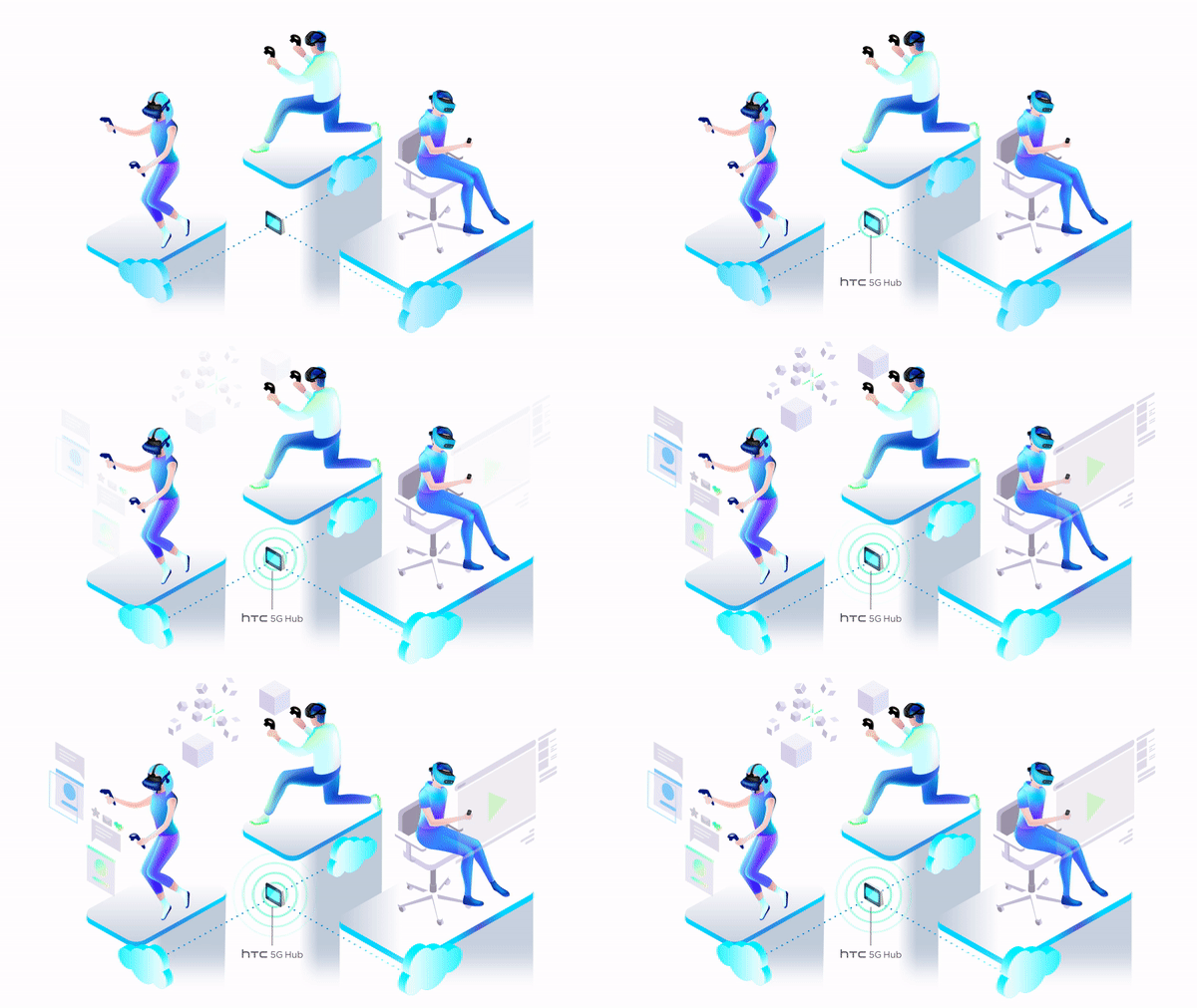
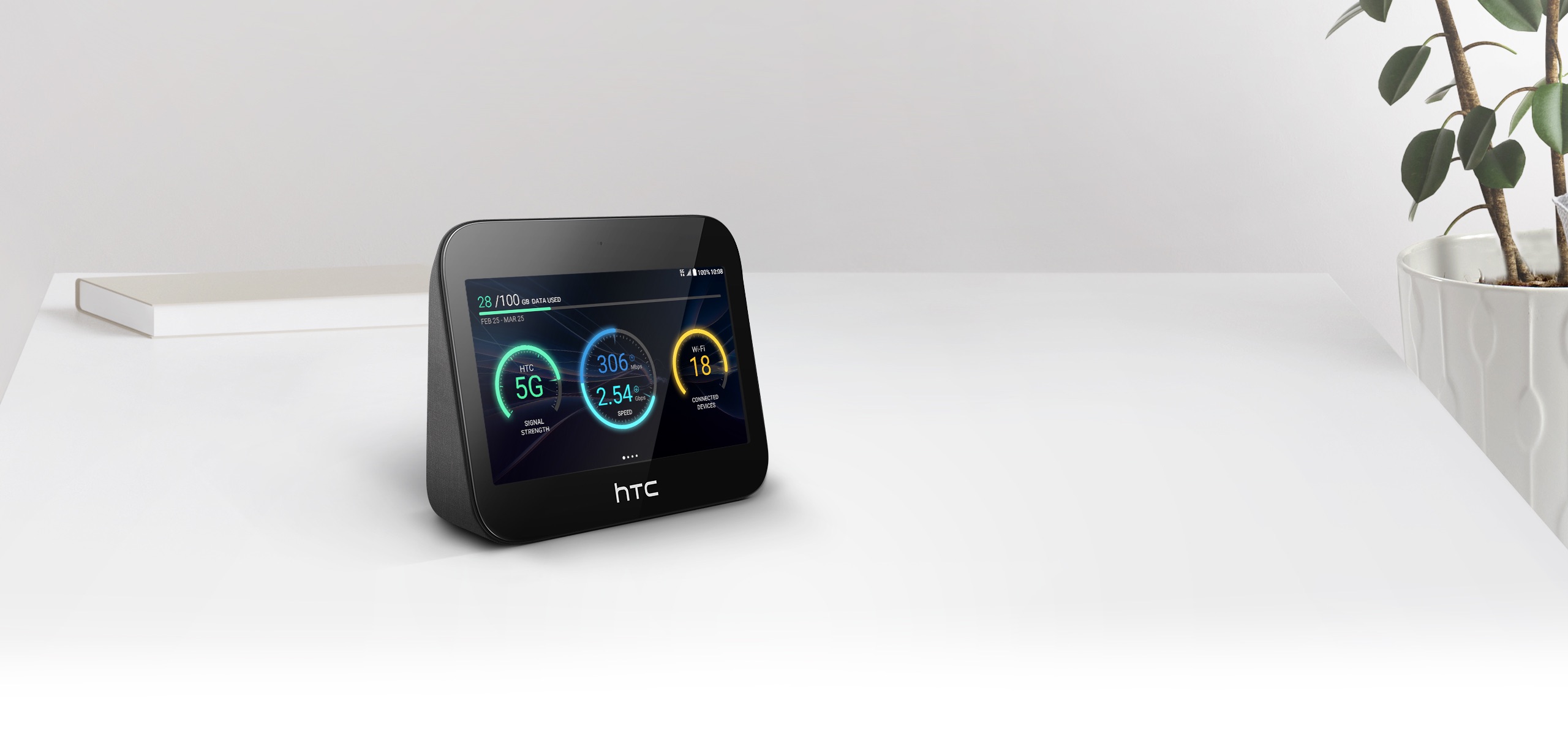
Yesterday, the company used MWC’s stage to reveal yet another new product, the HTC 5G Hub – a combination smart hub/mobile hotspot that brings 5G streaming to up to 20 connected devices. Not only that, but the device also serves as a digital assistant, as well as a media streaming platform with corporate VPN configuration.
Powered by Qualcomm Snapdragon 855 with Android 9 Pie support, the mobile hotspots 5G infrastructure is capable of streaming high-quality 4K video and gaming content to multiple devices simultaneously. The service is so strong in fact, HTC claims the infrastructure will soon provide support for low-latency cloud-based VR, allowing users to stream their favorite AAA experiences and games to their Vive headsets without the need of a PC, cables, or smartphone device.
Take a look a the full specs below:
DISPLAY: 5.0 inch HD capacitive touch screen (720×1280 pixels).
CPU: Qualcomm Snapdragon 855 Octacore, with Snapdragon X50 5G modem.
CONNECTIVITY: Bluetooth 5.0 Wi-Fi 802.11 a/b/g/n/ac/ad. Up to 20 Wi-Fi connections.
With major video game corporations such as Nintendo and Microsoft having already begun experimenting with high-quality game streaming, it comes as no surprise VR providers would begin exploring this technology as well.
Ditching the need of an expensive PC and cumbersome cables would no doubt make VR a more approachable platform, and the ability to connect multiple headsets at once would certainly make an impression with location-based VR providers.
We’ve tried HoloLens 2 and we kind of love it. In a few months’ time, Microsoft will let even more people test it out.
The company this week announced Mixed Reality Dev Days. Mixed reality is Microsoft’s semi-confusing term the covers everything from HoloLens to its VR headsets made with partners. Running on May 2nd and 3rd 2019, this event will welcome developers to Microsoft’s Redmond Campus. There they’ll get hands-on time with HoloLens 2 along with other MWC announcements like Azure mixed reality services, Azure Kinect Developer Kit and, in the company’s words, “more”.
The event will be feedback-focused, Microsoft is looking for impressions on its latest offerings and ideas on how to improve them.
Interestingly, the show takes place just a few days before Microsoft’s annual Build developer conference kicks off. We’d expect to see more MR updates at the show. We’ll also be interested to see if Microsoft has anything else to share on the MR front at GDC next month.
Tickets to the Dev Days won’t be free but pricing hasn’t been announced just yet. You can sign up to the company’s developer program to get an alert for when the invites go out.
HoloLens 2 is set to come out later this year. The AR headset improves upon the original device with a bigger field of view, improved interaction and better design. When I tried it at MWC this week I found one of the first AR headsets I could actually see myself using on a day-to-day basis. It’s an enterprise-level device (starting at $3,500) so not something that game developers will be looking to embrace.