Tuesday, 30 January 2018

ZEISS VR ONE Virtual Reality Headset for Apple iPhone 6 Smartphones Excellent

ZEISS VR ONE Virtual Reality Headset for Apple iPhone 6 Smartphones Excellent
ID: 263467681295
Auction price: $39.99
Bid count:
Time left: 29d 23h
Buy it now: $39.99
January 31, 2018 at 03:32AM
via eBay http://ift.tt/2DZFziJ
Review: Samsung Odyssey Sits Among The Best VR Headsets

Late last year Microsoft’s partners unleashed a collection of headsets powered by the company’s tracking technology. Leading the pack with a superior resolution is Samsung’s Odyssey, which sports the same resolution (1440×1600 per eye) as the yet-to-be-released Vive Pro.
Odyssey costs more than the other Microsoft headsets, around $500 officially, and doesn’t feature the flip-up display that’s so useful to developers. For enthusiasts, the resolution bump is important. We called the Odyssey 2017s best VR hardware partly because it legitimized Microsoft’s efforts to enter the VR market after Facebook and HTC and those extra pixels are key to their effort. The other VR headsets in the Windows-based line up, like the entry-level Acer and Lenovo systems, worked well and since our initial reviews they’ve dropped to incredibly low prices. Everything in those reviews holds true with Odyssey, with a couple major changes. There’s the missing flip-up display, which is gone in favor of a more comfortable fit overall, and the addition of IPD adjustment alongside integrated sound and a microphone array. Combined with that increased resolution from Samsung’s OLEDs, it all makes a big difference in presenting Odyssey as more of a complete package.
To put it simply, to my eyes the Odyssey’s visuals improve upon Rift and Vive in every way. At CES we also tried the Vive Pro, which uses the same resolution Samsung display. It wasn’t a lot of time with the Vive Pro and we didn’t try them side by side, so it is hard to comment more about the optical differences between the two. But we are left with the overall impression that Odyssey’s clarity — from resolution to lenses — currently leads the industry. In a CES demo provided by NextVR using the Odyssey, the company showed how crisp a captured scene can look in the Odyssey. It is hard to go back to the decreased resolution after experiencing the improvement.
Microsoft’s SteamVR integration is absolutely critical to making any of the Microsoft-based systems worth the investment, because its store is still lacking lots of great content. There are popular apps like Arizona Sunshine, Superhot VR, Bigscreen, Fantastic Contraption, Space Pirate Trainer and others available on the Microsoft Store, but you’re going to want to access Steam to get some of the latest and greatest content in order to make the headset purchase worth it.
Some developers have been working to update their content so it works with lower end PCs as well as Windows-based headsets, and this list is likely to grow over time. It is important to recognize, however, that Microsoft’s SteamVR integration remains in early access and your mileage will vary depending what graphics card you have and which games you want to play. The description for the SteamVR integration says it would remain in early access until it is “stable for the majority of games and apps.” There’s no timeline yet for that to happen. This may mean you should lean toward getting a more powerful PC if you are thinking about getting an Odyssey.
It is a pain to set up cameras or laser boxes around the room with Rift and Vive. Rift also comes with a whole lot of great exclusive content on the Oculus Store, while also running most things on Steam. It isn’t an easy choice picking between Odyssey and Rift. Vive is still great for the largest setups, of course, but Odyssey is way more convenient and Rift sets itself apart with content exclusives. So Rift has access to the greatest amount of quality content (yes Vive owners can use a hack to access some Oculus content) and the Oculus hand controllers are superior, but you have to plug in three cameras to your computer to make Rift offer the same freedom as the others. The hand controllers with Odyssey are slightly more ergonomic than those with other Windows-based headsets, but overall the differences are pretty minor — they’re still a little bulky.
Final Recommendation: Worth It
Overall, the Odyssey sits among the best VR headsets on the market offering a resolution improvement not visible in a Rift or Vive today, and greater convenience in setup. With Vive Pro likely to require a hefty premium, Odyssey’s integrated audio and microphone combined with a boost to visual quality make it a tempting purchase for the near future.
from UploadVR http://ift.tt/2rV5uDz
via IFTTT
ETVR Virtual Reality 4.0 VR headset

ETVR Virtual Reality 4.0 VR headset
ID: 253398138769
Auction price: $39.99
Bid count:
Time left: 29d 23h
Buy it now: $39.99
January 31, 2018 at 03:44AM
via eBay http://ift.tt/2Gv8c5V
What Virtual Reality Is, How It Works, and What It Can Do
Experience On Demand is an in-depth look at VR and how it can be harnessed to improve our everyday lives.
I’m still old enough to remember a time when typing a message on a touchscreen keyboard felt very cutting-edge. But I also remember doing that for the first time in a crowded Apple store, with no real intention of buying the first-generation iPhone I was playing with. The experience felt interesting and exciting, but not necessarily useful, and certainly not necessary.
This, many experts argue, is the stage we’re currently at with virtual reality. It’s an exciting technology with applications that people are happy to try out – but not yet willing to embrace fully.
Yet just as the tipping point eventually came around when even my grandparents bought their own smartphones – and used them every day – there is a building consensus that it’s only a matter of time before technologies such as virtual and augmented reality will transform the way we interact with digital content in even more fundamental ways than the smartphone has done.
For those feeling befuddled by that whole idea, Experience on Demand is certainly a helpful read, and oftentimes an entertaining one as well. Its author – Professor Jeremy Bailenson – is the Director of Stanford University’s Virtual Human Interaction Lab, and one of the world’s greatest authorities on virtual reality, yet this doesn’t come across as an academic book.
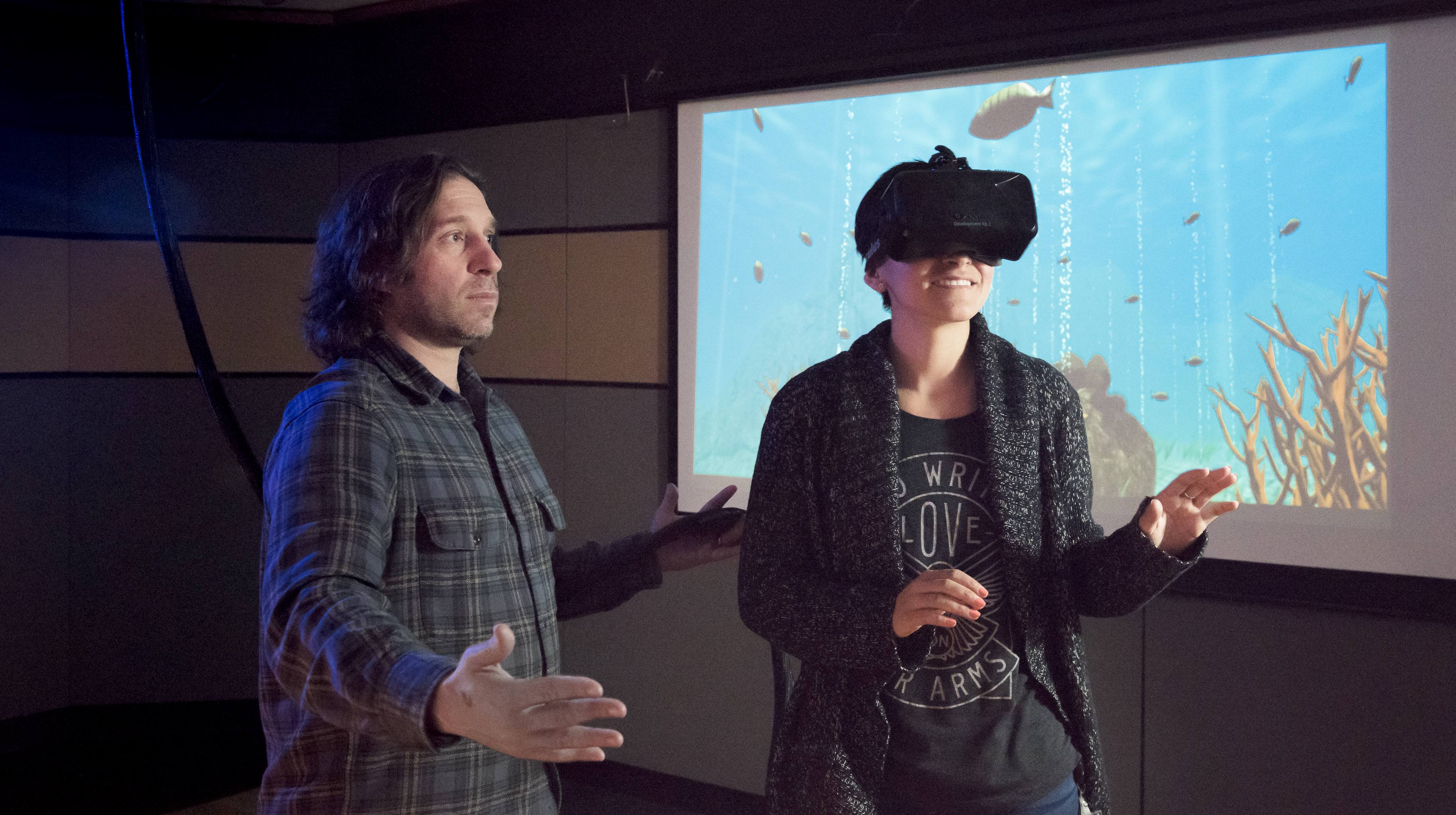
Professor Jeremy Bailenson guides Social Science Research Asst. Elise Ogle as she uses a VR headset to experience a coral reef.
When writing about technology, it’s often difficult to strike a balance between ensuring that enough of the basics are covered without being patronizing to those already familiar with the subject. The book walks that fine line very well by focusing primarily on the human experience, so that whether or not you know what terms like latency, rendering, tracking or lag mean, you should come away with a better understanding of what virtual reality actually does.
As an expert in psychology and mass media, Bailenson has largely remained unalarmed about the extent to which traditional media affect us. Yet he writes that as absorbing as books or video games or television are, they pale next to virtual reality: “VR engulfs us (…) it’s the apotheosis of every media fear and fantasy we’ve ever had,” he writes.
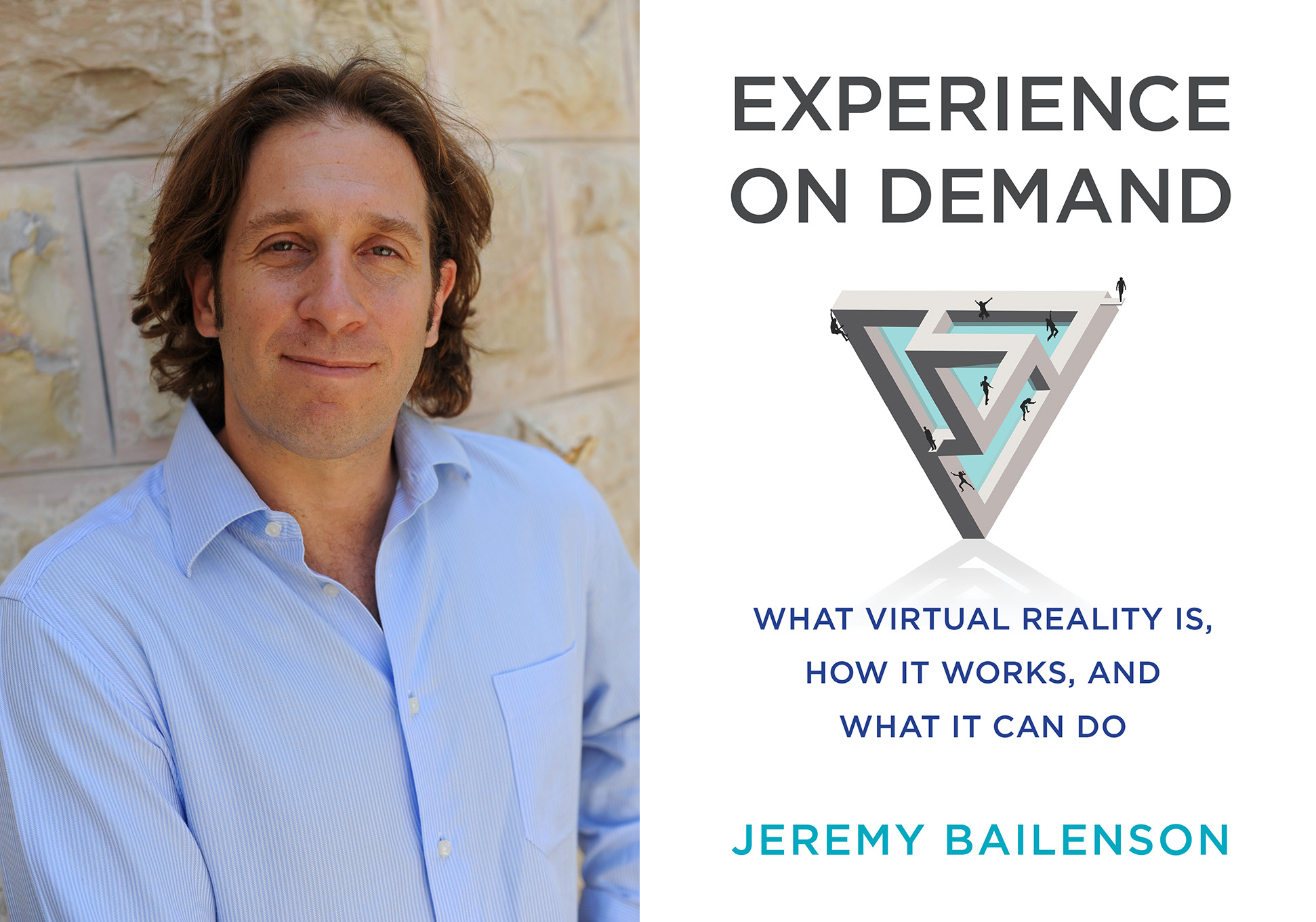 His book does a good job of pulling back the focus to place VR within a broader social context, explaining how it relates to other technologies – both traditional and emerging – and our existing relationship with the digital world.
Although he cites scientific research throughout, the book is mainly pegged around personal anecdotes and use cases that illustrate what it does to real people, and why it matters to everyone, not just the techy crowd. The picture that emerges is of an astoundingly broad range of applications for VR, none of which involve either gaming or pornography.
Those anecdotes tell the story of how NFL teams have significantly improved the performance of their players by training them in virtual reality simulations, and how VR is being used to treat conditions such as chronic phobias and Alzheimer’s. It has helped 9/11 victims overcome post-traumatic stress disorder, and burns patients manage their pain with fewer opioids.
There are examples of how VR can be a powerful learning tool, as Bailenson argues that almost any skill can be improved by virtual instruction (groups learning tai chi moves in virtual reality remembered their moves better and performed them back with 25% greater accuracy than those who had been taught by watching a video, for instance).
We also learn how VR’s unique ability to create empathy by literally “placing you in someone else’s shoes” has been successfully applied to a variety of scenarios, from helping people relate on a personal level to issues such as climate change, to tackling bias and prejudice in diversity training.
Several – often rather bizarre – experiments in the book describe how experiencing a simulated virtual scenario first-hand can result in instant and lasting changes in behavior. In one, they explored if walking around as a virtual cow might change participants’ attitude towards consuming red meat, while in another, people visualized their energy consumption during a shower in terms of literally eating lumps of coal, and subsequently went on to use hot water more sparingly. And although more research is needed to verify such results at scale, it is difficult to remain unimpressed by these early indications of VR’s power to create empathetic responses in people – not only in relation to other human beings, but also towards animals and the environment.
One of the surprising arguments that Bailenson puts forward seems to be that by living more of our lives in virtual worlds we can help save the real one. Business travel, for example, could be vastly reduced if we are able to replicate in VR the same levels of interaction and feeling of presence that one gets from face-to-face meetings.
“Conspicuous or wasteful consumption in the real world comes with real costs, be it in fossil fuel consumption, the mountains of plastic junk that are piling up in our homes and landfills, or the floating islands of garbage that are growing in our oceans…. When considered this way, deep engagement in social virtual worlds seems less scary than the dystopian scenarios would have us believe, and may have significant social benefits,” he says.
This desire to protect the environment reflects a passionate appreciation of the real world which might seem out of place for someone who has spent the last two decades studying computer-generated environments. Paradoxically, he argues, the more time you spend in virtual experiences, the more you come to appreciate the vibrancy of real life.
The post What Virtual Reality Is, How It Works, and What It Can Do appeared first on VRScout.
from VRScout http://ift.tt/2BFBoTT
via IFTTT
More Survival Games Should Start Including Full VR Support

Update – This article has been republished to coincide with the release of Subnautica, an intense survival game with full VR support.
(Original Published 05/31/17) – A few days ago I was playing H1Z1: Just Survive alone and it was horrifying. For those unaware, the game is a lot like other survival games available for PC on Steam, such as DayZ, Rust, Ark: Survival Evolved, Conan Exiles, and more. The premise is that it’s the middle of the zombie apocalypse and you must scrounge up supplies to get by, teaming up with and killing other players along the way. Just like in The Walking Dead TV show, you quickly learn that the other humans around you are far scarier than the zombies themselves. You really feel alone when you’re playing outside of a group without friends.
But even beyond just multiplayer focused games there are single player survival games to take note of as well, such as The Solus Project. Other than being a single player focused title the other thing that sets this game apart in a major way is the full, official, VR support for HTC Vive, Oculus Rift, OSVR, and tracked motion controllers. Even Ark at least has minor VR support (just the Oculus Rift officially) which is better than nothing. Fallout 4 VR is coming and with enough mods and it can become like a survival game, but that’s not what it was designed to be really at its core.
More survival games should take note of how proactive the team at Grip Games, the folks behind The Solus Project, have been not just because VR gamers want more robust experiences, but also because the genre makes a ton of sense for VR as a medium.
Sense of Presence
For most gamers that get into VR, the appeal of being immersed in another world is priority #1. When playing games like H1Z1, DayZ, Conan Exiles, and Ark players get wrapped up in the experience because they feel ownership of what you’ve made for yourself. From building bases and staking your claim on the land to crafting weapons and taming creatures to control, you’re not given anything easily.
Starting from scratch with nothing at all and having to scavenge for food and supplies makes every moment of survival feel earned. While Battle Royale games such as PlayerUnknown’s Battlegrounds, The Culling, H1Z1: King of the Kill, and others throw gobs of weapons and ammo at you from the very start in a bid for fast action, survival games are all about the slow burn.
I once spent hours with a friend slowly clearing out a neighborhood of abandoned houses in H1Z1: Just Survive only to eventually end up in a standoff with a group of two other people. Over the game’s proximity-based voice chat we were talking, trying to coax one another to step out into the open as a sign of goodwill. After a solid twenty minutes of negotiation we flanked them while they were distracted talking, murdered them in cold blood, and stole all of their belongings. We had become monsters and survival games have a way of really making you feel bad about it.
I don’t think I could do that again if you asked me to replay that encounter inside a VR headset.
Isolated Survival
Since you lose all of your items when you die in many of these games, death has a real consequence. Could you imagine the feeling of playing a survival game online with other people just trying to get by, while in VR? Raising your hands to surrender is suddenly much more immersive when it’s extended to your actual arms instead of a simple hotkey on the keyboard. It would be much more difficult to lie and trick people if they can visibly see your hands reaching for a gun.
That sense of isolation I felt while playing H1Z1: Just Survive alone would be even more poignant if in VR. Games like The Solus Project go to great lengths to make you feel like you’re both an integral part of the game world and like you’re all alone without anyone to relate to. Survival games are at their best when they can make you feel an intimate connection to your character and there’s no better way to connect a player to the game world than to ask them to literally step into their avatar’s shoes with a VR headset.
If I were playing one of these survival games in VR I’d be much more likely to approach every human interaction with caution. I’d also be more likely to try and work together, rather than against, my fellow players. Looking another human avatar in the eyes and betraying them is a lot harder when the head tracking makes it clear we are standing face-to-face in a digital world. The dynamics of what it means to fight for survival would be completely turned upside down.
What do you think? Would you like to see more survival games adopt VR support? Let us know what you think down in the comments below!
from UploadVR http://ift.tt/2pJ9tjY
via IFTTT
Step Inside the Unabomber Investigation in New Interactive VR Experience

If you were alive in the ’90s, chances are you’ve heard about Ted Kaczynski, aka the Unabomber, the American domestic terrorist that between 1978 and 1995 killed 3 people, and injured 23 others in a nationwide bombing campaign. Now, HTC Vive Studios and The Newseum, an interactive news museum in Washington, D.C., have come together to produce a VR experience detailing the Unabomber case, which features an interactive inside look at Kaczynski’s infamous Montana cabin where he planned his bombings.
According to HTC’s blogpost, Unabomber: The Virtual Reality Experience not gives you an inside look at the same cabin that officials found in 1996, but lets you “actively participate in the case and get a front row seat to the process that led to Kaczynski’s arrest.”


The experience features insights from FBI agents Terry Turchie, who served as Assistant Special Agent in Charge of the UNABOM investigation from 1994 to 1998, and Max Noel, an FBI agent during the investigation.
“Being in the cabin and looking out at the woods, and that first time you’re on the snow and you’re looking it – that’s just amazing,” said Turchie. “It almost looks exactly like the day we [first came upon the cabin].”
The Newseum, which actually has the original Unabomber cabin in their exhibition, will also be featuring the VR experience in an effort to better ‘cement’ all of the information presented there.
The app is now available on Viveport for $5, and will eventually make its way to Steam “at a later time.”
The post Step Inside the Unabomber Investigation in New Interactive VR Experience appeared first on Road to VR.
from Road to VR http://ift.tt/2nmvwea
via IFTTT
