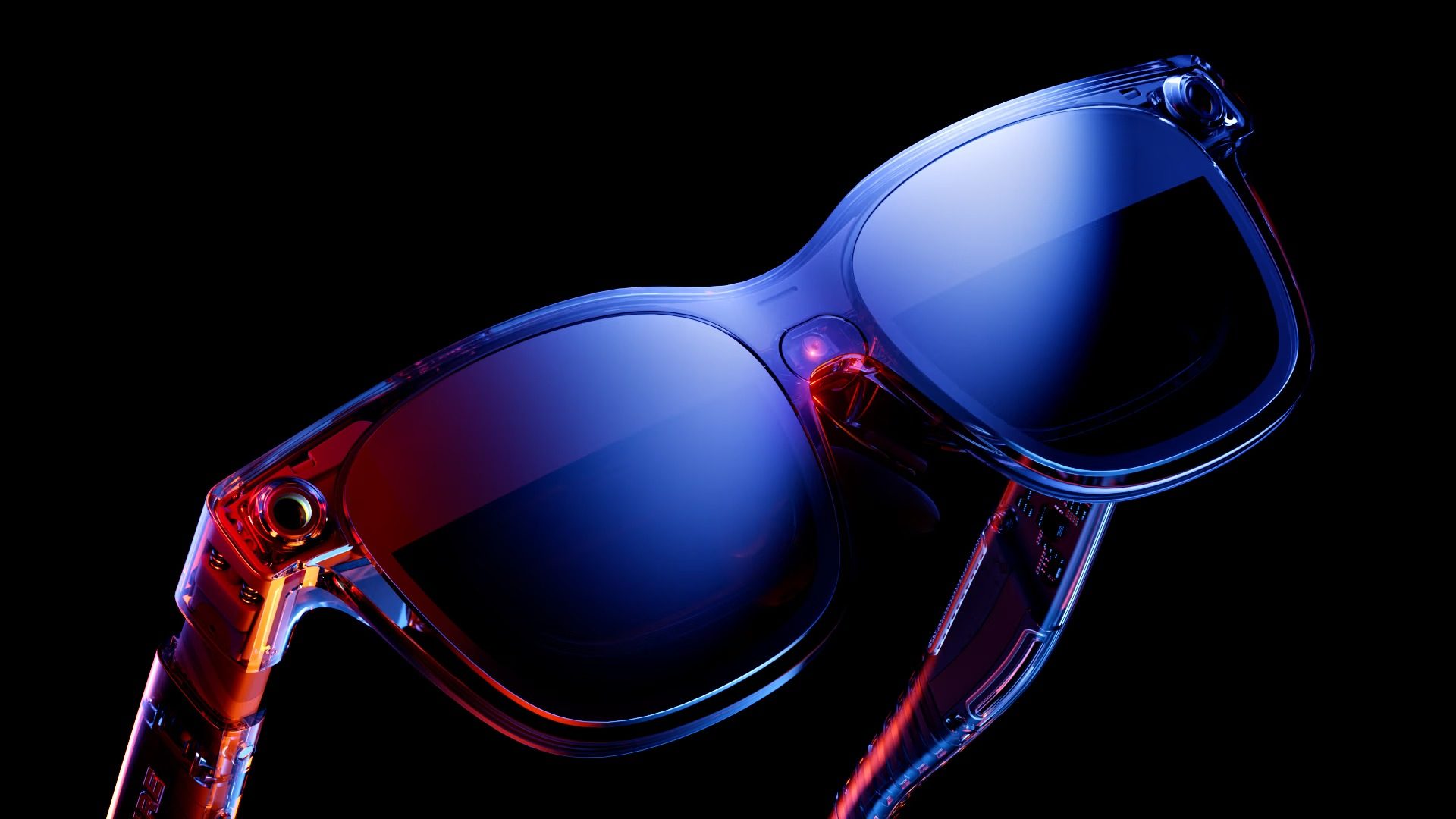
It seems Meta has a new generation of smart glasses to show off at Connect this week, and it appears we’ve just got an eye-full of the long-rumored version with a built-in display, previously codenamed ‘Hypernova’.
As noted by XR analyst Brad Lynch, Meta seems to have leaked the next slate of smart glasses built in collaboration with Essilor Luxottica.
The video, which was unlisted on Meta’s YouTube channel, has since been deleted.
New Meta smartglasses with display leaked via an unlisted video on their own YouTube channel
Along with their EMG wristband, and other smartglass models they plan to show off this week at Meta Connect pic.twitter.com/8tTlmaeQ0a
The video shows off four main models: the recently released Oakley Meta HSTN, the rumored Oakley Meta Sphaera model, what appears to be the next gen version of Ray-Ban Meta, and the rumored variant with display, which also comes with an electromyography (EMG) based wristband for input.
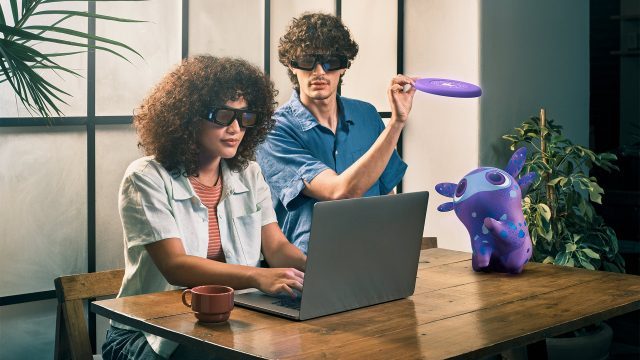
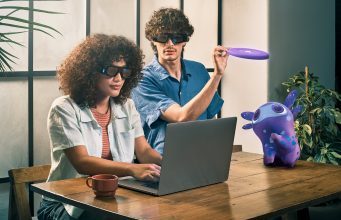
Meta also showed off a few use cases for the new display-clad smart glasses: typing on the back of a laptop to send a message, following turn-by-turn directions, identifying an object using AI, and real-time text translation.
Image courtesy Brad Lynch
Notably, prior to its unintentional unveiling, it was thought the display model would not be built in collaboration with Essilor Luxottica, and instead be marketed under the Meta name, owing to its ‘Celeste’ branding seen in previous leaks. It appears however the company is coopting a slightly larger Ray-Ban Wayfarer design and appending the name ‘Display’.
What’s more, the new smart glasses with heads-up display are also shown with the previously reported EMG wristband, which is meant to control the device’s UI. Meta has previously shown the wristband input device working with its prototype Orion AR glasses, which picks up movement in the wrist without needing line of sight to camera sensors, like Meta Quest 3 does.
There’s no confirmed pricing info yet, however a previous report from Bloomberg’s Mark Gurman maintains the display model and EMG wristband controller could cost “about $800.”
Meta Connect kicks off September 17th – 18th, where we expect to learn more about release dates and pricing for all of the company’s newest smart glasses.
We will be at Meta Connect this week, so make sure to check back soon for all of the latest in Meta’s XR hardware and software.
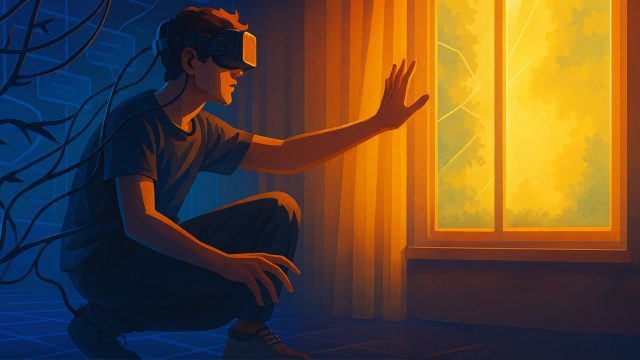
You don’t have to look far to find reports of people who have used VR headsets and then felt ‘off’ after removing them. While motion sickness is surely the most well-known post-VR symptom, a subset of people say they have experienced feelings of being ‘stuck in VR’ after taking off their headsets. It’s tempting to brush off such reports as someone having seen The Matrix (1999) one too many times, but it turns out there is a clear scientific basis for the sensation.
I’ve been professionally reporting on the XR industry for nearly 15 years, and along the way I’ve come across many reports of users who described some vague sensation of still being in virtual reality after removing their headset. I queried my social media community recently and was surprised at the response. Across more than 100 replies, people shared their experiences with the feeling. Here’s a sampling:
It happened to me when I was new to VR and had just played Boneworks for hours. Looking down at my body, my hands didn’t feel like they belonged to me. I was trying to grab a knife and fork for dinner and that required a huge concentrated effort, where I was staring at my hands. – @Edward1370
After my first session with Gorilla Tag. Movement felt strange, like my legs weren’t there. Surreal experience, loved it. – @greenlig
In the early days I used DK1 on my Mac and there was a crazy latency. After using it for 2 hours my brain fully adapted to the latency. Taking off the headset was surreal. It was as if the real world had “tracking” issues. – @robinhuse
It’s only happened to me once. After I wore the vision pro for around 24 hours. Super weird feeling, but fascinating as well. – @RoberJALA
In a sense yes, but more so I went upstairs to eat after a longer VR session when I first got the Quest 1 in 2019 and I stopped myself suddenly because I thought my boundary lines were going to show up. Then I realized I was irl. – @OpalStar3
I played 2 hours of Walkabout Mini Golf just before going to a real Mini Golf course with my friends. Standing on the hole gave me a weird feeling that I was in the game. It did also help me to comfortably win. It was strange though. My eyes kept pixelating the course. – @TheNeoism
Yeah, my hands felt fake for a couple of days but it passed pretty quick, like the brain adapted to the perspective change. – @OneMoreBenjamin
It happens from time to time, where things feels “off” when I’m out of VR, like the body feels sluggish, not my own or out of place for a while. – @KathielRayna
Many struggle to articulate the feeling, but clear themes emerge: an altered perception—a vague sense that the real world, or their own body, doesn’t seem quite as ‘real’ as usual.
The phenomenon may be rare, but it’s certainly real. Fortunately it’s also temporary, as far as we can tell.
The primary cause of feeling ‘stuck in VR’ relates to proprioception. Proprioception is your brain’s model of where your body is in space. The model is essentially an intuition that’s constructed through visual and tactile feedback. And it can be thought of as a ‘real-time’ model that’s constantly updating itself as new feedback is observed.
The proprioceptive model lets you close your eyes and still touch your nose, elbows, or knees with high accuracy. You maintain a remarkably precise sense of your body relative to itself and the world, even with no visual feedback.
VR headsets might be incredibly good at convincing us that we’re standing in another reality, but the simulation is imperfect.
Consider VR motion controllers: they track quickly and accurately, yet there is always some latency and inaccuracy. Many experiences even manipulate controller position deliberately to boost immersion.
These inaccuracies (inherent or intentional) tend to fluctuate throughout the course of using the headset, but they are largely hidden because instead of seeing your real hands, you only see your virtual hands. And since your brain perceives the virtual hands as your own, it starts to incorporate the inaccuracies into its proprioceptive model.
For instance, if you’ve ever played Beat Saber, you’ll know it’s a high-motion game that requires accurately swinging your hands to cut blocks. If you play the game on a system with twice the latency of another headset, you’d expect to be thrown off; however, with practice most people compensate as the brain updates its model to match the imperfect world it sees.
This isn’t limited to controllers. Headsets themselves also have imperfect tracking and a certain degree of latency. That can cause your brain to think that turning your head just takes a little longer than you’re used to.
Or consider the case of a VR game that makes you one foot taller than you are in real life. And what about a game that makes your arms twice as long as normal? At first it would feel very strange and it would be hard to accurately grab things.
With enough time, your brain feels as if you really are that tall—or that your arms are that long—because that’s the reality you see inside the headset. Your brain incorporates the new information in order to make you feel ‘normal’.
Then, when removing the headset, the very same thing happens. Your brain gets new feedback (ie: you’re a different height and your arms are different length than when you were in virtual reality). So now the real you (and by extension, the real world) feel ‘weird’, until you get used to the real world again.
If your arms felt longer a moment ago, your sense of reaching may suddenly feel shorter than expected, forcing more conscious effort to grasp objects—like snagging a coffee cup from the peripheral vision—making the real world feel slightly off.. like somehow you’re still in VR.
I tend to call this weird feeling (as it pertains to perception and VR) ‘proprioceptive-disconnect’, and it’s the root of the feeling of ‘being stuck in VR’. The broader phenomenon that this sensation falls under is called depersonalization-derealization disorder, though it is not exclusive to VR.
Ironically, this feeling of ‘being stuck in VR’ after removing the headset comes from a combination of modern headsets being able to fool our visual system so effectively, while at the same time still having imperfections like tracking latency and inaccuracy. We also have the impressive ability of our brains to adapt to new feedback to thank.
Fortunately the feeling of proprioceptive-disconnect is temporary and generally fades away in an hour or two. Some people are more sensitive to this feeling, and whether or not it will happen to you can equally depend on the capabilities of the VR hardware you are using, and even the specific VR game or app you’re using.
Note: For completeness it’s worth mentioning that there are other factors which can contribute to the feeling of being ‘stuck in VR’ after taking off a headset; two major ones are mismatched IPD setting of the headset (leading to a change in the sense of scale) and the vergence-accommodation conflict (an eye-related artifact caused by modern VR headsets lacking varifocal displays).
Researchers have actually studied and quantified the phenomenon of VR-related proprioceptive-disconnect.
Our brain’s plasticity rapidly adapts our senses in VR, a phenomenon leveraged by techniques such as redirected walking, hand redirection, etc. However, while most of HCI is interested in how users adapt to VR, we turn our attention to how users need to adapt their senses when returning to the real-world. We report cases where, even after leaving VR, users experience unintended, lingering side-effects: distortions in proprioception or memory that may pose safety or usability risks.
To investigate, we conducted two studies examining (1) proprioceptive side-effects from altered hand movements (retargeting), and (2) memory distortions arising from spatial mismatches between the virtual and real-world locations of the same object.
In one part of the study, the researchers intentionally exaggerated the position of the hand-tracking (unbeknownst to the subjects of the experiments), a common technique used in VR design called hand retargeting. After the users removed the headset they were asked to perform pointing tasks, which allowed the researchers to quantify how the use of VR impacted the users’ real-life motions after removing the headset.
The researchers found that, “after leaving VR, participants’ hands remained [inaccurate in pointing tasks] by up to 2.75 inches (7 cm), indicating residual proprioceptive distortion.”
In another part of the study, the researchers showed that peripheral awareness of a virtual environment could alter a person’s memory of that environment.
For this experiment the researchers placed a handful of objects in a room, including a seemingly irrelevant fire extinguisher that was placed off to the side. The researchers cleverly began the experiment by asking the subjects to collect a number of pre-positioned balls in the room, which gave the subjects a peripheral awareness of the seemingly irrelevant objects in the room.
Then the subjects were placed in a VR headset which showed a virtual replica of the room. But in the virtual replica, some of the objects were altered (unbeknownst to the subjects); for instance, the position of the fire extinguisher was moved to the other side of the room.
The virtual recreation of the study room was almost identical, but with some objects intentionally repositioned | Image courtesy Antonin Cheymol & Pedro Lopes
Now in the virtual replica of the room, subjects were asked to repeat the same ball-gathering task as before. After leaving the room and then removing the headset, the subjects were asked to recall where various objects were in the room. The researchers found that a significant portion of subjects misremembered the position of the real fire extinguisher, and instead remembered the location of the virtual fire extinguisher.
While the study didn’t directly address the feeling of being ‘stuck in VR’, it quantified how the use of virtual reality can indeed have lingering side effects that can temporarily alter a person’s proprioception and memory.
The paper’s authors, Antonin Cheymol and Pedro Lopes, stress that these seemingly small effects could lead to potentially dangerous edge-cases.
Consider the use of VR for training emergency personnel using virtual replicas of real spaces. The intent of the training is to familiarize the trainee with emergency procedures, but if the virtual replica that’s used isn’t a careful copy of the real situation that’s being trained for, it could lead to costly mistakes.
While potential dangers from these VR side-effects are definitely edge-cases, such edge-cases will definitely occur once a sufficient number of people are using VR headsets.
The authors emphasize the need for more study in this area, especially considering there’s already millions of headsets out in the world.
While our work suggests that VR can induce side-effects in relatively unconstrained scenarios, more research should follow to broaden our understanding and better assess their risks. First, in this study, we only focused on a limited subset of the large variety of perceptual manipulations that can be presented to a VR user. Therefore, future work should investigate the potential of VR side-effects of other perceptual manipulations, such as walking curvature, speed alteration, or alteration of one’s virtual body structure are likely to reveal similar to the side-effects induced by hand retargeting that we observed in our studies. Altering the perception of an object’s physical properties (e.g., its weight, its tangibility, etc.) could also lead users to adopt mis-adapted, potentially dangerous, behaviors (especially if they incorrectly learn to interact with a fragile or harmful object). Moreover, as previously mentioned, more factors might be hiding at play. For example, the duration of exposure in VR, should be investigated, as it might impact a side-effect’s magnitude and lingering duration. Moreover, the intensity of perceptual qualia, such as presence or embodiment might be interesting predictors to the emergence of VR side-effects.
Virtualware, the Spain-based XR and 3D simulation software company, announced it’s secured a €5 million ($5.8 million) deal to broadly roll out its VIROO platform in vocational training facilities supported by Spain’s Ministry of Education.
The six-year contract allows Virtualware to bring its XR enterprise platform VIROO to 66 new ‘Centres of Excellence for Vocational Training’ (VET), the company says in a press statement, which are run by Spain’s Ministry of Education, Vocational Training and Sport (MEFPD).
The rollout to Spain’s VET Centres will join the more than 25 vocational training centers across the country already equipped with VIROO. In Spain, VET supports initial training of young people as well as the continuing up-skilling and re-skilling of adults across a variety of industries.
“We are opening a new chapter of growth and pedagogical innovation, allowing thousands of students to train with state-of-the-art immersive simulators developed and deployed through VIROO platform, raising their technical skills from day one,” says Virtualware founder and CEO Unai Extremo. “Our goal is to bring immersive technology to every vocational training classroom in Spain, through a sustainable model for content creation and deployment”
Founded in 2004 and then later acquired by Swedish company Simumatik in 2024, the in Bilbao, Spain-based company has recently focused on expanding its capabilities to support a number of key industries, including energy, automotive, transportation, defense, manufacturing, education, and healthcare.
Among Virtualware’s clients are GE Vernova, Petronas, Volvo, Gestamp, Alstom, ADIF, Bosch, Biogen, Kessler Foundation, Invest WindsorEssex, McMaster University, the University of El Salvador, Ohio University, the Spanish Ministry of Defense and the Basque Government.
Check out VIROO in action below, which was created to showcase the company’s work with the Spanish nation rail service, ADIF (Administrador de Infraestructuras Ferroviarias).
Feel free to double-check the calendar… yes, it is in fact September 12th and not April 1st. Nintendo, always managing to surprise in one way or another, is reviving its infamously failed 3D gaming console, the Virtual Boy.
First released in 1995, the Virtual Boy was portrayed as a type of “virtual reality” experience, but considering its small field-of-view, lack of motion tracking, and single-color (red) display, it was functionally just a 3D display on a stand. Still, the console has been culturally associated with “virtual reality” ever since—and it’s not exactly a positive association.
Ambitious as it was, Virtual Boy was an infamous failure of a game console, owing largely to its minimal game catalog, single-color display, and reports of motion sickness while playing. It was discontinued less than a year after its launch. Even so, the console was not without its fans.
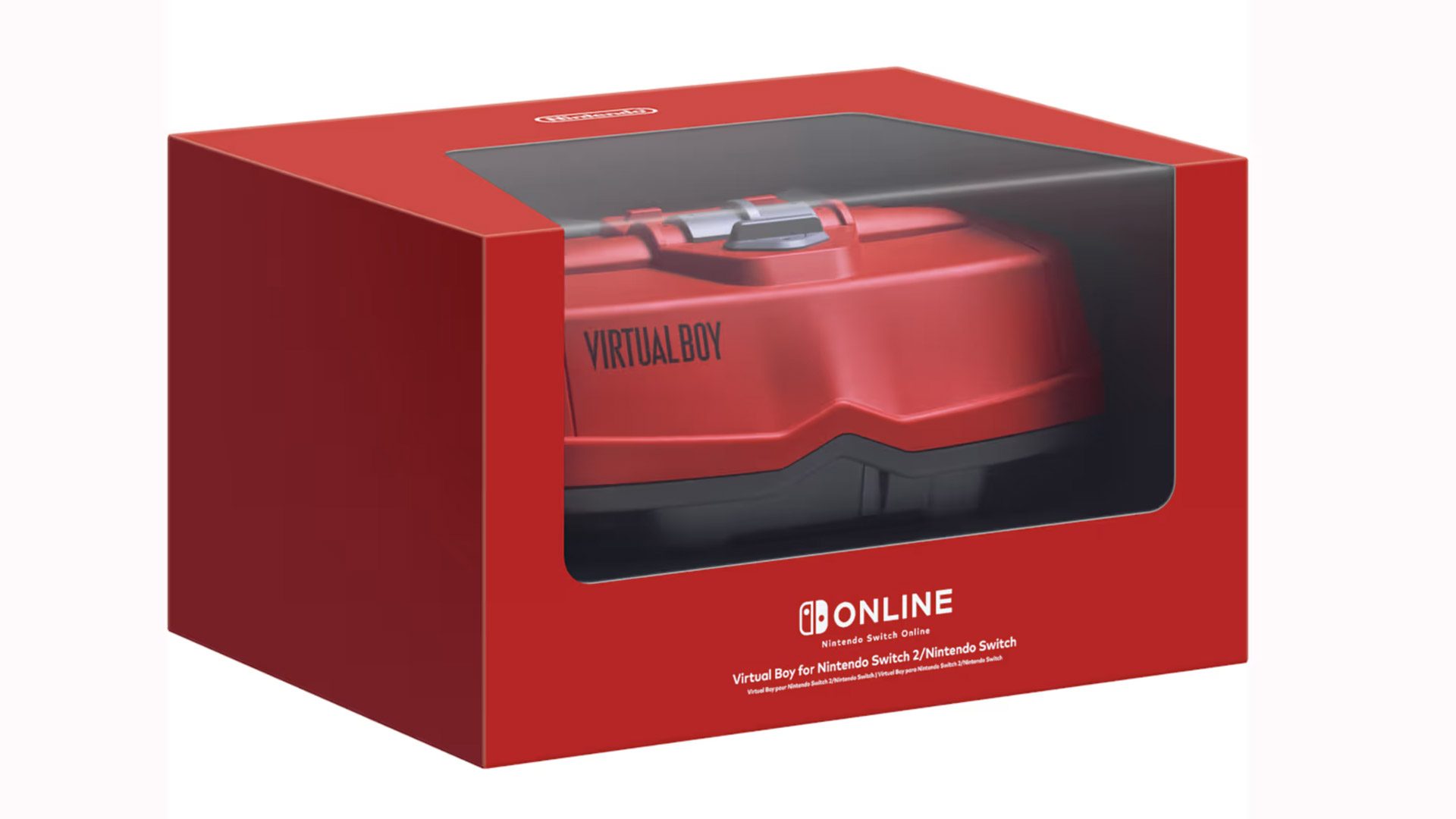
Now, for some reason, Nintendo announced it’s reviving the Virtual Boy with a new $100 replica accessory that uses the Switch or Switch 2 (but not the Switch Lite) as the brains and display for the device. And this isn’t just a facade; Nintendo is re-releasing original Virtual Boy games (first released 30 years ago) to be played on the device.
The company says it will launch first with Mario’s Tennis, Teleroboxer, and Galactic Pinball, with 14 games in total to be released over time. That may not sound like many, but it’s more than 50% of the entire Virtual Boy game catalog.
It’s unclear at this point if the games are simply being emulated or if they have been retouched or remastered. In any case, we hope they’ll be at least updated to render at the native Switch or Switch 2 resolutions, rather than the tiny 0.086MP (384 × 224) per-eye resolution of the original Virtual Boy.
Image courtesy Nintendo
It’s also unclear if the new Virtual Boy accessory will allow users to play a handful of existing Nintendo games with an optional ‘VR mode’, like Zelda Breath of the Wild and Super Mario Odyssey, which were updated alongside the Nintendo Labo VR Kit back in 2019.
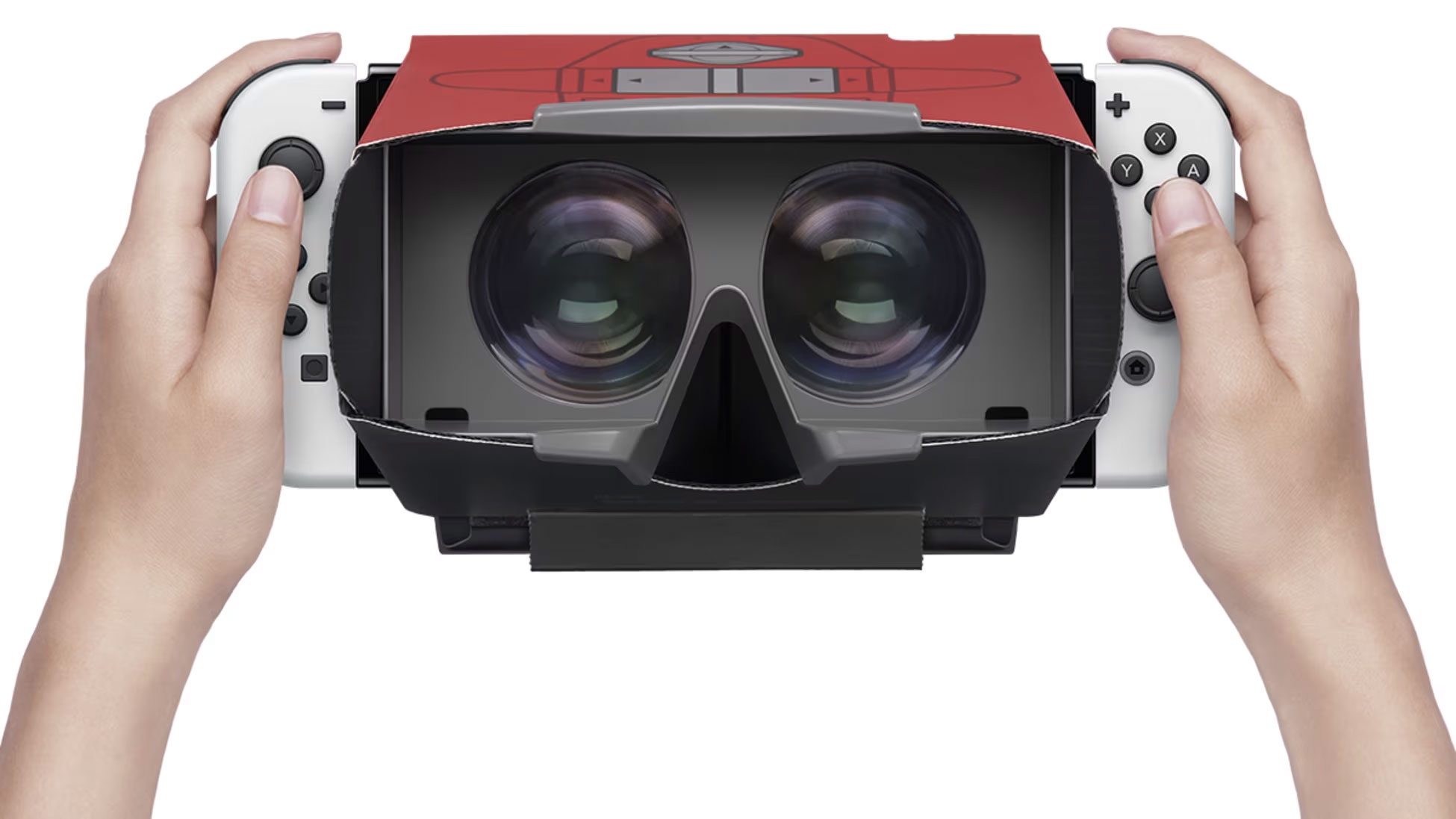
And speaking of infamous VR products, Nintendo is going a step further to make these retro games accessible: the company is also releasing a “Virtual Boy Cardboard Model,” which certainly brings back some memories. Priced at $25, it’s definitely more accessible, but it looks like the accessory is played by holding the entire Switch or Switch 2 console up to your face with the controllers attached… not the most comfortable thing for more than a few minutes.
Image courtesy Nintendo
Both the replica of the Virtual Boy and the Virtual Boy Cardboard Model will be available starting February 17th, 2026, directly from Nintendo.
Weird as the move may seem, it’s honestly pretty cool to see a company revive and revere a piece of its history, even if it wasn’t a particularly successful one. In an era where companies can shut down servers or revoke ‘ownership’ of games from paying customers, Nintendo is bringing back games that were essentially inaccessible.
According to Snap’s CEO Evan Spiegel, the company behind Snapchat has reached a “crucible moment” as it heads into 2026, which he says rests on the growth and performance of Spectacles, the company’s AR glasses, as well as AI, advertising and direct revenue streams.
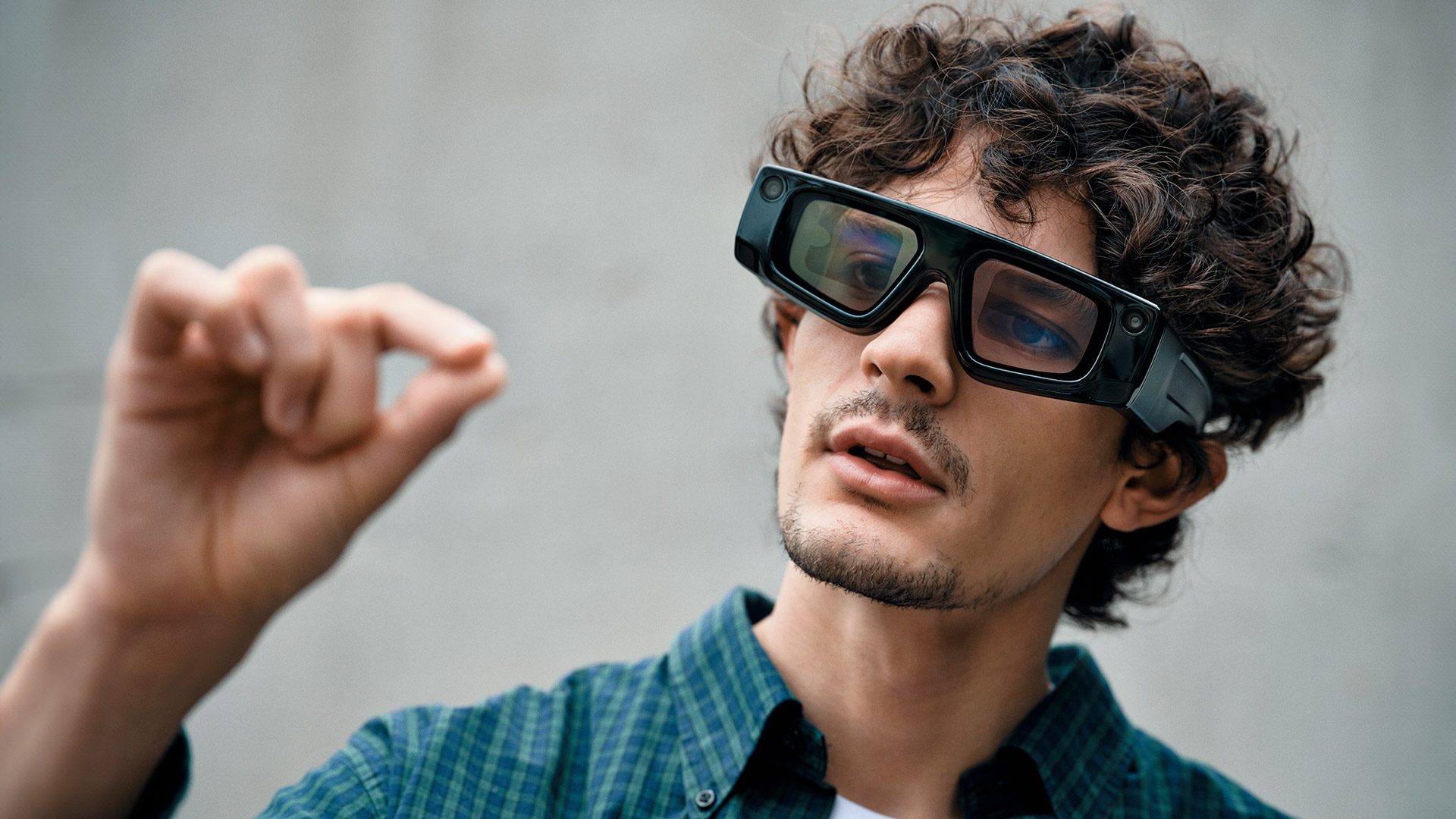
Snap announced in June it was working on the next iteration of its Spectacles AR glasses (aka ‘Specs’), which are expected to release to consumers sometime next year. Snap hasn’t revealed them yet, although the company says the new Specs will be smaller and lighter, feature see-through AR optics and include a built-in AI assistant.
Snap Spectacles (gen 5) | Image courtesy Snap Inc
Following the release of the fifth gen in 2024 to developers, next year will be “the most consequential year yet” in Snap’s 14-year history, Spiegel says, putting its forthcoming generation of Specs in the spotlight.
“After starting the year with considerable momentum, we stumbled in Q2, with ad revenue growth slowing to just 4% year-over-year,” Spiegel admits in his recent open letter. “Fortunately, the year isn’t over yet. We have an enormous opportunity to re-establish momentum and enter 2026 prepared for the most consequential year yet in the life of Snap Inc.”
Not only are Specs a key focus in the company’s growth, Spiegel thinks AR glasses, combined with AI, will drastically change the way people work, learn and play.
“The need for Specs has become urgent,” Spiegel says. “People spend over seven hours a day staring at screens. AI is transforming the way we work, shifting us from micromanaging files and apps to supervising agents. And the costs of manufacturing physical goods are skyrocketing.”
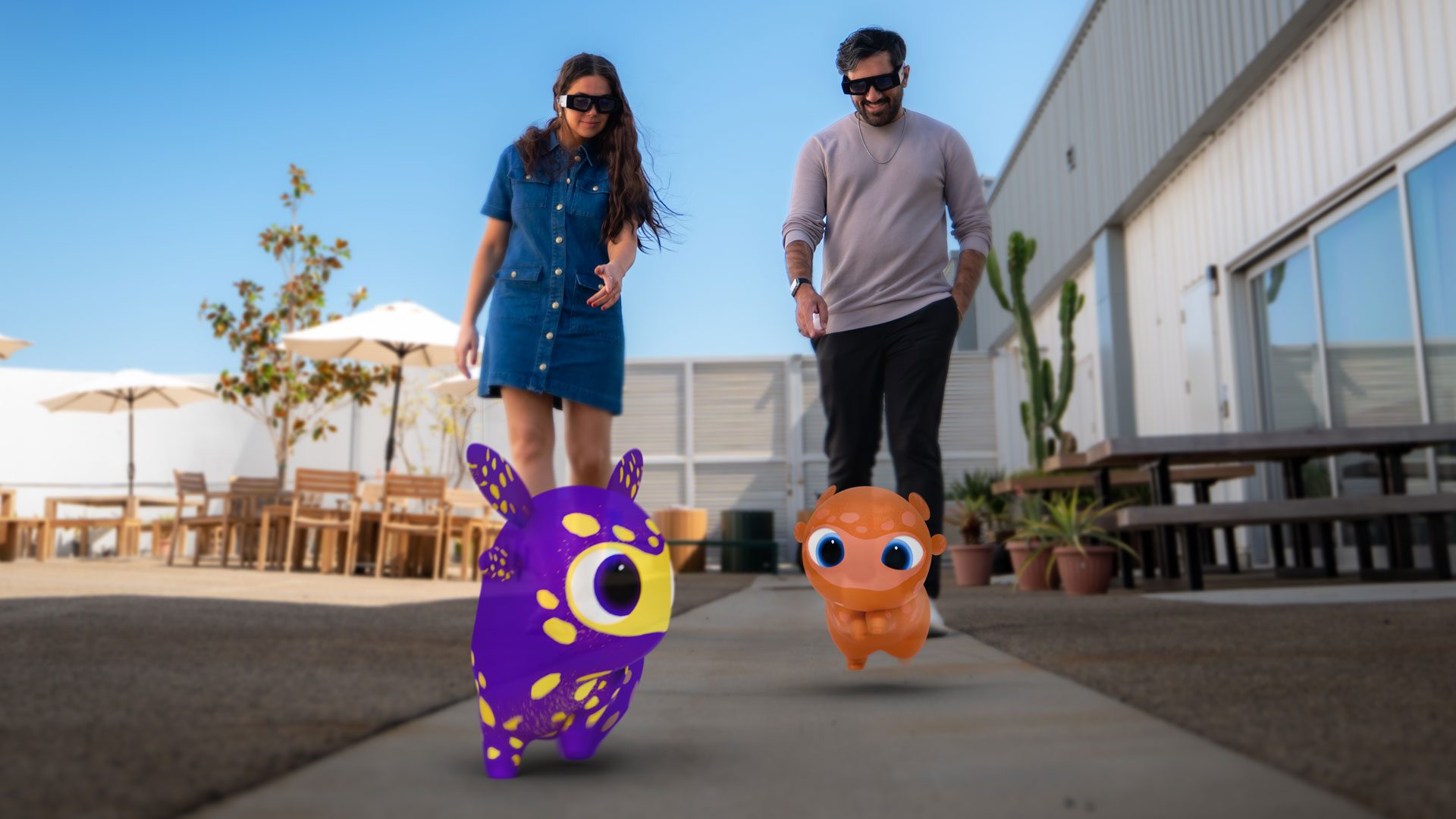
Image courtesy Snap Inc, Niantic
Those physical goods can be replaced with “photons, reducing waste while opening a vast new economy of digital goods,” Spiegel says, something the company hopes to tap into with Specs. And instead of replicating the smartphone experience into AR, Spiegel maintains the core of the device will rely on AI.
“Specs are not about cramming today’s phone apps into a pair of glasses. They represent a shift away from the app paradigm to an AI-first experience — personalized, contextual, and shared. Imagine pulling up last week’s document just by asking, streaming a movie on a giant, see-through, and private display that only you can see, or reviewing a 3D prototype at scale with your teammate standing next to you. Imagine your kids learning biology from a virtual cadaver, or your friends playing chess around a real table with a virtual board.”
Like many of its competitors, Spiegel characterizes Specs as “an enormous business opportunity,” noting the AR device can not only replace multiple physical screens, but the operating system itself will be “personalized with context and memory,” which he says will compound in value over time.
Meanwhile, Snap competitors Meta, Google, Samsung, and Apple are jockeying for position as they develop their own XR devices—the umbrella term for everything from mixed reality headsets, like Meta Quest 3 or Apple Vision Pro, to smart glasses like Ray-Ban Meta or Google’s forthcoming Android XR glasses, to full-AR glasses, such as Meta’s Orion prototype, which notably hopes to deliver many of the same features promised by the sixth gen Specs.
And as the company enters 2026, Spiegel says Snap is looking to organize differently, calling for “startup energy at Snap scale” by setting up a sort of internal accelerator of five to seven teams composed 10 to 15-person squads, which he says will include “weekly demo days, 90-day mission cycles, and a culture of fast failure will keep us moving.”
It’s a bold strategy, especially as the company looks to straddle the expectant ‘smartphone-to-AR’ computing paradigm shift, with Spiegel noting that “Specs are how we move beyond the limits of smartphones, beyond red-ocean competition, and into a once-in-a-generation transformation towards human-centered computing.”
You can read Snap CEO Evan Spiegel’s full open letter here, which includes more on AI and the company’s strategies for growth, engagement and ultimately how it’s seeking to generate more revenue.
Schell Games, the studio behind the I Expect You to Die series and Among Us VR (2022), announced they’re developing a new free-to-play online party game for Quest and PC VR headsets that’s all about a high-falling game of tag.
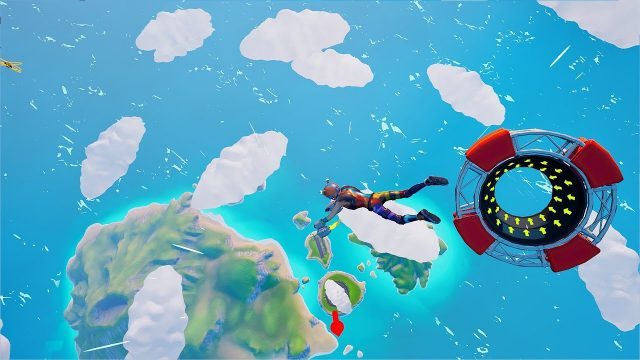
Called Project Freefall, the game pits you against seven friends as you plummet towards Earth, leaving only one parachute to scramble for.
While the rules are simple (don’t die), there’s more than just snatching a parachute from your pals as you freefall through the clouds.
Image courtesy Schell Games
Schell Games says it’s tossing a load of kit your way too, including grenades, fire extinguishers, as well as obstacles like sharks, fans, and plenty of falling structures to hide in as you escape your pursuers.
“As the ground rushes up to meet you, the intensity skyrockets. It’s a hilarious, high-skill dance of chaos where only one can claim the ultimate victory, leaving the rest to an… explosive landing,” the studio says.
Unlike the studio’s other VR titles, Project Freefall appears to be a third-person game, which equally supports flatscreen PC and VR cross-play.
Project Freefall is slated to head into “earliest” access soon on the Horizon Store for Quest 2 and above, and on Steam and the Epic Games Store for PC and PC VR headsets.
San Francisco-based XR glasses company VITURE announced it’s secured $100 million in Series B financing, which the company says will aid in global expansion of its consumer XR glasses.
Viture initially announced in October 2024 it successfully secured a Series B, however now the company reveals its most recent tranche has brought the Series B total to $100 million, bringing overall funding to $121.5 million, according to Crunch Base data.
Previous investors include Singtel Innov8, BlueRun Ventures, BAI Capital, Verity Ventures, with the company noting that some strategic investors in the Series B “prefer to remain undisclosed at this time.”
Viture Luma | Image courtesy Viture
The company says its Series B will allow it to expand its consumer XR glasses globally through retail and distribution networks, grow its enterprise offerings, and further develop its hardware and AI-powered software ecosystems.
This follows the July announcement of the company’s Luma series and Beast, phone/PC-tethered XR glasses that use bird bath-style optics, which the company is targeting towards casual content consumption and productivity.
Meanwhile, the XR glasses segment is heating up, although not uniformly in the direction of the sort of casual content-focused specs that Viture is developing.
More precisely, smart glasses with heads-up displays (i.e. not augmented reality) appear to be the next hot commodity among Meta, Google, Amazon and possibly even Apple, which generally see them as stepping stones to all-day wearable AR glasses of the future.
These sorts of smart glasses are very different from Viture’s however, or full-AR glasses, like Meta’s Orion prototype; smart glasses are essentially designed to offload daily tasks from the user’s smartphone, such as notifications, turn-by-turn directions, AI queries, calls, as well as photo and video capture.


 –
–