Friday, 29 August 2025

Sandbox VR Shows that ‘Social’ Beats ‘Spectacle’ at VR Attractions

https://ift.tt/8tTgBnW

Sandbox VR is a longstanding VR attraction chain featuring unique VR experiences for up to six players in a large, shared playspace. I recently got a chance to check out one of Sandbox VR’s newest locations and try two of its latest experiences—Squid Game Virtuals and Deadwood Phobia.

Sandbox VR is one of the original VR attraction companies. After nearly going out of business during the Covid-19 lockdowns, the company has rebounded, now operating nearly 60 locations worldwide and recently surpassed $200 million in lifetime revenue.

Driving its success is a focus on high-quality first-party content, like Deadwood (which has turned into a trilogy of Sandbox VR experiences), and deals with recognizable IP from Netflix (like Squid Game VirtualsRebel Moon the Descent, and an upcoming Stranger Things experience).

I recently visited one of Sandbox VR’s newest locations in Philadelphia, PA, and I brought three ‘non-VR’ friends along to see what they thought.
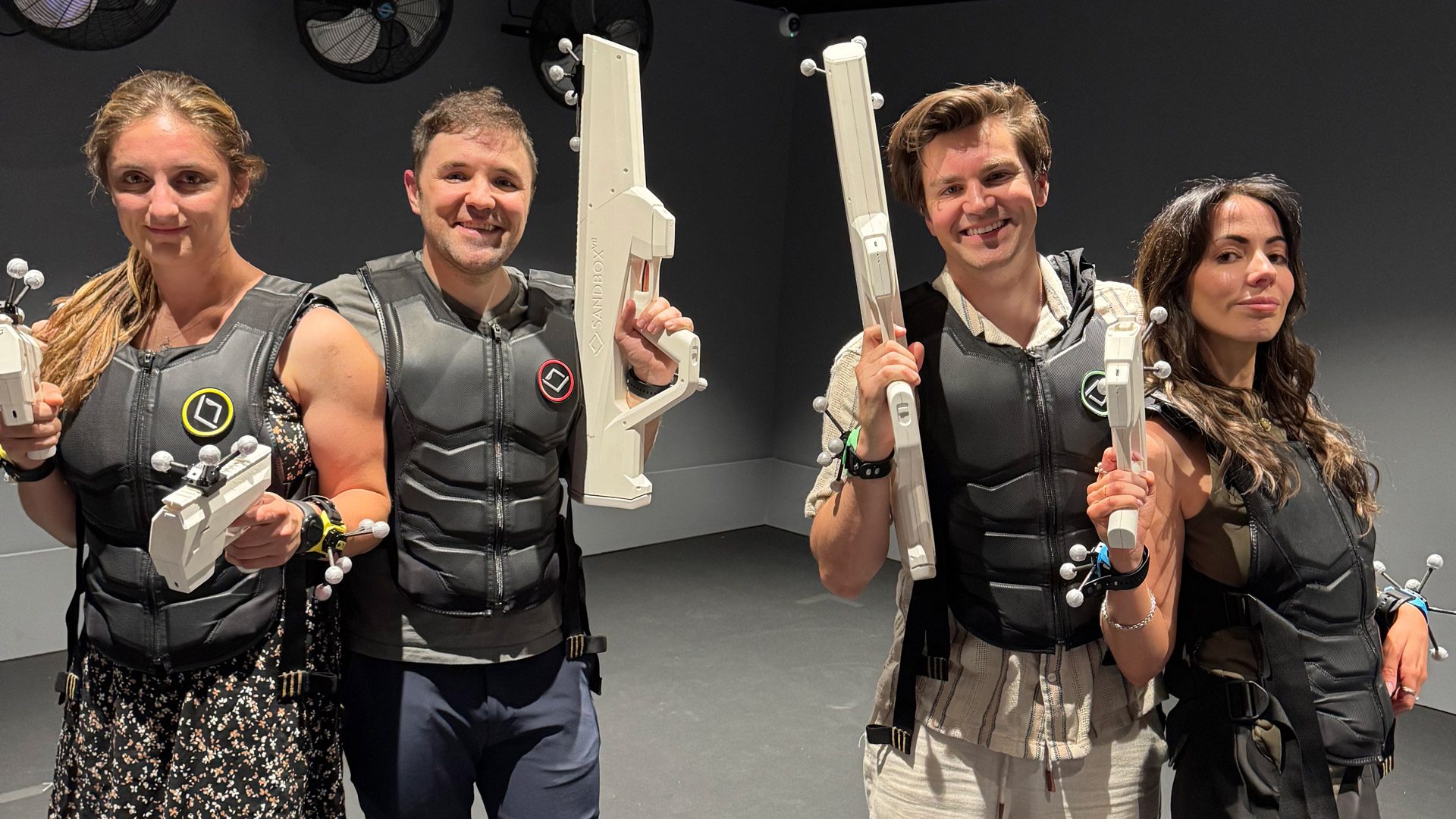
Photo by Road to VR

The four of us played two of Sandbox VR’s newest experiences: Squid Game Virtuals followed by Deadwood Phobia.

VR expert or newbie, one underlying theme emerged for all four of us: gameplay involving interactions between the real players was the most fun and memorable part of it all.

Would You Like to Play a Game?

Like the TV series it’s based on, Squid Game Virtuals exclusively pits the real players against each other across a variety of mini-games.

For instance in one game there was a giant bomb hanging from a rope in the middle of the platform, with the four of us positioned at each corner. The goal was to slap the bomb away (and toward the other players) instead of having it blow up in your face. It felt like a deadly game of hot-potato mixed with tetherball. Seeing my friends duck, dodge, and slap the ball back and forth was surprisingly entertaining, and reinforced that we were all in there together, sharing this otherworldly experience.

Another one of the mini-games had four platforms, each with a different symbol on it. Every round, one or more of the platforms was swing down, dropping anyone unlucky enough to be standing on it. But before that happens there are coins you can collect that will reveal hints about which platforms will drop and which will be safe.

Since not everyone could grab all the coins, the full knowledge about which platforms were safe and which were not was spread between us. But since we were competing with one another, there was an unspoken aspect of trying to trick the other players into thinking you were on a safe spot and then perhaps jump away at the last minute to make them fall (or to fake a move to another platform so they jumped first, only to plummet into the void!).

This ‘shared knowledge’ scenario turned out to be really fun, especially because it all culminated in one or more of us getting dropped to our deaths each round. Although, as a VR expert, I have a few critiques about the underlying Sandbox VR technical experience in this moment we were all fully lost in the world of Squid Game and furiously trying to discern if we were on the right platform while we waited to find out which of us was doomed.
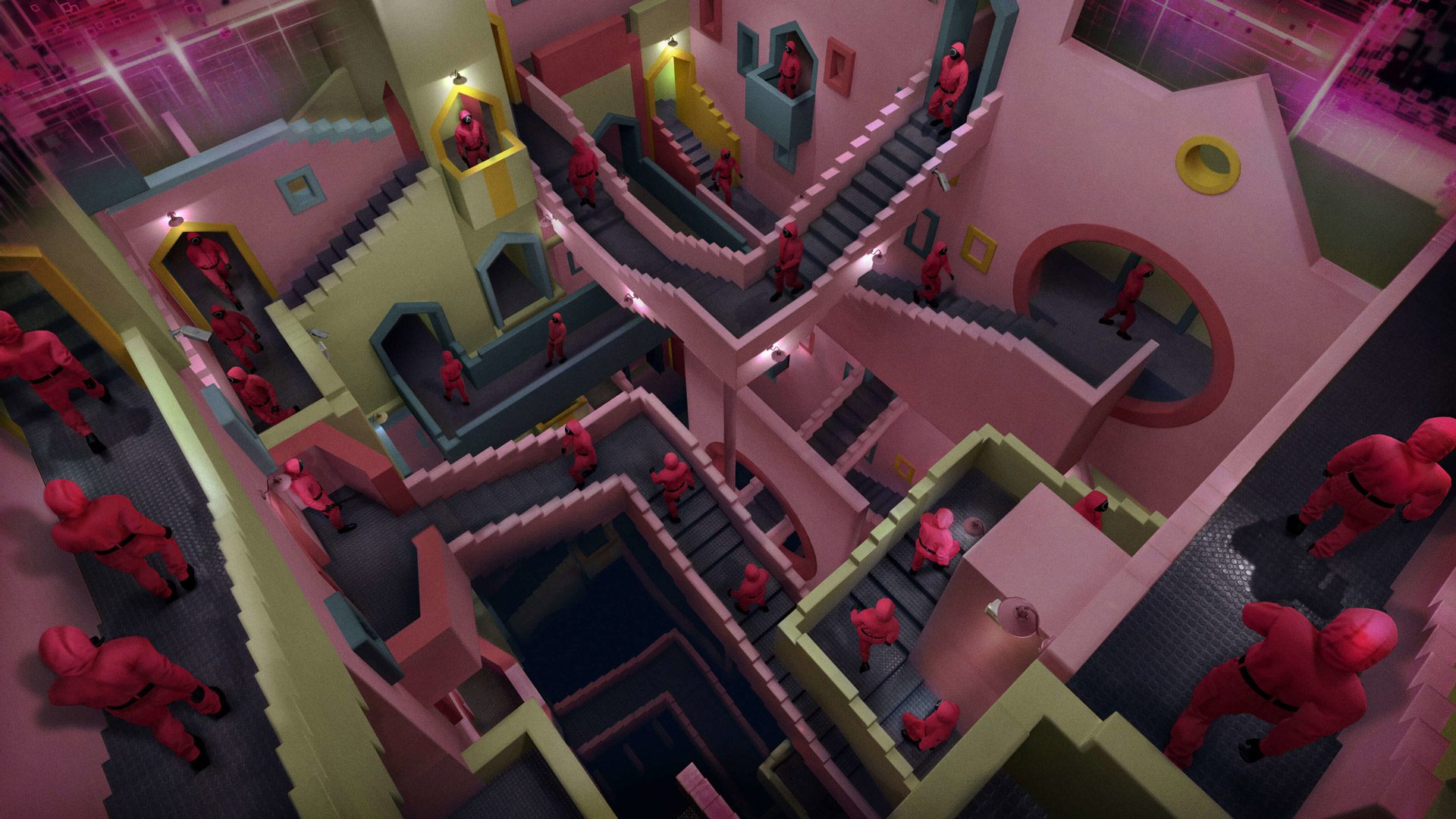
Image courtesy Sandbox VR

One especially memorable moment came in the final round when two of us thought that platform A was safe, and two of us thought that platform D was safe. With the group split 50/50, we were anxiously staring at each other as we awaited the countdown, not knowing who would be left standing. I instinctively put my arm around the friend next to me, knowing that if it was our time, we would face the end together.

3… 2… 1… the platform across from us dropped and we watched two of our friends scream as they plummeted into the darkness below. It was an exhilarating climax and hilarious too, leaving the four of us laughing together as we transitioned to the next mini-game. That moment felt like something out of a movie, but it was purely organic, thanks to game design built around social interaction rather than just pointing and shooting.

Shoot’em Up, Down, and All-around

While Squid Game Virtuals used only our hands and bodies for gameplay, Deadwood Phobia saw us equipped with VR gun controllers.

This action-horror experience has impressive graphics and it’s clear that a lot of time went into the look and direction of it. From a gameplay standpoint, the vast majority of Deadwood Phobia involved trying to stop hordes of zombies from overrunning us. And while there were interesting variations in enemies and environments that spiced things up a bit, for the most part the four of us were all looking out at the world around us, instead of directly interacting with one another (save for occasionally calling out high priority targets or trying to cover one another).

Through much of the Deadwood Phobia experience we were back-to-back in static playspaces, but I especially enjoyed a segment where we rode a moving platform with obstacles—like spinning blades—that forced us to dodge carefully. Since there was limited space on the platform, we all had to be somewhat aware of each other in order to dodge the obstacles without crashing into one another.

With zombies flying at you from every direction for the majority of the experience, the gameplay felt very intense. The shooting felt satisfying but there was a lot of it. My index finger literally got tired from pulling the trigger so often (speaking as someone who probably has more finger stamina than most, considering that I type for a living), and I heard the same complaint from companions who also had semi-automatic weapons like mine.

For a runtime of only about 20 minutes, I have to say that I’m impressed that it felt like we had gone through a whole adventure, with several scenes and a narrative arc, by the end of the experience.

After the Headsets Come Off
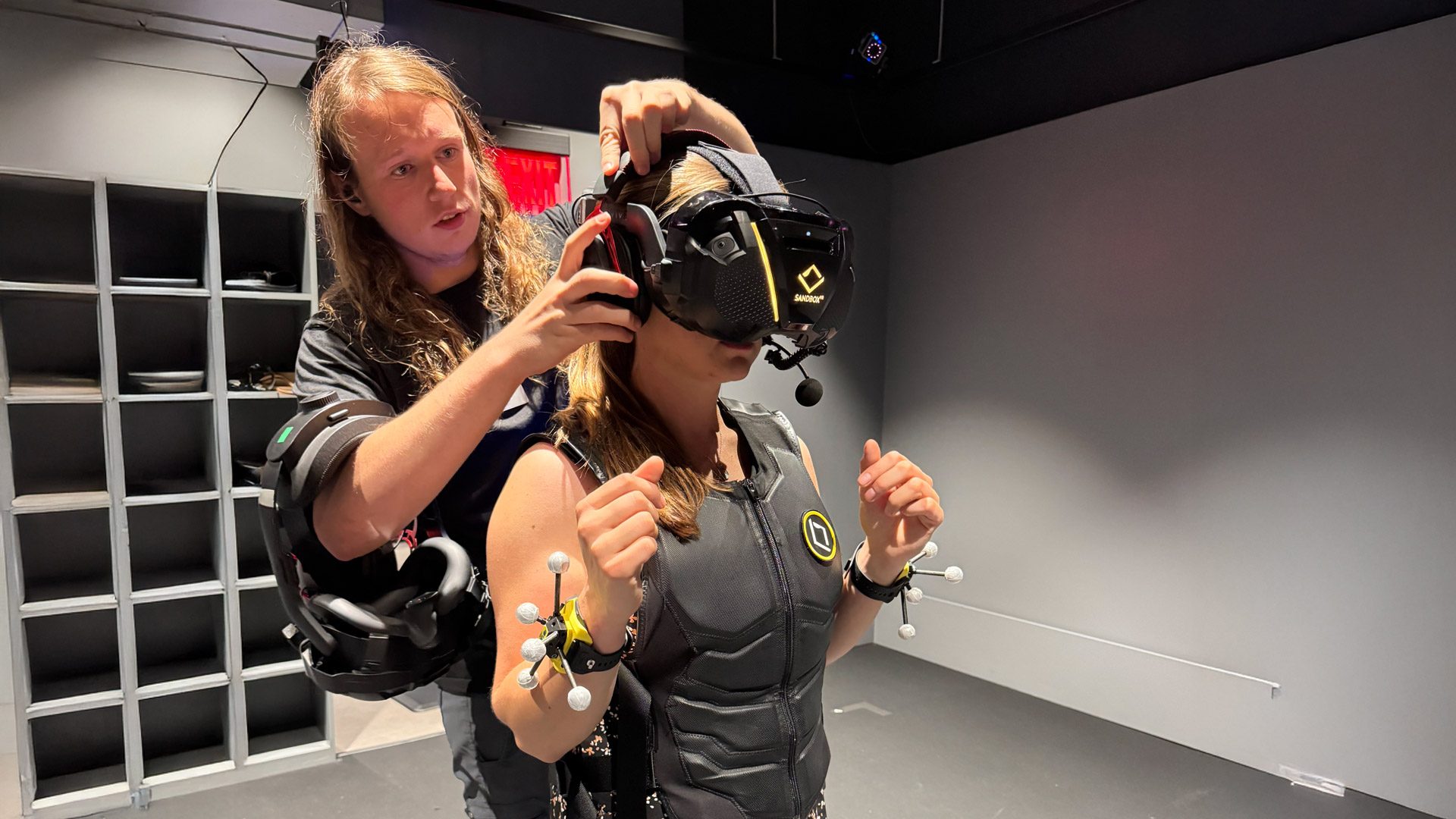
Photo by Road to VR

Squid Game Virtuals wasn’t as intense as Deadwood Phobia. It wasn’t as graphically rich. It didn’t even use the tracked gun controllers. But all four of us agreed at the end that Squid Game Virtuals was our favorite of the two experiences.

That’s not to say that Deadwood Phobia wasn’t fun. As a VR experience I was impressed at its visual quality, structure, and presentation. But we all agreed it would have benefited from more moments of direct player-to-player interaction.

Adding a few moments of downtime where players must communicate—solving a puzzle, opening a complex mechanism, or tackling other cooperative tasks beyond just shooting at the same target—would improve pacing and create more of the organic social interactions that made Squid Game Virtuals so memorable.
Photo by Road to VR

In the end, the nice part is that you can pick and choose which kind of experience you want, because a single Sandbox VR room can be used for a large number of experiences (at the location I went to there were nine different titles to choose from).

After reflecting on the experience with my three ‘non-VR’ friends, we all agreed that we’d love to go to Sandbox VR again, and we’d be especially interested in trying more experiences that emphasize player-to-player interactivity—something closer to an escape room than a simple shooter.


Disclosure: Sandbox VR invited us to visit the Philadelphia location and covered the cost of admission for the session. It was a standard booking as far as the attendants at the location could see, so we got to the ‘retail’ experience without any extra fluff.

The post Sandbox VR Shows that ‘Social’ Beats ‘Spectacle’ at VR Attractions appeared first on Road to VR.


from Road to VR https://ift.tt/6IOtzjl
via IFTTT

An Infamous Cave Sealed After a Fatal Accident is Being Reopened for Exploration – in VR

https://ift.tt/cdIlCE0

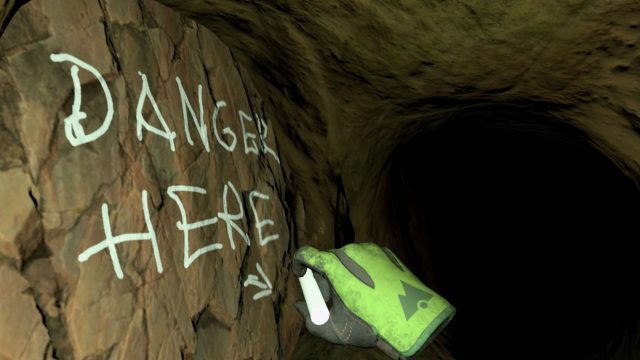
Cave Crave (2025) is a VR game where you explore caves. No monsters, no treasure chests, no puzzles—just the oppressive cave interiors tightening around you as you traverse further underground. Now, developers 3R Games are doing something few would expect: they’re purposefully recreating a now inaccessible cave system where a man died.

Next month, Cave Crave is releasing an update on Quest and PSVR 2 that brings to the game a recreation of Nutty Putty Cave, the infamous Utah-based cave system which attracted amateur and professional cavers alike before being permanently sealed shut in 2009, following a fatal accident that killed 26-year-old John Edward Jones.

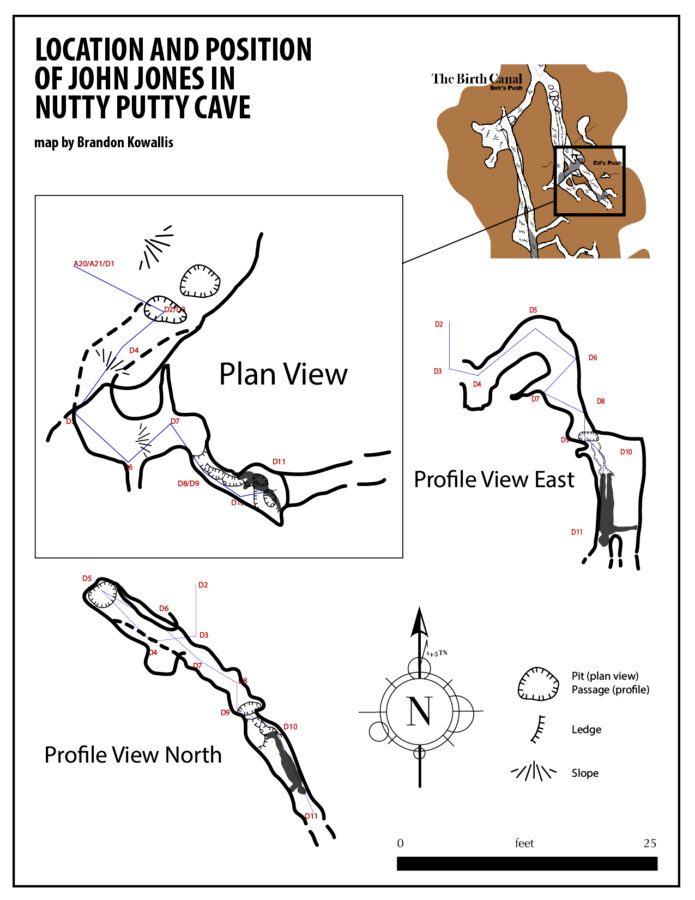
In short, Jones was caving through Nutty Putty with a group when he broke off to go solo, finding himself trapped in a vertical fissure just 10 by 18 inches wide. What resulted was 27 hours of rescue attempts that ultimately failed to save him. You may have seen the image below, showing Jones’ route, as the haunting story has reverberated around the Internet ever since.

Rescue map of Nutty Putty | Image courtesy Brandon Kowallis

You can’t go there today in any capacity. In the wake of the disaster, explosives were used to collapse the ceiling of the section where Jones’ body was, and all entry points to the cave were permanently sealed off by filling them with concrete so nothing of the sort could ever happen there again.

To recreate Nutty Putty, 3R Games says they’ve used public documentation and an official cave map provided by Brandon Kowallis, a rescuer in the incident who later wrote a detailed account of the efforts to extract Jones. Kowallis’ recounting is a harrowing read that I won’t recap here.

Profit, Ethics, and the Virtual Tourist

Critically, the studio says its recreation of Nutty Putty “avoids gamification of the tragedy,” ostensibly by allowing users to visit in ‘Tourist Mode’, an option that removes bits like environmental hazards, collectibles, and player death.

“Our goal is to give VR explorers access to a place that can no longer be visited in reality—nothing more, nothing less,” says Piotr Surmacz, CEO of 3R Games and director of the title.

But recreating Nutty Putty raises questions. To the studio’s credit, they seem to be handling the recreation with grace, since it won’t be gamified. Still, I’m conflicted.

Dark Tourism isn’t anything new. Purposefully visiting a place you know has a history of misery and death can be for remembrance, exploring your own feelings on the matter, or simple morbid fascination. None of it should be penalized when it’s done with respect, and especially not when done in such a low stakes arena as a single-player virtual reality game.

I don’t take issue with the recreation. Ideally, some platform at some time in the future will recreate the whole world in detail, maybe even including the past and present so we can explore it virtually. To this day, one of my favorite apps is Google Earth VR, which lets you do that to an extent, admittedly with much less granularity since it only integrates 3D building, geographic scans, and Google Street View 360 photos.

Google Earth VR is free though, which somewhat abstracts profit motive from the equation—knowing full well Google makes money in other unseen ways, but not directly from me popping my head into some of the most gut wrenching places on Earth, like the Chernobyl Exclusion Zone, the crematorium at Buchenwald, or public memorials to tragedies of all sorts—many of which are captured on Google Street View.

While the update is free, Cave Crave is a paid game. In a way, it could be seen as profiting off the misery of Jones’ death to some extent. 3R Games hasn’t made any indication that it’s associated with any sort of charity or caving association, which you might expect given the nature of the update.

That difference—between exploration as public service and as commercial product—is where things get murky.

This will be the first real cave 3R Games is recreating for the game. Since launch on Quest and PSVR 2 in June 2025, Cave Crave has exclusively included fictional caves, which offer players challenging and memorable paths to traverse. Many popular caves have been involved in tragedies, albeit less publicized than Jones’, so recreating any cave may come with similar moral grey areas.

The whole thing leaves me with more questions than answers, which feels unsettling.

Is this a somber homage to the real world risks of caving? Or is it a publicity stunt to attract eyeballs to the studio’s game? I think it’s a little of both.

And how is stepping into Nutty Putty different from playing any game based in history, like World War II? Companies profit off those motifs all the time without any whiff of controversy despite the real implication that the events undoubtedly saw the deaths of thousands.

I’m still not sure. Maybe because it was more recent. Maybe because we can relate more directly to Jones; if he were alive today, maybe he’s be playing Cave Crave right now. Maybe I’m partially wrapped up in the taboo of reopening something that was purposefully closed, not only for safety, but as a memorial to a man who died in the most gruesome way any caver can think of. Maybe having it featured in a game, and not as a part of a public tool, feels just a little too off-color.

Whatever the case, in writing this, I’ve become part of the same dark tourism circuit as Cave Crave. And by reading it, so have you.

The post An Infamous Cave Sealed After a Fatal Accident is Being Reopened for Exploration – in VR appeared first on Road to VR.


from Road to VR https://ift.tt/JQfMyop
via IFTTT

Thursday, 28 August 2025

Mixed Reality’s Best Laser Tag-style Multiplayer Gets Better Spatial Stability, New Enemies & More

https://ift.tt/esGbAIr

Spatial Ops (2024) is a bit like laser tag for Quest, letting you set up barriers and squad up with your friends for everything from room-scale to arena-scale mixed reality shootouts. Now, developer Resolution Games released an update today that brings more stability to co-located gameplay, more enemies, support for bHaptics gear, and more.

Called ‘Pulse Protocol’, the update brings a bevy of updates for the Quest version of the game, supporting Quest 2 and above, and a few things for the ‘Campaign Edition’ available on Pico headsets too.

The game’s multiplayer ‘Arena Mode’ on Quest now features an in-game spatial marker system, which the studio says will let you generate, print, and place spatial markers in your environment, and then use them to create maps.

Resolution Games says the markers ensure “reliable, precise alignment of both maps and player positions during matches,” something that can be tricky when matches get hectic and Quest struggles to keep up with spatial awareness.

Pulse Protocol is also bringing more enemy types, including Hatchet Corp soldiers and their Infected counterparts, each with their own unique weapons and tactics like revolver-wielding Guards and RPG-armed Rocketeers.

And if it weren’t high enough stakes, the update also introduces Permanent Death Mode, so you can setup matches with one-team or both-teams permadeath.

So far, these updates are only available on Quest, however both Quest and Pico headsets are getting a few additional quality of life enhancements. Users with bHaptics kit will be able to link up their TactSuit, TactSleeve and TactVisor to the game for the first time with native support, upping the realism of getting tagged by a stray bullet.

Additionally, Both Quest and Pico versions are getting an in-game achievement tracking system, horizontal grip angle offset for better weapon handling beyond the default grip angle, and a much requested in-game floor level adjustment tool, letting you do quick adjustments without using the system menu. You can check out more on Pulse Protocol here.

In the meantime, you can find Spatial Ops over on the Horizon Store for Quest 2 and above, and the ‘Campaign Edition’ over on the Pico Store for Pico 4 and above.

The post Mixed Reality’s Best Laser Tag-style Multiplayer Gets Better Spatial Stability, New Enemies & More appeared first on Road to VR.


from Road to VR https://ift.tt/qXV6DnI
via IFTTT

Meta’s Reported $800 Smart Glasses with Display Won’t Shoot for the Stars, Claims Respected Analyst

https://ift.tt/48pm0Xj

Meta’s smart glasses with display, codenamed ‘Hypernova’, are reportedly slated to cost less than initially expected, with Meta allegedly slashing price expectations from the rumored $1,000 – $1,400 range to $800. Now, respected supply chain analyst Ming-Chi Kuo says Meta is nearly ready to begin mass production, although sales expectations aren’t very high.

Bloomberg’s Mark Gurman reported last week that Hypernova will be cheaper than initially reported, delivering a pair of smart glasses with a single display and a wrist-worn electromyography (EMG) based controller for input at “about $800,” Gurman says.

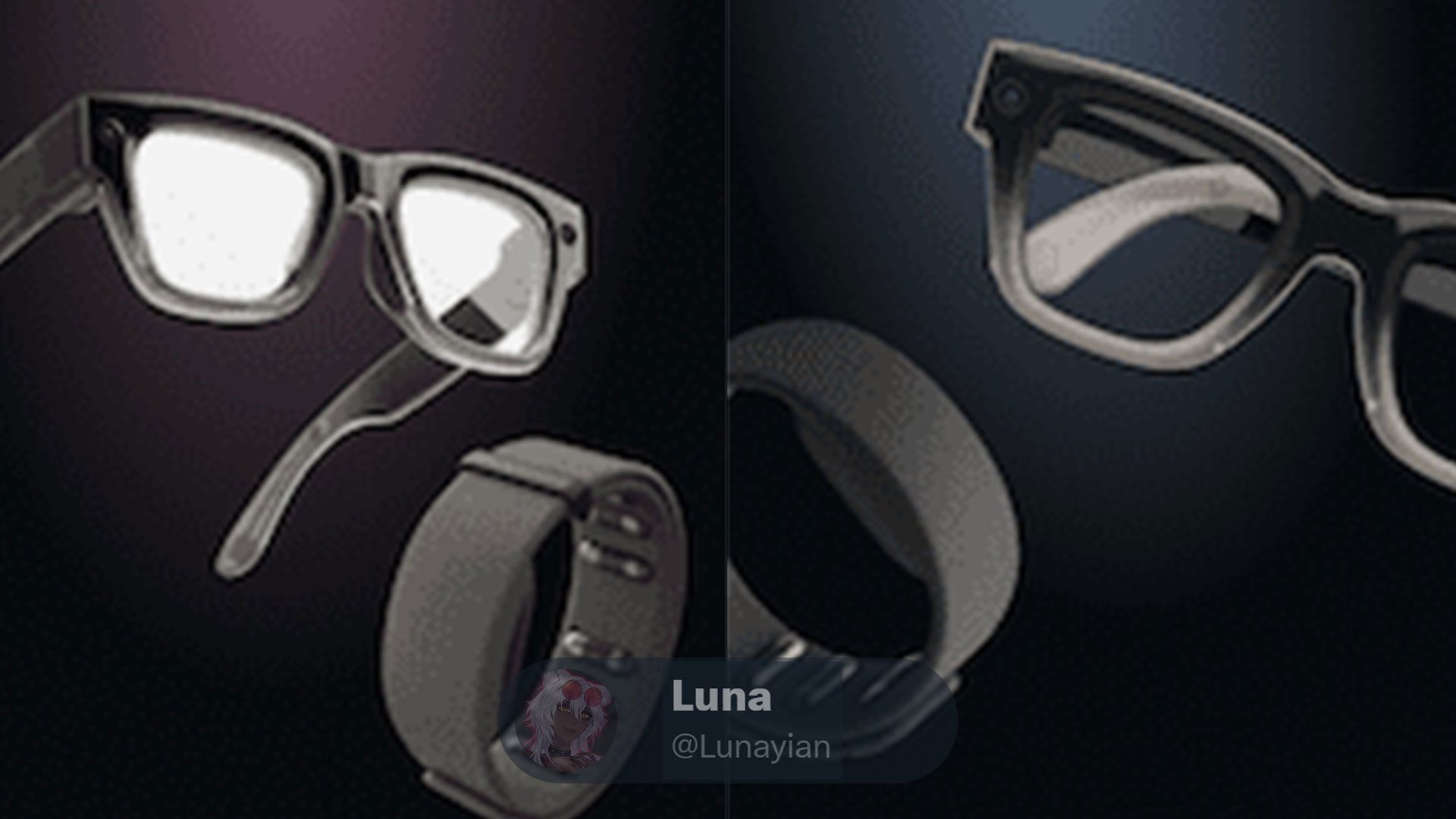
Notably, a number of recent leaks provided by data miner ‘Luna’ have also seemingly unveiled the glasses in full, suggesting not only is Hypernova (also referred to as ‘Celeste’) real, but it may be a Meta solo launch—i.e. not a partnership with Ray-Ban and Oakley parent company EssilorLuxottica.

Image courtesy Luna

Kuo, known for releasing insider info on Apple products, recently posted on X (machine translated from Traditional Chinese) that Hypernova is expected to enter mass production in Q3 2025.

Ostensibly sourcing supply chain info, Kuo says Hypernova will have a two-year product cycle, with shipments over the next two years estimated to be around 150,000 to 200,000 units in total—significantly less than the over two million Ray-Ban Meta units sold since release in 2023.

“Based on Qualcomm chip shipment forecasts, global smart glasses shipments in 2026 are estimated at about 13 to 15 million units, which shows that Hypernova’s market share is negligible, hence it seems more like Meta’s experimental product,” Kuo maintains.

Continuing:

AI will be the most important selling point of Hypernova, but the exploration of applications integrating AI and AR is still in the early stages, and with a selling price of about $800, this should be the main reason Meta is conservatively viewing Hypernova’s shipment volumes. Additionally, to pursue mass production feasibility, it adopts LCoS, but this also brings hardware design challenges such as appearance design, brightness, response time, and battery life.

Kuo posits that Hypernova holds a few strategic implications for Meta: to preempt Apple’s release and build brand image, accumulate ecosystem experience as early as possible, and understand user behavior.

Truly, the addition of a ‘simple’ display to its smart glasses platform changes things from both a user and platform holder perspective. As with early entrants into the ‘smart glasses with display’ segment, such as Rokid’s recently pitched Glasses, users won’t just be snapping photos and video, taking calls and listening to music, or talking with LLMs.

Rokid Glasses | Image courtesy Rokid

People will expect display-clad smart glasses to do things smart things like turn-by-turn directions, live text and audio capture real-time translation, and more interaction with apps, given Hypernova is supposed launch with more articulated input beyond simple swipes, button presses, and voice input can provide. Getting that right is no small feat, as Kuo suggests Meta may simply not be ready for the sort of wider adoption Ray-Ban Meta has driven.

Meta sees smart glasses as a stepping stone to all-day AR, likely making hesitancy the right move. The company needs to not only feed all of those learnings into a bigger and better AR platform down the line at some point, but also create something that won’t frustrate the glut of consumers with half-baked experiences or hardware limitations that could tarnish the segment before it even gets off the ground.

After all, Meta is banking on owning a sizeable piece of AR as it hopes to eventually generate a return on its multiple billions of dollars spent per year on Reality Labs, its XR research and product division, so rashly jumping into the coming wave of smart glasses may do more harm than good.

The post Meta’s Reported $800 Smart Glasses with Display Won’t Shoot for the Stars, Claims Respected Analyst appeared first on Road to VR.


from Road to VR https://ift.tt/elZhkSL
via IFTTT

‘Horizon Worlds’ is Getting AI-powered NPCs Soon That Talk, Guide and React in Real Time

https://ift.tt/7tls4Vc

Meta laid out the next step of its AI integration strategy for social VR platform Horizon Worlds, noting that “very soon” creators will be able to add AI-powered NPCs to their worlds.

Earlier this year Meta introduced non-embodied NPCs, essentially letting Horizon Worlds creators plug in ‘background’ AI agents, which were meant to offer help, but not exist as avatars.

Now, Meta announced in a developer blog post it’s soon rolling out “fully-embodied conversational [large language model] NPCs”, which means makers will soon be able to populate their Horizon Worlds creations with NPCs ostensibly sourcing responses from Meta’s latest Llama LLM.

Meta says this will allow NPCs to hold dynamic, unscripted conversations with players, mix scripted dialogue with LLM-generated replies, and use different AI-generated voices from a built-in library. Check out the character builder in action below:


Creators will also be able to define NPCs by name, and include things like backstories, personality traits, and specific dialogue styles, which Meta notes could serve as quest givers, guides, lore-deepening characters, shopkeepers, or bosses that react dynamically.

Meta isn’t stopping there either. Later this year, the company says they’re also adding the ability for NPCs to trigger in-world actions, dynamically converse with real players, and “more.” We’re sure to learn more at the company’s annual developer conference, Meta Connect, when it kicks off September 17th.

This comes amid continued efforts to boost engagement in Horizon Worlds, and further differentiate it from other platforms too—like Rec Room, Roblox, and VRChat—all of which feature scripted NPCs.

To boot, earlier this month Meta released two major generative AI features (Creator Assistant and Style Reference) for its Horizon Worlds desktop editor, aimed at streamlining the development of user-generated environments.

In all, Meta is striving to arm Horizon Worlds creators with better desktop maker tools that require less technical knowledge, effectively letting them build more visually-rich (and soon) more narratively-rich games and experiences.

The post ‘Horizon Worlds’ is Getting AI-powered NPCs Soon That Talk, Guide and React in Real Time appeared first on Road to VR.


from Road to VR https://ift.tt/cLlD0fH
via IFTTT

Wednesday, 27 August 2025

‘No Man’s Sky’ Brings Massive Multi-crew Starships in Latest Update

https://ift.tt/nBVpoUF

No Man’s Sky (2016) is well beyond its redemption arc now, having just shipped ‘Voyagers’ across VR and flatscreen platforms, making for one of its biggest updates yet.

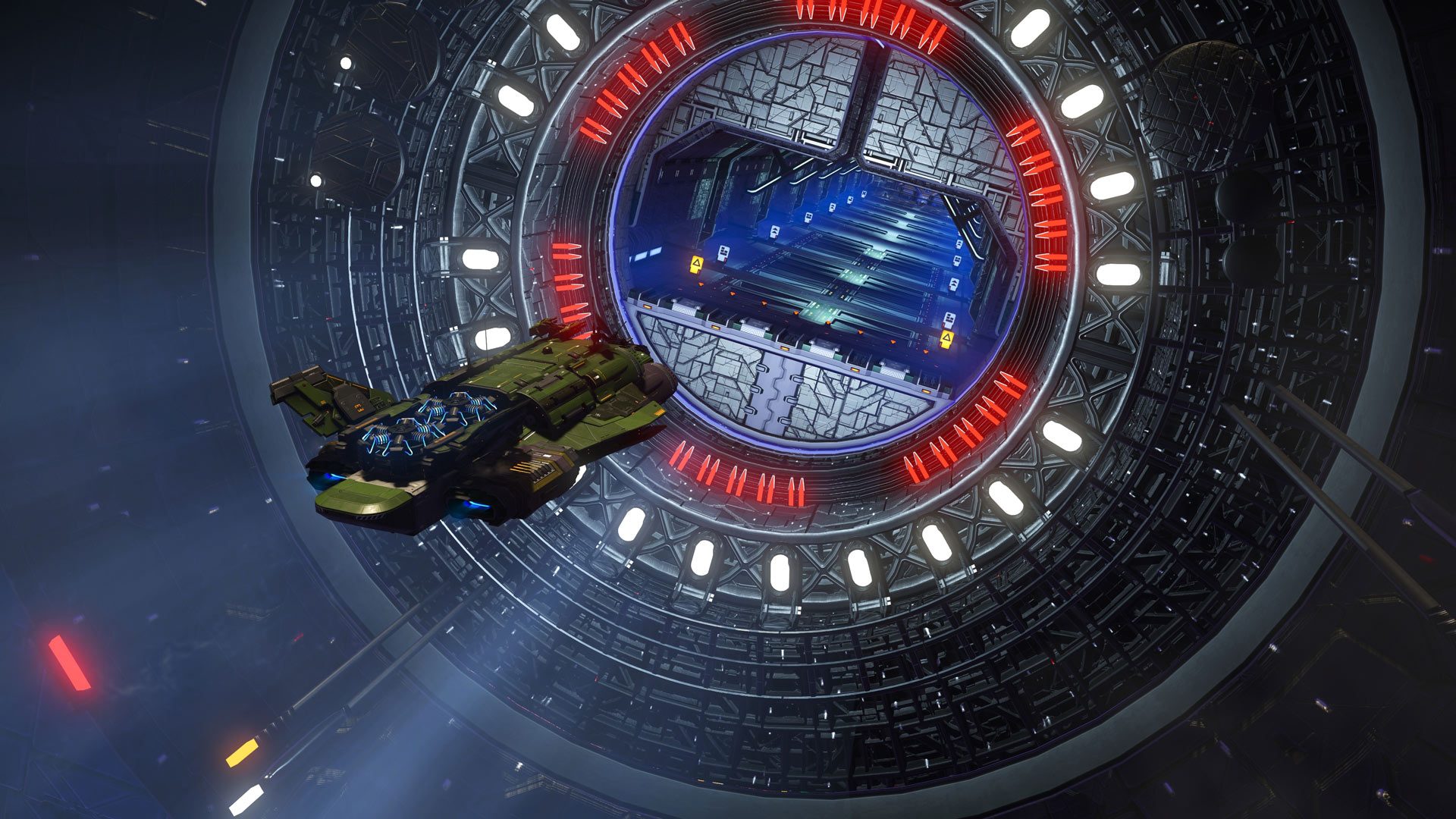
Starting today, you’ll be able to step aboard even bigger starships that you can crew with your friends. From the trailer, it certainly feels like No Man’s Sky is finally delivering on the sort of hardcore Star Trek/Star Wars space fantasy players have always wanted.

Called ‘Corvettes’, the massive customizable ships come replete with hulls, wings, landing gear, cockpits, engine parts, thrusters—everything you’d expect, but also real interiors you can kit out and customize with friends.

Image courtesy Hello Games

Inside, you’ll find med-bays, sleeping quarters, war rooms, radars, and teleporters, Hello Games says in a post on Steam.

“By design, Corvettes are encountered a little way into the game and veteran players will be able to unlock them reasonably swiftly,” the studio says. “But we wanted to give all players a taste of what they can expect, so the accompanying ‘Corvette’ expedition is specifically designed to get you to the workshop as quickly as possible and to take you on a journey which unlocks some of the parts you’re going to need to build out your sci-fi fantasy.”

Image courtesy Hello Games

Notably, there are a few perks for VR users too. PSVR 2 players can now take advantage of PlayStation Spectral Super Resolution for better graphical fidelity. And PC VR users with compatible NVIDIA RTX graphics cards can also now enable DLSS4, serving up faster performance and improved rendering.

Here’s a quick recap of VR specific stuff in the game’s latest patch notes, also including some things to heighten visual immersion:

Rendering & Visuals

  • NVIDIA DLSS 4 support (PC VR): boosts FPS, reduces latency, and improves clarity in VR on RTX GPUs.
  • PlayStation Spectral Super Resolution (PSVR 2): AI upscaling for sharper, more detailed VR visuals on PlayStation 5.
  • Intel XeSS 2 support: AI upscaling option for Intel GPU users, also helps VR rendering.
  • Moment-Based Order-Independent Transparency (MBOIT): upgrade to glass, windows, aquariums, and cockpit transparency, improving visual stability.
  • Hero Lighting: player character is lit independently of the environment, so your suit looks clearer even in dark scenes.
  • Improved rendering stability: fixes flickering and corruption issues in VR, especially with distant or semi-transparent objects.

Performance & Optimization

  • Multi-threaded rendering on PC: significant CPU performance improvements, especially noticeable in VR.
  • Occlusion culling & optimizations: higher framerates in caves, buildings, and indoor environments, reducing in-headset discomfort.
  • Reduced load times & memory optimizations: faster transitions in and out of VR-heavy areas like large bases.

Gameplay & Immersion Features

  • Fully traversable Corvettes: fully walkable ship interiors are naturally more immersive in VR.
  • Spacewalking & Skydiving: now fully supported, letting players float outside their ships and navigate with jetpacks.
  • Improved mission HUD timers: better readability of estimated travel times.

You can find No Man’s Sky over on the PlayStation Store for PSVR 2 and over on Steam for PC VR headsets where it’s currently priced at $24, 60% off its regular $60 MRSP.

The post ‘No Man’s Sky’ Brings Massive Multi-crew Starships in Latest Update appeared first on Road to VR.


from Road to VR https://ift.tt/Rul7mqD
via IFTTT

‘Aces of Thunder’ Still Coming in 2025 Despite Recent Store Glitch Showing September Release

https://ift.tt/T9BktUZ

If you recently spied the September 2nd release date for VR combat flight sim Aces of Thunder on the PlayStation Store, sorry to burst your bubble: developer Gaijin Entertainment says it was “a malfunction at the store.”

Gaijin Entertainment says in a recent X post that while the PlayStation Store release date was indeed a flub, the game is still coming this year, “just not that exact day.”

While announced in late 2023 and initially expected to launch in late 2024, earlier this month the studio announced Aces of Thunder’s release as “imminent,” which probably didn’t help temper player expectations concerning the recent gaff.

Still, the studio, which is also behind popular flight combat sim War Thunder (2013), did further confirm at that time that Aces of Thunder will indeed include a solo campaign alongside full-featured multiplayer gameplay, which you can see in the trailer below.

Some healthy (and suitably unverifiable) speculation here as to the overall situation: Gaijin announced back at the game’s unveiling it was creating Aces of Thunder “specifically with capabilities of PlayStation VR2 in mind.” All things considered, PSVR 2-focused multiplayer gameplay may not have been the right horse to bet on.

Following the game’s 2023 announcement, Sony has acted uncharacteristically anemic in its support for PSVR 2 post-launch, even going as far as cutting the once console-bound headset from PS5 in 2024 by officially supporting PC play via SteamVR and a separate adapter.

While a Steam listing for the game appeared in late 2023—suggesting those PSV2 capabilities maybe weren’t so fundamental after all—the studio further announced in April 2025 that it would also support flatscreen gameplay in a post-launch update. Granted, the plan may have been to support as many headsets as feasible from the start, although the timeline does raise questions.

That said, Aces of Thunder is supposed to land on PSVR 2 and SteamVR headsets sometime this year (even if not imminently), so we’ll be following the game’s X account and official blog in the meantime. Fool me once.

The post ‘Aces of Thunder’ Still Coming in 2025 Despite Recent Store Glitch Showing September Release appeared first on Road to VR.


from Road to VR https://ift.tt/J6V0PmR
via IFTTT
Related Posts Plugin for WordPress, Blogger...