
Thursday, 5 December 2024

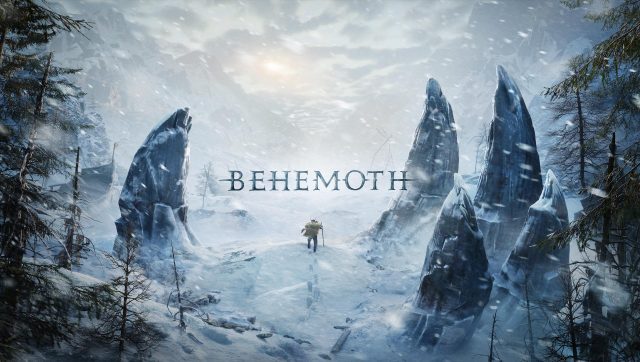
‘Skydance’s Behemoth’ Review – A Colossal Step Forward in VR Action-Adventure Gaming

https://ift.tt/KPDJ81F

Skydance’s Behemoth showcases a lot of hard-won lessons in VR design, which is mostly thanks to the studio’s pioneering work on its most successful VR game to date: The Walking Dead: Saints & Sinners (2020). As an original IP in the action-adventure genre, Behemoth goes in a pretty familiar direction when it comes to the game’s narrative, which would otherwise make it difficult to stand out in the crowd were it a standard video game. In VR though, there are precious few that provide such a monster-sized offering, and do it in a way that feels oh-so-satisfying.

Skydance’s Behemoth Details:

Developer: Skydance Games
Available On: Quest 2/3/Pro, PSVR 2, (coming to SteamVR)
Reviewed On: Quest 3
Release Date: December 5th, 2024
Price: $40

Gameplay

Much like Studio Ghibli’s Princess Mononoke (1997), in Behemoth you take on the role of an afflicted villager (Wren) marked with a rapidly progressing curse that will soon turn you into a mindless belligerent. It’s a double-edged sword: the curse means certain doom, but it also gives you superhuman powers to move faster, slice harder, and punch the ever-living shit out of everything—all of it in service of finding out the source of the evil that has felled a once mighty kingdom, and putting a stop to it yourself.

Image captured by Road to VRhemo

Using the curse to your advantage—and making you feel suitably bad ass in the process— you make your way through crumbling castle keeps and winding pathways filled with a variety of afflicted enemies who have unwittingly vowed to serve whatever dark forces govern the fallen world, which just so happens to have a few very nasty Troll-like giants wreaking havoc. More on those in a bit.

Behemoth is a physics-based combat game with a heavy emphasis on melee, so as you’d expect, the strike and parry system isn’t overly burdened with artificial moments to slice at baddies, giving you a good measure of creativity in how to approach situations.

Parrying simply requires you to hold up a sword in the direction of an enemy strike, which leaves your foes open to greater damage as they reel back. Smashing wildly and dashing around can quickly deplete your auto-regen stamina bar though, making every one of the game’s mid-level baddies worthy of your undivided attention, as they all have different weapons and combat styles. Some are fast, some have unblockable moves, so you have to stay on your toes, making it feel like a finely balanced act of managing your super strength, your dashing ability, and keeping attacks from landing on all sides.

View post on imgur.com

There are a few shortcuts to making encounters easier though, chief of which is using your super human strength to smash through armor and kill multiple low-level baddies in a single blow. I didn’t use it in the clip above because it was cooling down from a previous bum-rush, although it lets you deal a lot more damage, and as you upgrade it, move faster and even extend it with chain kills.

The second half of the game almost exclusively features armored enemies, requiring you to rely more heavily on your strength, and use the three legendary weapons dolled out throughout the game, including a two-handed sword, a bow with auto-regen arrows, and an armor-breaking axe—all of them upgradable at conveniently placed forges using the game’s sole upgrade currency that you can loot from chests, Coloss Alloy.

Upgrading weapons at the forge is the only crafting portion of the game, which feels like a missed opportunity given the number of collectable (and non-storable) medicinal plants around, which give you only a tiny fraction of health when eaten on the spot. Maybe the studio planned a potions table that was scrapped? As it is, the medicinal herbs are pretty useless, although you’ll find plenty of health potions to loot from the pile of dead dudes you’re sure to leave in your path.

View post on imgur.com

Outside of the small-ish upgrade tree available for your legendary weapons and super strength ability, that’s it for a big portion of the main gameplay loop. In between though, you’ll encounter environmental puzzles, which range from quick and easy to long and easy, as well as a variety of mini-bosses, which usually precede the stars of the show: the Behemoths.

As much as I like slicing dudes in half in fun and interesting ways, what I’m really here for is the game’s namesake, of which there are only four in the entire game. Although I wish there were more, I’m pretty satisfied with the difficulty ramp though, as Behemoths basically put all of your increasingly refined skills to the test: shooting, slicing, climbing, grappling, dashing, everything—making for epic multi-stage encounters that can equally flummox you on how to approach. How do you kill something the size of a skyscraper, anyway?

There’s really no leeway on how to tackle Behemoths, as you also have a witch-like companion in your head driving you forward, and consequently also spelling out the steps as they happen. That doesn’t make it any easier though, as you’ll need to strike at weak points scattered all around the giant beast, forcing you to climb up their legs through winding pathways and grapple your way up to clearly marked grapple points. Behemoths are cool, and I want more of them.

View post on imgur.com

I could go into the full gamut of extras on display in Behemoth—collectibles are meh, found notes offer interesting bits of backstory, inventory is holster-based and works very well, and so on. But here’s the gist: everything works as well as you’d expect from the seasoned studio that smashed it out of the park with Saints & Sinners, although the only real weak point for me is the story, which feels a just little too predictable to be truly engaging.

Difficulty is also quite high. Even on its easy ‘Tenderfoot’ mode, Behemoths and mini-bosses are far from easy, requiring multiple tries to fully grok attack patterns and their unique weaknesses.

That said, across my nine hours defeating the game’s campaign, I noticed very little chaff on the stalk. Almost everything, save a few rando non-essential items scattered on tables, has a defined purpose. Every narrative encounter is important (if not a little too predictable). Every weapon upgrade is powerful enough to make me want to search through levels for chests for the precious Coloss Alloy, and smash every urn to find health potions or Coloss shards, five of which equals one Alloy.
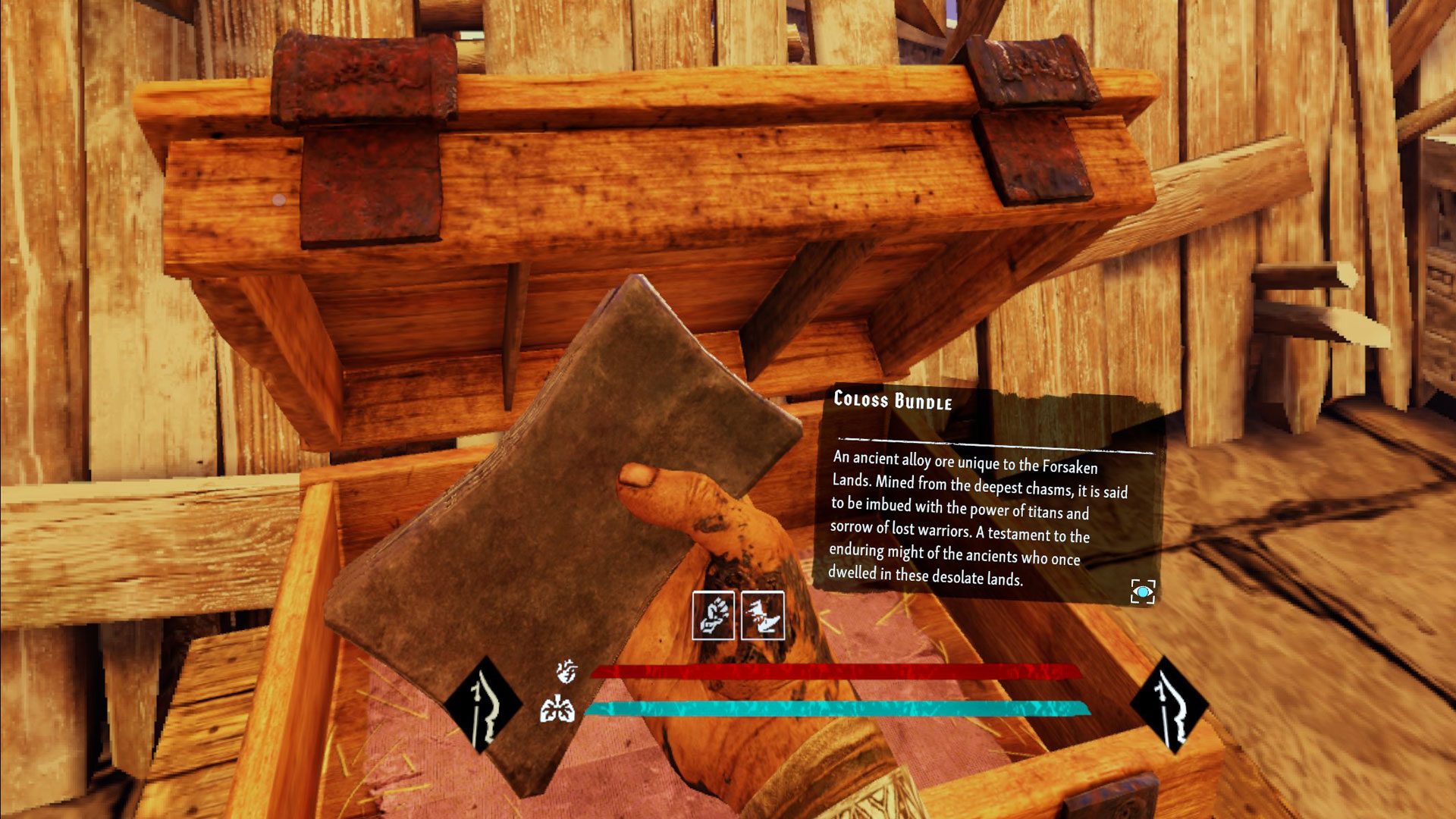
Image captured by Road to VR

While Behemoth presents you with the possibility to retread older levels via fast travel to find secret areas, it’s not relying on recycling anything, which is such a relief.

Immersion

As voiced protagonists go, I actually don’t hate Wren—or the witchy companion in his head, who definitely has ulterior motives. Neither tend to butt into puzzles or combat encounters, leaving you to experience the game’s non-narrative bits almost entirely in peace. I absolutely hate the ‘helpful robot’ trope that many action-adventure games fall into, probably because it’s just easier to tell people what to do than to build a game that lets you figure it out on your own. With effectively two voices in my head, there was a real opportunity for Behemoth to screw up twice as much in that respect, but it doesn’t. Here, Behemoth has my heart, but maybe not my mind.
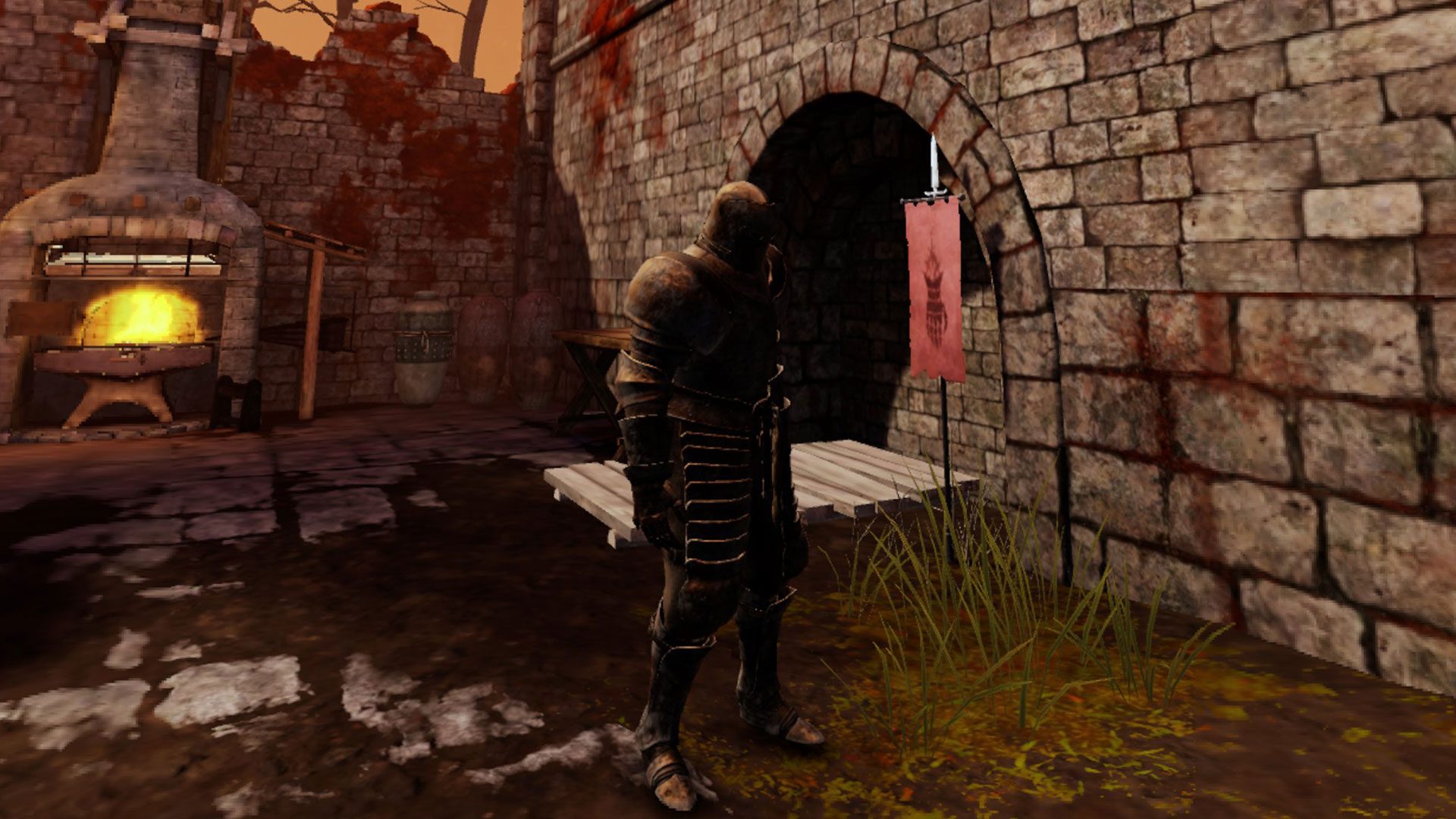
Image captured by Road to VR

Voice acting is a minor sticking point for me when it comes to immersion. It’s competent, but one of the main characters (there are only two besides yourself) feels way too melodramatic and commercial, which plays as an odd contrast to the gritty, fallen world of broken castle and dank crypts. I’m intentionally not revealing plot points here, but one of them is annoyingly plastic-feeling.

The story itself is also a bit weak, which is a shame. The narrative offers more than filler, but less than you’d expect from a game that absolutely nails the visual aesthetic, immersive interactions, physics-based combat—hell, it even runs so well on Quest 3, you’d almost expect it to be a PC VR game given the visual panache and well-realized textures on display.

While Behemoth does fall into well-trodden tropes of predictable twists and an end-game duel that I feel like I’ve played a dozen times already, all of it’s ameliorated by the game’s fun and satisfying combat, and dynamic grappling locomotion method, which was always used to its fullest in boss battles.


My other (much lesser) gripe is with AI enemies. While not nearly as frangible as the zombies in Saints & Sinners, they can feel a little too artificial at times. The overall gamey-ness of larger arena levels also feels on the predictable side. Gates close in obvious arenas for whatever reason, and reopen when the arbitrary number of bad guys stop spawning from the edges of the map.

That said, the Behemoth’s package as a whole is impressive, dull points and predictable tropes and all. I never felt too beleaguered by the story, and there was always a good reason to continue, as the game presents a wide variety of levels to tackle and interesting set pieces of lumbering Behemoths, teasing the encounters yet to come. Smashing through walls is also stupid fun.


In all, if I handed a Quest 3 to you even five years ago with Behemoth loaded up, it would be hard not to be impressed at the strides developers have been able to eke out of mobile hardware.

Comfort

As you would expect, Behemoth is a pretty physical game, although it equally supports seated or standing play, which may help you eke out a long play session without fatigue. Two-handed interactions are a constant, so make sure to clear some space however you play, because you’ll need to swing big, and swing hard.

Standard VR locomotion options (no teleport) are also here, catering to hardcore smooth-turners and snap-turners alike, both of which are variable strength, and provide variable sizes of vignettes. A fine snowy particle field also gently envelopes your view, giving you constant point of reference as you dash through levels at full clip, acting as a barely noticeable cockpit of sorts.

I only got that odd lurch in my stomach from a single elevator ride that was a little too wobbly for my liking, otherwise Behemoth offers a very comfortable experience throughout.

Skydance’s Behemoth Comfort Settings – December 5th, 2024

Turning
Artificial turning
Snap-turn ✔
Quick-turn ✖
Smooth-turn ✔

Movement

Artificial movement
Teleport-move ✖
Dash-move ✔
Smooth-move ✔
Blinders ✔
Head-based ✔
Controller-based ✖
Swappable movement hand ✖

Posture

Standing mode ✔
Seated mode ✔
Artificial crouch ✔
Real crouch ✖

Accessibility

Subtitles ✔
Languages
Dialogue audio ✔
Languages
Adjustable difficulty ✔
Two hands required ✔
Real crouch required ✖
Hearing required ✔
Adjustable player height ✖

The post ‘Skydance’s Behemoth’ Review – A Colossal Step Forward in VR Action-Adventure Gaming appeared first on Road to VR.


from Road to VR https://ift.tt/MQBEVC8
via IFTTT

Tuesday, 3 December 2024

Quest Black Friday Sales Volume on Amazon May Have Fallen Short of 2023

https://ift.tt/QkSgpLl

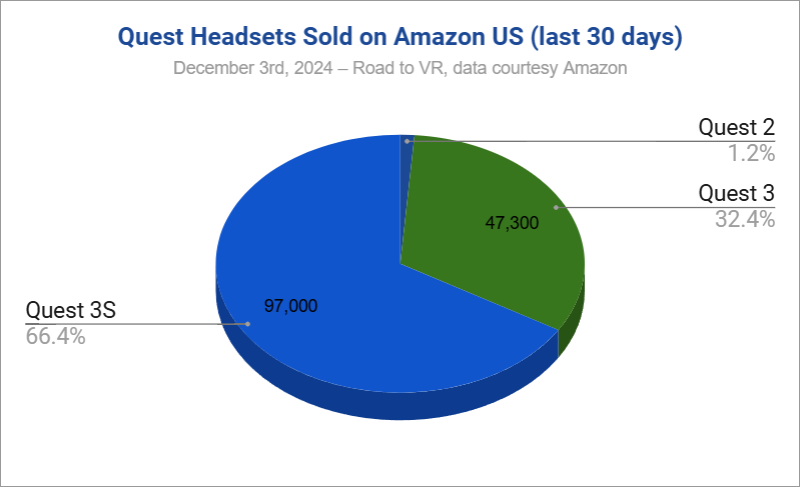
Data from Amazon US suggests that Quest headsets didn’t sell as well over Black Friday & Cyber Monday 2024 as compared to 2023.

Based on data from Amazon US, in 2023 about 170,000 Quest headsets had sold in the 30 day window surrounding Black Friday and Cyber Monday. In 2024, that number was around 146,000 Quest headsets, representing a drop in sales volume of 14%. This may not be representative of other retailers.

That’s a surprising outcome considering Meta just launched its new-and-improved Quest 3S, made a significant price cut to Quest 3, and had a flagship game with recognizable IP (Batman: Arkham Shadow) ready in time for Black Friday.

During the 2023 holiday shopping season, Meta was still selling its aging Quest 2 headset. That year’s Black Friday deal on the most popular version of the headset (128GB) was just $250 with a $50 gift card, making the headset essentially just $200.

That proved to be more popular at the time then this year’s deal in which Meta was pushing the Quest 3S (128GB) model for $300 with a $75 gift card, representing essentially a $225 purchase.

That’s not a huge difference in cost, and from a value standpoint, the Quest 3S is far and away worth the $25 difference. However, price isn’t the only factor; broader economic factors and deals on competing products (not to mention changes in interest in VR overall) are all significant additional variables.

When it comes to the sales ratio between Quest 3S and Quest 3 during this year’s Black Friday and Cyber Monday, the headsets have sold around 3:1, similar to the ratio between Quest 2 and Quest 3 in 2023.

The post Quest Black Friday Sales Volume on Amazon May Have Fallen Short of 2023 appeared first on Road to VR.


from Road to VR https://ift.tt/4tu8nRK
via IFTTT

‘Green Hell VR’ Gets Long-awaited Co-op Mode This Month on Quest and PSVR 2

https://ift.tt/BbpSWev

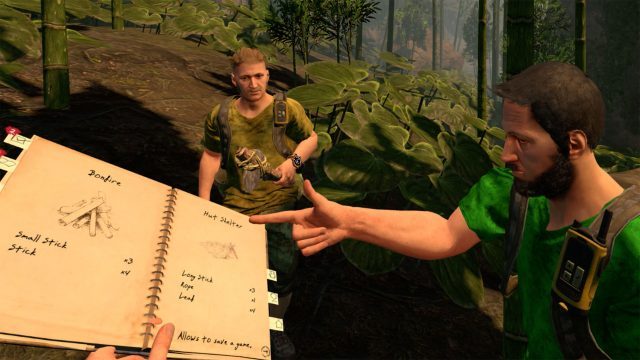
Green Hell VR (2022), Incuvo’s VR adaptation of the popular open world survival game, is finally getting the long-promised co-op mode this month on Quest and PSVR 2.

First announced in April 2023, Green Hell VR’s co-op mode is nearly here, launching December 16th for free to owners of game on PSVR 2 and Quest 2, 3 and 3S.

The co-op edition is said to build on the game’s challenging solo play by allowing teams of up to four players, who arm themselves with melee or ranged weapons to hunt food or protect each other from the jungle’s deadly predators, and build shelters to fend off environmental dangers. The studio also says players who need healing will visually appear to need help, even allowing others to spot leeches that need to be plucked off each other.

Unfortunately, the co-op update doesn’t include cross-play between any of the platforms, including PC-to-VR, or Quest-to-PSVR 2 gamplay. The studio says in an X post the team “was focused of developing the Multiplayer update. But working on cross play would make that process even longer. We’ll surely keep this in the back of our heads though.”

“Bringing co-op to Meta Quest and PSVR2 is extremely important to our VR community, and we know they have been waiting for this feature since we first launched the game on those platforms. Still, we had to ensure it lived up to their expectations for an immersive, co-op survival experience.“ said Incuvo CEO Andrzej Wychowaniec.

The studio hasn’t confirmed whether it’s also bringing the long-awaited co-op mode to its SteamVR version, although the chances seem fairly slim; the PC VR version has largely languished since its release on Steam, last seeing an update in late 2022 as the studio ostensibly prioritized releasing its ‘Spirits of Amazonia Part I’ expansion on Quest and PSVR 2.

The post ‘Green Hell VR’ Gets Long-awaited Co-op Mode This Month on Quest and PSVR 2 appeared first on Road to VR.


from Road to VR https://ift.tt/smNjDxE
via IFTTT

Samsung Reportedly Set to Unveil Smart Glasses at Galaxy S25 Event in January

https://ift.tt/OYIx03p

A recent report from South Korea’s Yonhap News maintains Samsung is set to unveil a pair of XR glasses at its annual Unpacked product event, which is expected to take place sometime next month.

Samsung promised back in July we’d be hearing more about its forthcoming “XR platform” before the end of this year, which it’s developing in partnership with Google and Qualcomm.

We still don’t know precisely what form its “XR platform” will take, with previous rumors suggesting work on an Apple Vision Pro competitor in addition to a Ray-Ban Meta smart glasses competitor, as reported in October by The Information.

Now, a Yonhap News report (via Techradar) maintains Samsung is expected to unveil some sort of device on stage, coming in the shape of “regular glasses or sunglasses, and weigh[ing] around 50g.”

The report notes the device is expected to have a payment function, gesture recognition, and facial recognition, and further maintains industry insiders expect the product to launch around Q3 2025. Its Android-powered XR software is also expected to be unveiled sometime this month.

Image courtesy Samsung

While Yonhap calls the device “AR glasses” (machine translated from Korean), the rumored weight and the lack of any mention of built-in displays suggests it may be closer in function to Ray-Ban Meta Smart Glasses instead of something like Meta’s Orion AR glasses prototype.

You can read more about the difference between AR glasses and smart glasses in our handy primer, although here’s the short of it: smart glasses don’t overlay immersive imagery, instead providing the user with access to data you might otherwise use on a smartphone or smartwatch, be it a visual heads-up display, or audio output, such as the case of Ray-Ban Meta. AR headsets on the other hand do overlay immersive imagery, like HoloLens 2 or Meta Orion, and are consequently more expensive and difficult to build as a result.

Provided Samsung is indeed releasing a pair of smart glasses and not a full-fledged AR device, it would be in good company. According to Meta, its smart glasses partnership with Ray-Ban has been very successful since the product’s initial release in 2021, prompting Meta to extend its smart glasses collaboration with parent company EssilorLuxottica into 2030. China’s Xiaomi is also reportedly preparing such a device with the help of long-standing ODM Goertek, which is reported to “fully benchmark” against Ray-Ban Meta.

Notably, this follows a string of Samsung trademarks ostensibly geared towards the next generation of XR devices. In mid-2023, the South Korean tech giant filed the name ‘Samsung Glasses’ with the UK’s Intellectual Property Office. In early 2024, Samsung filed a similar trademark request with the United States Patent and Trademark Office for ‘Galaxy Glasses’.

Whatever the case, Samsung hasn’t intimated when Unpacked will kick off, which typically takes place in January or February. An Android Police report suggests however the date has leaked: January 23rd in San Francisco, California.

The post Samsung Reportedly Set to Unveil Smart Glasses at Galaxy S25 Event in January appeared first on Road to VR.


from Road to VR https://ift.tt/vZqCya0
via IFTTT

Monday, 2 December 2024

Well-received Release of ‘Trombone Champ’ Bodes Well for Port-focused VR Studio

https://ift.tt/tHpo06F

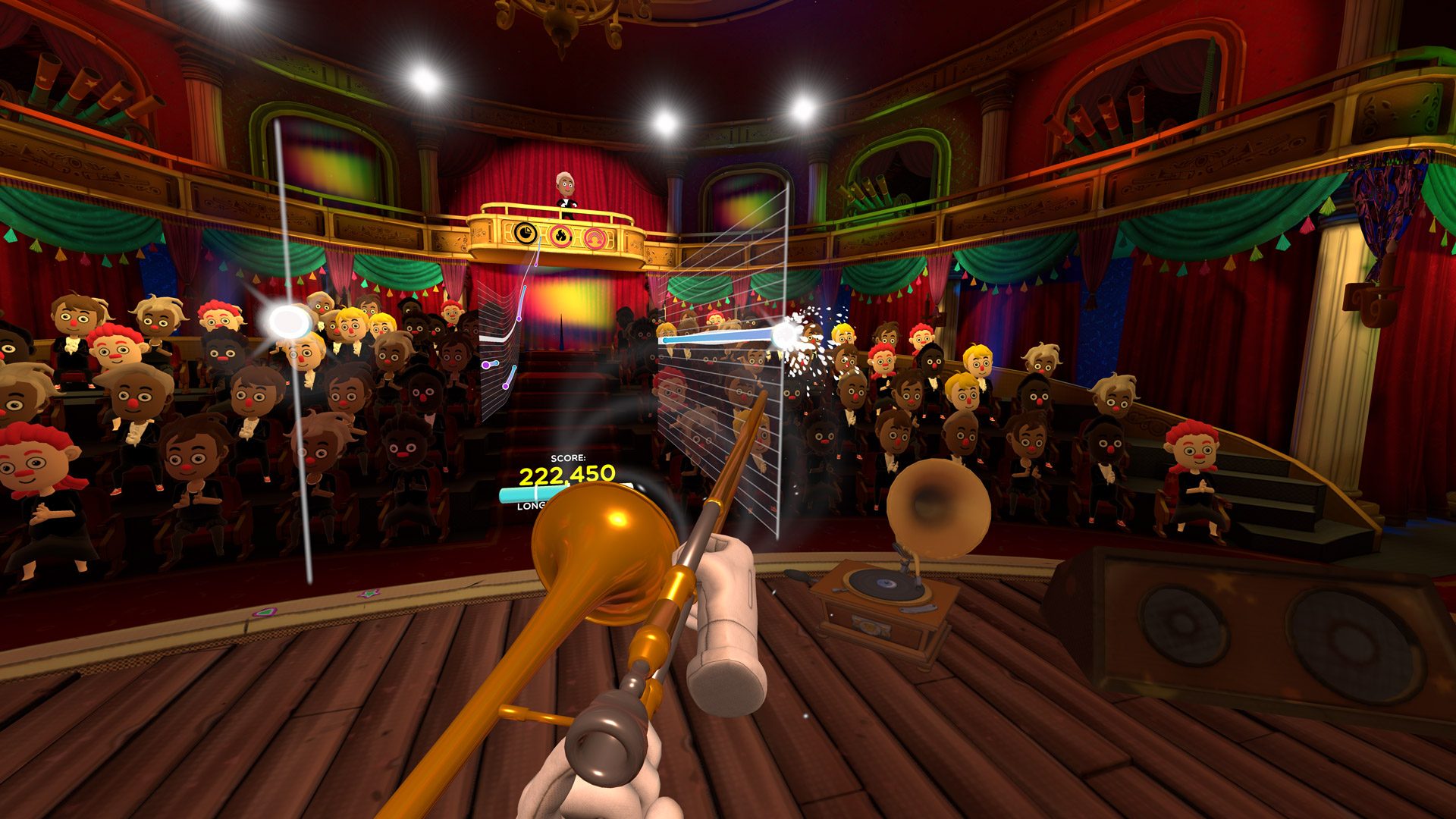
Flat2VR Studios, a recently-formed game studio focused on bringing existing flatscreen games to VR, has released its first game, Trombone Champ: Unflattened!. A positive early reception bodes well for both the studio’s ability to deliver and its choice of which games to port in the first place.

Flat2VR Studios is a formalization of a group of dedicated modders who were making unofficial VR mods for flatscreen games. The studio announced earlier this year that it would release official VR conversions of four games.

The first of those projects, Trombone Champ: Unflattened!, has launched to overwhelmingly positive user reception on Quest, PC VR, and PSVR 2:

  • Quest: 4.9 out of 5 stars (251 ratings)
  • PC VR: 100% positive (43 ratings)
  • PSVR 2: 4.9 out of 5 stars (120 ratings)

While the ratings don’t suggest blockbuster sales numbers (not expected for this unique and quite niche game), it’s clear that the studio’s first official VR conversion has delivered something that people are enjoying.

That bodes well for the studio’s foundational premise: that certain existing flatscreen games can be adapted for VR to make them not just playable in a headset, but actually fun and fitting for the medium.

It also bodes well for the studio’s ability to pivot from unofficial projects to commercial work with partners, and its ability to make good choices about which games would fit well in VR. Trombone Champ, in particular, certainly seems like a game that was destined to be in VR in the first place—after all, there’s no more realistic way to mime the trombone than with motion controllers.

Image courtesy Flat2VR Studios

While Trombone Champ looks to have been a fitting choice, the next three titles that have been announced from the studio are very different in subject matter and it remains to be seen how well they will port to VR. Those are: WRATH: Aeon of Ruin VR (a Quake-inspired shooter), Roboquest VR (a modern roguelite shooter), and Flatout VR (a demolition derby racing game)Release dates have yet to be announced.

The post Well-received Release of ‘Trombone Champ’ Bodes Well for Port-focused VR Studio appeared first on Road to VR.


from Road to VR https://ift.tt/TFB3VHI
via IFTTT

This Free ‘Halo: Combat Evolved’ PC Mod Brings VR Support to the OG of Shooters

https://ift.tt/BqlixEQ

Halo Combat Evolved (2001) released on the Xbox over two decades ago, but thanks to this mod, you can now play the original PC version in VR, which critically includes motion controller support.

The mod, called ‘HaloCEVR’, was created by modder ‘LivingFray’, who is also known for their work on an unofficial Metal: Hellsinger VR mod before the release of the official Metal: Hellsinger VR in September.

If you already own the remastered Halo: Combat Evolved Anniversary edition via The Master Chief Collection, we have some bad news; HaloCEVR only supports the original 2003 PC edition of Halo: Combat Evolved.

Still, the mod brings a host of wishlist items any PC VR mod ought to include, such as first-person shooting, tracked motion controller support for weapon and grenade aiming, two-handed aiming modes, and motion-controlled features like melee, flashlight activation, crouching, and both snap turning and smooth turning.

You’ll also find a functional PiP scope, rebindable controls with a left-handed preset, a detached floating UI layer, joystick-steered vehicles, and a floating crosshair, with desktop mirroring recommended via SteamVR.

Notably missing is first-person vehicle riding, as it zooms you out to a third-person view, which is also the case for the game’s many cutscenes.

You can check out a full gameplay session, courtesy of Beardo Banjo below:

Finding the original game for download isn’t difficult, as it’s largely considered abandonware at this point. As Beardo Banjo notes, the original PC version is available for free via various sources, such as Internet Archive if you can’t find your own copy.

You’ll also need a separate Halo PC patch, also available for free via Internet Archive in addition to the VR mod itself.

Check out the steps below to see what it takes to install and mod it work with PC VR headsets:

  1. Install Halo: Combat Evolved for PC using an original installation CD + product key
  2. Install the 1.10 patch
  3. (Optional) Install chimera (fixes a few bugs/issues such as entities moving at 30fps)
  4. If using chimera: open chimera.ini, locate the “Font Override Settings” section, and change enabled=1 to enabled=0 (failing to do this will break many UI elements in VR)
  5. Download the latest version of this mod from the releases page
  6. Extract HaloCEVR.zip and place the files in the same directory as the halo executable (You should see a VR folder, openvr_api.dll and d3d9.dll if done correctly)
  7. Launch the game once to generate a config.txt file in the VR directory
  8. If setting LeftHanded=true in the config, consider selecting the left handed controller bindings in the game’s SteamVR controller bindings page

The post This Free ‘Halo: Combat Evolved’ PC Mod Brings VR Support to the OG of Shooters appeared first on Road to VR.


from Road to VR https://ift.tt/sPGUu2S
via IFTTT

‘Shapelab’ 3D Modeling App Launches on Quest in Early Access, Bringing Polygon-based Sculpting

https://ift.tt/3uhz498

Leopoly, the studio behind PC VR modeling software Shapelab (2023), has launched a new version built specifically for Quest headsets.

Called Shapelab Lite, the polygon-based 3D modeling app is now in early access for Quest 3, Quest 3S and Quest Pro.

Shapelab Lite offers up many of the core features of the PC VR app’s toolset, targeting its intuitive sculpting tools at beginners, hobbyists, and professionals seeking a standalone 3D modeling solution.

Key features include a polygon mesh-based framework for precision modeling, dynamic topology for flexible detail adjustments, and user-friendly controls for creating 3D assets like props and characters.

Shapelab Lite represents a significant step forward in making professional-grade 3D modeling accessible to everyone,” said Daniel Andrassy, Chief Product Officer of Shapelab. “We’re excited to bring the core features of Shapelab PCVR to standalone VR users, empowering a new wave of creators. This is just the beginning of what we envision for the future of Shapelab Lite. As an early-access software, we’re actively listening to user feedback to guide future updates and ensure the app meets the needs of our community, keeping in mind the capabilities and constraints of a device with lower processing power compared to the PC version.”

You can find Shapelab Lite on the Horizon Store for Quest 3/S/Pro, priced at $15.

The post ‘Shapelab’ 3D Modeling App Launches on Quest in Early Access, Bringing Polygon-based Sculpting appeared first on Road to VR.


from Road to VR https://ift.tt/gk6pbjS
via IFTTT
Related Posts Plugin for WordPress, Blogger...