In a strategic move that underscores the expected growth of the AR industry, SCHOTT—a global leader in advanced optics and specialty glass—has announced the completion of a new production facility in Kulim, Malaysia. This development comes just a day after Meta unveiled its latest AR glasses prototype.
The new facility in Kulim is set to significantly boost Schott’s production capacity for optical components, which are crucial for AR devices. The plant is expected to create approximately 400 engineering and production jobs.
“This new site will significantly enhance Schott’s capacity to supply high-quality optical components to international high-tech industries, including Augmented Reality (AR),” the company says.
Image courtesy Schott
Schott’s expansion is timely, aligning with the industry’s anticipation of a surge in demand for AR lenses and optical components. The company’s longstanding presence in Penang, Malaysia—where it has operated for 50 years—has laid a strong foundation for this new venture. The Kulim facility complements the Penang site, enhancing Schott’s ability to supply high-quality optical components to international industries.
The announcement closely follows Meta’s reveal of its ‘Orion’ AR glasses prototype, highlighting a significant industry push towards more immersive and compact AR experiences. For AR to become a mainstream technology, it needs to be built upon technologies than can be affordably manufactured at scale. Schott’s expertise in delivering high-precision optics—and its anticipatory expansion—positions the company to be a key supplier in this evolving market.
Schott has been a longstanding partner of Lumus, which makes unique waveguides for AR. It’s likely the new facility has been geared toward the kind of manufacturing needed to manufacture Lumus optics at a large scale. Meanwhile, Meta says it new Orion glasses rely on silicon carbide lenses, rather than glass, to achieve a wide field-of-view.
Schott’s Advanced Optics business unit has a global manufacturing network with centers in Germany, North America, Switzerland, and China; the expansion in Malaysia is a strategic addition to this network.
Starship Home isn’t just a clever and infectiously cute sci-fi gardening game with casual ship management stuff. It’s probably one of the best cases right now for how mixed reality developers can break away from the usual gimmicks on Quest 3, and create something truly worth playing in your own living room. Read on to see why I think you’ll fall in love with this big little MR game.
Starship Home Details:
Available On: Quest 3 Release Date: September 26th, 2024 Price: $20 Developer: Creature
Gameplay
Many mixed reality games struggle to find their reason for existence, with a rash of early entrants mostly relying on the coolness of doing ‘X’ in your own room. It’s led to some pretty low-hanging fruit which has lent MR games less prestige than they probably should have, especially given that headsets like Quest 3 and the newly unveiled Quest 3S hope to act as more than just an obvious upgrade path for Quest 2 owners. For Meta to bring MR to the masses, it needs to be more than just an optional mode to new VR games, or, for all its benefits, a handier way of grabbing a drink from your desk.
Some of this comes from Meta’s historical stance (now changing) on not allowing developers access to Quest’s cameras, limiting their ability to create games that can better digest your room and offer up the sort of granularity MR games need to transform your home into a backdrop for a truly compelling experience.
Image courtesy Creature
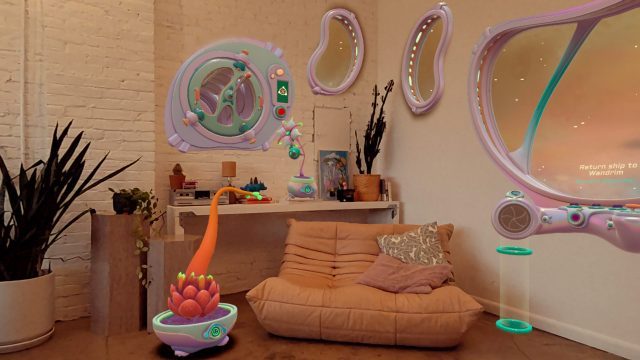
Working with those same limitations, indie studio Creature seems to have really hit the sweet spot with Starship Home, offering you components to turn your living room, office, or bedroom (hell, it may even work in a bathroom) into your own spaceship, and doing it in way that finally feels like its finally on an even playing field with VR games. In short, I love it and I think you will too.
In Starship Home, you need to collect plants infected with an evil Blight, and bring the universe back into harmony. Here’s the basics of the gameplay loop, although there are some surprises along the way I won’t reveal.
Thrust aboard your own starship-home-office, your job is to find the plants scattered throughout the galaxy by traveling to alien worlds.
Freewheeling space explorers beware: ship-flying is essentially an on-rails experience that requires you to reveal planet coordinates on a 3D map and push a big ‘GO’ lever on your helm controls. This isn’t No Man’s Sky, after all. It’s a chill, fairly easy game that’s more about exploration and fun room-scale interactions.
Despite being on rails, there’s a good amount of interactivity involved in getting your spaceship to blast off to the next location. You’ll need to charge up your ship with energy blobs—which is found in a storage tank embedded in your floor—before making the trek. You’ll also need to scan the planet from orbit, and again down at the surface below using a drone to uncover its unique biome. Toss you ever-present robot buddy out the airlock so he can make his way to the planet and automatically collect them.
Bringing you plant back inside your ship, you now need to rid them of the evil Blight that’s taken over the galaxy by entering their dreams. Yup, these plants dream about weird stuff, and they even have personalities too.
Each dream is basically its own unique mini-game, which makes for a fun one-off puzzle, like bouncing raindrops down from the ceiling using little stepping stones, or squashing blight-ridden slugs with extendo-tentacle hands—all of it cast in different technicolor shades.
Now it’s time to plant your newly healed plant buddy and tune them to the right frequency. Because baby, these plants can sing.
Then it’s your job to feed them and keep them happily singing, which you can do by grabbing one of your squishy little buds from the terrarium and dripping the goo on your plant. You’ll also need to repot plants from time to time so they can grow and eventually morph into their final forms.
And keeping your plants happy is important. I’ve killed so many orchids IRL that I should be on a blacklist—even a cactus or two—but remembering which fertilizer-bro they need and when to water them feels less like a chore than I though it would. It’s more like a fun little mini-game in its own right, with plants rewarding you with a catchy little tune that syncs up in chorus when everyone is full-up on all the right fixins. If only real plants were so straight forward in their constant expectations of me.
Then, you just need to keep exploring the galaxy to find the source of the Blight.
In all, it took me around three hours, but you could easily play for longer depending on your individual speed since none of the action feels frantic, letting you sit back and mind your plants at your own pace and organize them by what sort of care they need.
And yes, I’m in love with this game despite it being a very chill, and maybe even slightly repetitive experience at times. It’s just so damn cute and quirky, and so full of surprises. Granted, there is a helpful alien bud who pipes in a little too much for my liking, but I can see why they’re tagging along. There’s a lot to do in Starship Home, and you’ll definitely need a hand not only learning the ropes, but keeping track of all of the many tasks you need to complete along the way.
My only wish is Starship Home were bigger universe and a little more off-rails. I want more (virtual) plants, more control over my ship, and maybe a little more organic exploration overall. Still, you I couldn’t help but bob my head to my game’s catchy plant-derived beat, and dutifully care for my home’s new intergalactic garden in a way I’d never do with the the ragtag gang of languishing house plants who have survived for some unknown reason.
Botched botany side, Starship Home is by far the first mixed reality game that’s absolutely grabbed my brain, putting it squarely at the top of my library for more game sessions yet to come.
Immersion
While all of the whimsical gadgets in Starship Home could easily be placed in a virtual ship, even one tailored to your own room space, I’d still argue that MR passthrough is essential to the experience thanks to the game’s clever modularity.
At the beginning, the game lets you pop a variety of control panels, portholes, storage locked, and airlock wherever you want. The room orients itself to where your helm control and main window are located, although you can easily pop panels off the wall, and re-jigger your setup mid-game.
Having those portholes scattered around my home office—which is consequently also a full-time shoe depository—really sells the illusion that you’ve stepped aboard a little escape pod from reality, all the while serving as a ‘new’ environment to place my growing collection of plant buddies and gadgets.
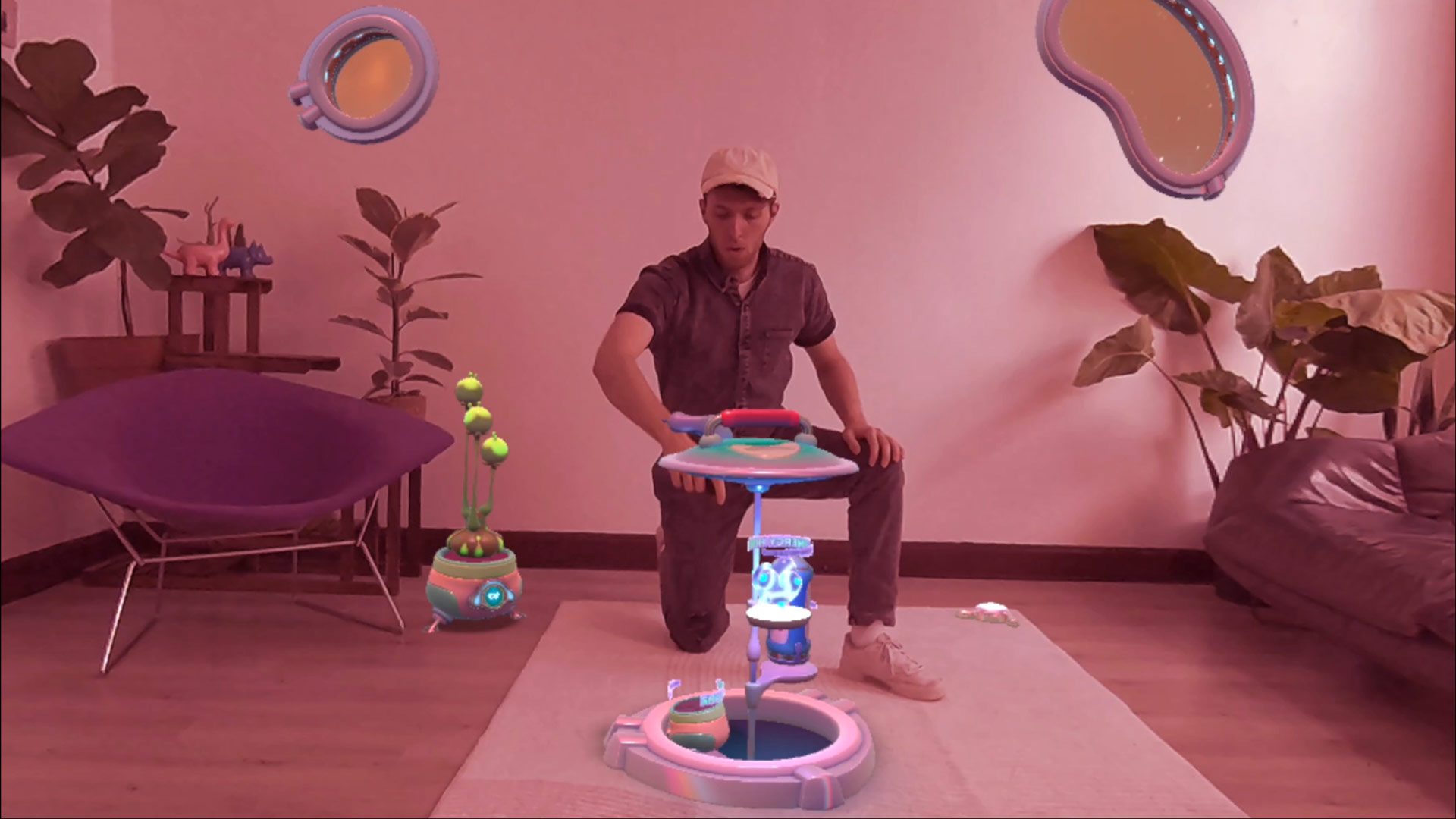
Colored overlays sets the mood for each encounter too, with the constant shift of blue, red and purplish hues lending it a cool sci-fi vibe. In plant dreams, you’re always treated to some new, weirdly colored overlay that mentally brings you out of the ship, but still somewhere distinctly home-shaped, as dream mini-games use the real-world layout of your rooms as a backdrop.
Image courtesy Creature
Diegetic interfaces are also everywhere, meaning the only screens you be reading are informational displays about those unique plants, which are consequently have their own personalities. Smack a plant around, and it may even glare at you with a distrustful eyeball, or curl up into a ball and writhe in pain when you forget what fertilizer it needs. So be nice.
And while Starship Home could all be stuffed into a VR game, its smart modularity allows rooms of nearly any size to be transformed into a proper game space, which I think is additive and definitely not a gimmick.
Comfort
As a room-scale game, you won’t need to worry about artificial locomotion beyond the on-rails exploration your ship can do. That’s always a comfortable experience though, since your room is solid ground for all locomotion.
Quest 3’s mixed reality passthrough is pretty good, but is still in its infancy. Better, clearer, and quicker passthrough would improve everything from a long-term user’s standpoint, Starship Home included, although the game can’t be faulted for this. This really comes from a place of wanting to bring all of the gadgets and immersion the game brings to the table closer to my eyeballs, and therefore closer to reality.
While you could play seated by placing all of the controls at chair-level, some of the interactions in mini-games and accessing the ships storage locker require a good range of moment, making this primarily a standing, room-scale game.
‘Starship Home’ Comfort Settings – September 26th, 2024
Meta Connect 2024 is kicking off today, with CEO Mark Zuckerberg just moments away from making what hopes to be a big announcement, possibly even the thoroughly leaked Quest 3S.
Starting at 10AM PT / 1PM ET (local time here), Zuckerberg is set to take the stage as he shares the latest developments in mixed reality, AI and wearables. Meta is hosting its big keynotes over on the Meta for Developers Facebook page, which we embedded below:
You can also watch it in VR via Horizon Worlds, which is set to be stereoscopic 3D livestream, which VR Oasis Editor and resident VR video producer at Connect ‘ElnarVR’ tells us will be “a window onto the stage at 4K60” unlike years past.
The official program says we’ll hear about how Meta is “building towards the next computing platforms and get a first look at new products and features that will deliver the future of human connection.”
Outside of the big (likely juicy) keynote from Zuckerberg, there’s slated to be another massive developer keynote presented by Meta CTO Andrew Bosworth, VP of Product Management Aigerim Shorman, Senior Director Engineering Rachad Alao, VP of Meta Horizon OS and Quest Mark Rabkin, and Chief Product Officer Chris Cox.
We’re also hoping to learn more about the previously teased AR prototype device, which Zuckerberg said in June was “almost ready” to show off.
On top of it all (it is a developer conference, right?) there will be a ton of developer sessions throughout the day, which we’ll be sticking around for, since we’re here live at Connect 2024. Make sure to check in for all the latest in XR reveals!
Update: Added info on Horizon Worlds viewing, thanks to ElnarVR!
Owlchemy Labs, the Google-owned studio behind Job Simulator (2016) and Vacation Simulator (2019), surprise announced its next VR title today, a hand-tracking-tastic social co-op game called Dimensional Double Shift. And you can get ready to multiplayer job this week.
Launching for free on Quest on September 26th, Dimensional Double Shift lets up to four players work at the Gas N’ Grill, an omnidimensional diner and service station owned by Conglomni Corp.
Promising to pack in the studio’s patent madcap humor and plenty of very human jobs, players work together to operate the service station and sling greasy bites to an eclectic array of creatures from all over the Omniverse.
Image courtesy Owlchemy Labs
“Players will cook, fix, refuel, incinerate, soak, and serve the bizarre citizens of each dimension, earning rewards and progressing in their career with corporate-approved Conglomni Corp. swag. Don’t waste any food — Conglomni Corp’s resident manager, ALICE, is always watching,” the studio says.
Moreover, you won’t need to pick up a controller, as Dimensional Double Shift is designed exclusively for hand-tracking, which Owlchemy has notably adopted across both Job Simulator and Vacation Simulator on Quest.
Image courtesy Owlchemy Labs
Following its open beta, which launches for free on Quest on this week, the studio says we should expect regular content drops, including more dimensions, gameplay activities, and features.
Owlchemy hasn’t shared whether it will eventually monetize the game at full launch, however confirms that beginning bits of the game will remain free for players.
The studio also hasn’t mentioned whether it will support more platforms beyond Quest in the future, highlighting however that it’s traditionally a “multiplatform studio.”
You can download the game for free over on the Horizon Store here once it goes live on Thursday, September 26th.
Vertigo Games is getting ready to release its remake of Arizona Sunshine (2016), the co-op zombie-killing adventure that started it all, showing off some new gameplay footage for Quest 3 and PSVR 2 too.
Announced back in mid-August, Arizona Sunshine Remake is headed to all major headsets come October 17th, including Quest 2/3/Pro, PSVR 2, and SteamVR headsets—cross-platform co-op included.
Among a bevy of graphical updates and new mutilation and gore system introduced inArizona Sunshine 2 (2023), the remake features all original DLCs and updates, including Dead Man DLC, The Damned DLC, Old Mine update, Trailer Park Update and Undead Valley Update.
Now Vertigo Games has released gameplay videos for both Quest and PSVR 2, giving us a direct look at how graphics compare between the two.
Quest Gameplay
Ostensibly captured on Quest 3, the new gameplay video shows a big jump in graphical fidelity over the original Quest-supported version launched in 2019. For comparison, take a gander at John McChaos’ no commentary playthrough on Quest 3 to see what Vertigo Games is promising with new overhauled version.
You can pre-order the game on Quest here, priced at a 10% discount off the usual MSRP of $30.
Note: players who already own the original Arizona Sunshine will be able to upgrade to Arizona Sunshine Remake at a discounted price, requiring you to have the original game purchased and installed on your platform. Keep that in mind before pre-ordering!
PSVR 2 Gameplay
Notably, the PSVR 2 version looks predictably a little more spiffy, showing off the same starting section. Hands-on previews with the PSVR 2 version from Gamescom 2024 in August were very favorable. Check out Beardo Banjo’s preview to see it in action.
PS Plus members can nab that 10% off on pre-orders, which is normally priced at $30 over on the PlayStation Store.
PC VR players can also grab 10% off on pre-orders on Steam. While we haven’t seen a specific gameplay video for PC VR, although we’re keeping our eyes peeled in the coming weeks for what promises to be the definitive way to play a true VR classic.
Meta shut down MARVEL Powers United VR (2018) back in 2021, the online co-op game released exclusively on Oculus Rift by Meta-owned studio Sanzuru Games. A recent fan project dedicated to reviving the game gave fans a glimmer of hope that they may even be able to play online again, but Meta has now shut that down too.
As reported by Video Gamer, the short-lived ‘Powers Revival’ project has been shut down, citing copyright infringement by IP holder Meta.
“Unfortunately, we regret to announce today that the ‘Powers Revival Project’ will be closed and completely removed in the following days,” organizers announced in the project’s Discord over the weekend. The Discord first opened its doors on August 20th, making for a fairly rapid response by Meta.
The project’s scope was to promote software tools so users could select game levels, and therefore play all of Marvel Powers United VR’s single player content. It also appears Powers Revival came fairly close to releasing multiplayer servers too, which is a shame.
Issues appeared to stem however from the group providing players with direct links to torrents so users could install Marvel Powers United VR content in its entirety, reasoning that many such legitimate owners had already deleted their game files as suggested by Meta back in 2021 “to avoid dead space taken up on your device.”
“While we, in good faith, wanted to help legitimate game owners download the game as most had already uninstalled it at Meta’s request after shutdown, that ultimately ended up being a terrible decision as we were unintentionally infringing on the copyrighted files belonging to Meta Platforms (MP). As would be expected, they’ve kindly asked us to take down this project and any infringing files.”
The revival group said over the weekend they’re still attempting to negotiate with Meta, although admits “it’s highly unlikely and if we don’t hear back positively the [Discord] server will be deleted as scheduled.” An announcement message from group organizers notes today is the “dawn of the final day. 24 hours remains.”
In its wake, the Powers Revival project is urging players to sign the Stop Killing Games initiative, which seeks to end the practice of publishers deleting video games they have sold to customers.
What’s more, all of this was in service of a game that received mostly middling scores for essentially offering up a super hero-flavored wave shooter, albeit letting you play as 18 different Marvel heroes, such as Black Widow, Captain America, Spider-Man, Storm, The Hulk, and Wolverine.
Still, its overall production value and ability to let you cosplay as your favorite superhero was a highpoint not worth overlooking. At the time of this writing, the fan revival Discord has nearly 6,000 members.
Thanks to Antony Vitillo of Skarred Ghost for pointing us to the news.
The Immersed IRL event, held yesterday in Austin, Texas was the company’s big moment to showcase its upcoming headset and build confidence that it was on track to deliver on the promise of an ambitious headset. But a botched demo may have done the opposite.
Guest Article by Eric Liga
Eric Liga is Chief Scientist at Net Edge VR, a Houston-based company specializing in the creation of VR training software. He has run the Houston VR Meetup for the past ten years, and was programming director for the Immersive Technology Conference, one of the first conferences to focus on uses of AR and VR in business and industry. He has given presentations about VR at NASA, the Translational Research Institute for Space Health, the Houston Global Health Collaborative Conference, and many other industry events.
Immersed IRL drew attendees from around the world. I stood in line with a pre-order customer from Japan, another who had driven in from Canada, a journalist from England, and others from a dozen different US states, all eagerly waiting to try the company’s upcoming Visor headset. The long wait would end in frustration and disappointment for most of them, tempered somewhat by a widely-expressed hope that Immersed might yet deliver on its promises in the end.
Visor is an ambitious, productivity-focused headset designed by Immersed, a small, formerly software-only company, in conjunction with an array of industry partners. It is intended for a largely unmet use case: doing ‘desktop productivity’ work to make use of the unlimited canvas afforded by VR, but with a lightweight, comfortable, socially acceptable, high-resolution headset.
While the Apple Vision Pro is largely intended for productivity (with Apple even coining the term “spatial computing” to emphasize its productivity and ‘computing’ focus), it missed the mark on a number of fronts. Its high weight and front-heavy balance make extended wear uncomfortable. Its size, shape, and uncanny-valley eye simulation on the front of the headset make many users hesitant to wear it in public or in social settings. Add to that its eye-watering price-point of $3,500—and the fact that only users of Apple laptops and desktops get the full productivity benefits—and it’s easy to understand why there’s interest in bringing a competitor to the market that chooses some different trade-offs.
The Visor’s final hardware design, revealed on stage by Immersed founder Renji Bijoy, weighs roughly 185 grams (less than a third of the Apple Vision Pro’s weight), in a thin form factor.
Image courtesy Eric Liga
From the front, it does a credible job of looking like a slightly oversized pair of sunglasses. The illusion is less successful from the side due to the width of the optics, but it’s at least in the ballpark of something a user could wear while working at a coffee shop without drawing too much attention. Its screens boast a slightly higher resolution than the Apple Vision Pro, and are intended to allow it to simulate up to five large 4k monitors in a virtual or mixed-reality workspace. It eschews handheld controllers for eye-tracking and hand tracking, for any interactions not handled by a mouse or keyboard.
The tethered battery (which also houses the headset’s wi-fi and Bluetooth hardware) can be set on the desk while working, dropped in a pocket when collaborating on a virtual whiteboard, or excluded completely when connected to a PC. The fact that the radio-emitting components are housed in the optional battery pack means the headset (with some other minor adjustments) could be viable for use in high-security military and government facilities—a potentially lucrative market.
The headset is priced at $400 (but will rise to $500 after October 1st) is subsidized by a required one or two year subscription to Immersed’s software ($40/mo for 2 years, or $60/mo for 1 year). This means that the total cost is a good deal higher than it appears, but makes the up-front cost more palatable. When the subscription is included, a total cost of between $1,120 and $1,460 places it at over double the price of a Quest 3, but less than half of the price of an Apple Vision Pro.
Image courtesy Eric Liga
While the Visor is usually shown with over-the-ear stems, like a pair of sunglasses, it will also ship with a head strap designed to better balance its weight and improve comfort. Bijoy was candid about the fact that the stems are there to make non-VR users more comfortable with the idea of wearing a headset. He fully expects users to switch to the strap for extended, every-day use, and said future versions might not include the over-the-ear stems at all.
The prospect of a high-end productivity headset at a reasonable price being produced by a small software company raised an understandable mix of excitement and skepticism from the VR community. The Immersed IRL event was intended, in large part, to demonstrate that the company can deliver on its ambitious promises. But it may well have done the opposite.
At the end of the keynote, Bijoy said that the headsets were being updated to a new firmware, and that the start of promised demos might be slightly delayed. I headed to the demo line, scheduled to be part of the first demo group at 11am. At 11:30, a harried-looking group of Immersed employees pressed quickly through the crowd with headsets cushioned in styrofoam and disappeared behind the black curtain screening off the demo area.
For the next couple of hours, we waited patiently, getting occasional hints from event workers that setup was still in progress, and that demos should start soon. Eventually, a voice over the intercom announced that demos were starting, but that software issues meant that they would be “hardware only” demos.
What that ended up meaning was that we could look at and handle the headsets, and we could even put them on our heads to feel the comfort and weight. But that none of the headsets would actually be powered-on. I asked if we could at least power them up to see the quality of the displays, even if we couldn’t use them running a proper virtual environment, but was told no. Questions to determine when an actual demo might be possible—late in the day? Tomorrow?— were met with discouragingly noncommittal responses.
Finally getting one of the headsets in hand, I did my best to learn what little I could without seeing it in action. The weight was indeed lighter than any headset I’ve tried, other than the Bigscreen Beyond; more like an oddly heavy pair of sunglasses than an XR headset.
Image courtesy Eric Liga
It wasn’t as comfortable on the bridge of my nose as I’d hoped, but pressing down on the stems slightly to take a little of the weight off of the front (as the to-be-included, but apparently yet-to-be-manufactured head strap would do) made it comfortable enough that wearing them for a full work day should be reasonable. The lenses appeared to be of high quality (but I won’t be able to fully judge them until the headset is fully functional) and the build and materials looked reasonably good.
Image courtesy Eric Liga
As glum looking attendees filed through the demo area, trying on the lifeless headsets, a single engineer worked feverishly in a corner. It was clear from the glow emitting from his headset that it was powered-on. A crowd gathered to watch him from just outside the demo area, with an armed guard periodically asking them to step back, as the clock ticked down to the time when the event would be required to vacate the venue.
Less than half an hour before the event ended, the engineer sprinted to a demo station, headset in hand, and a small handful of us were ushered back in. We were each given a minute or so to try on the headset… but it still wasn’t exactly what we expected.
Image courtesy Eric Liga
The Visor was displaying a series of images and videos, but it was spreading the image across both eyes without adjusting for stereo overlap. This meant that the only way to view it without discomfort was to close one eye. There was no head-tracking or virtual environment, just a video playing directly to the displays.
From what I could see, the optics looked very good, with high clarity, a relatively large sweet spot, and minimal distortion at the edges, when the headset was properly aligned. The screen itself appeared to be vibrant, sharp, and very high resolution. You could not make out individual pixels. It was difficult to say given the limited content and brief demo time, but it looked like it was plausibly in the same league as the displays in Apple Vision Pro in terms of resolving power.
While the cameras on the headset appeared to be legitimate, it was impossible to test the passthrough view, hand-tracking, eye-tracking, positional-tracking stability, and a host of other critical features.
Image courtesy Eric Liga
I asked if I could drive back to Austin for a proper demo once the software was up and running, and was promised that I could. If and when such a demo takes place, I’ll have more to share.
After the brief and botched demo, Bijoy acknowledged that Founders Edition headsets would not be shipping soon after the event (as was originally announced). While the hardware may be close to final, I wasn’t shown anything that gave me confidence that the necessary software is approaching completion.
The Immersed crew seems sincere in their intention to bring the Visor to market, and their goals and design choices strike me as good ones. That said, I’ll be holding off on ordering one until I see signs that the software is stable, nearing feature-complete, and the promised features work as intended. I’ll be watching their progress closely, as, I’m sure, will their financial backers and pre-order customers.