Monday, 4 March 2024

Bigscreen Beyond & Varjo Aero Now Show On The Steam Hardware Survey

https://ift.tt/0TBDpAI

Bigscreen Beyond and Varjo Aero now show on the Steam Hardware Survey, giving an indication of their ownership and usage.

Both headsets actually started showing up in an update to the January data Valve made a few days after publishing it. February is the first month they appear from the start.
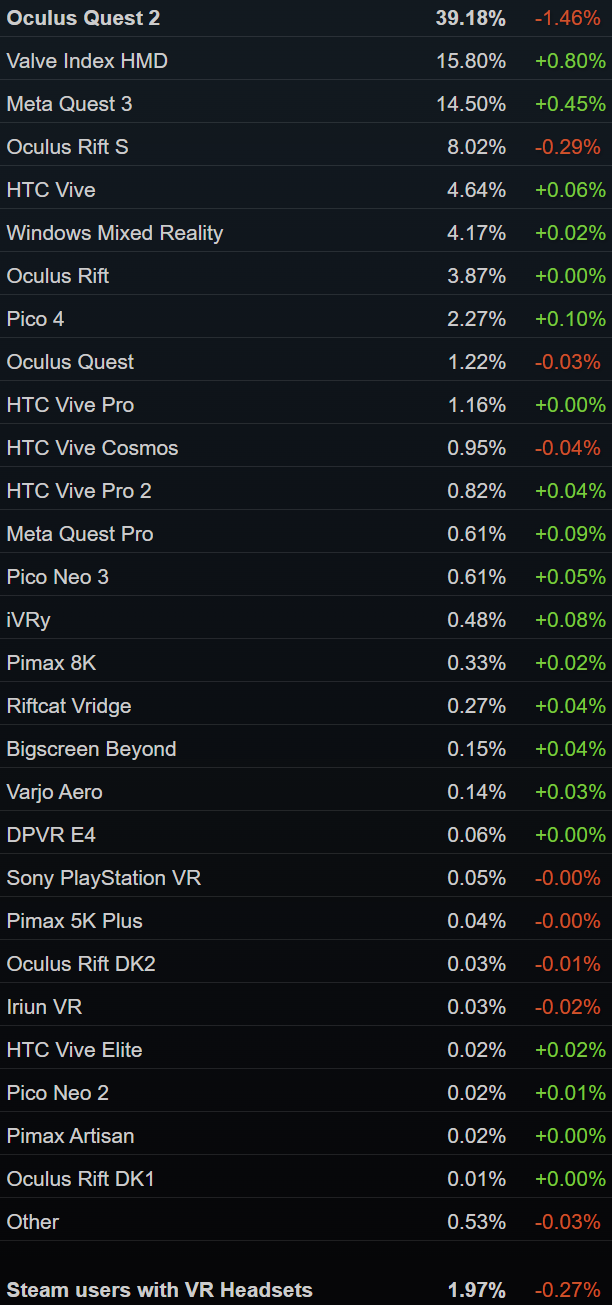
The Steam Hardware & Software Survey is offered to a random sample of Steam’s user base each month. If you accept, it uploads a list of your PC specs and peripherals to Valve, as well as any headset used on SteamVR in the past month.

The data for February shows no significant swings in the relative headset usage share. Meta Quest 3 had been rapidly surging since it launched in October, but this growth has now significantly slowed down, with the headset remaining at the #3 spot, just below the Valve Index. 14.5% of SteamVR users in February used Quest 3, while 15.8% used Valve Index.

Quest 2 still holds the top spot, as it has since shortly after it launched more than three years ago, with 39.18%, more usage than Quest 3 and Index combined.
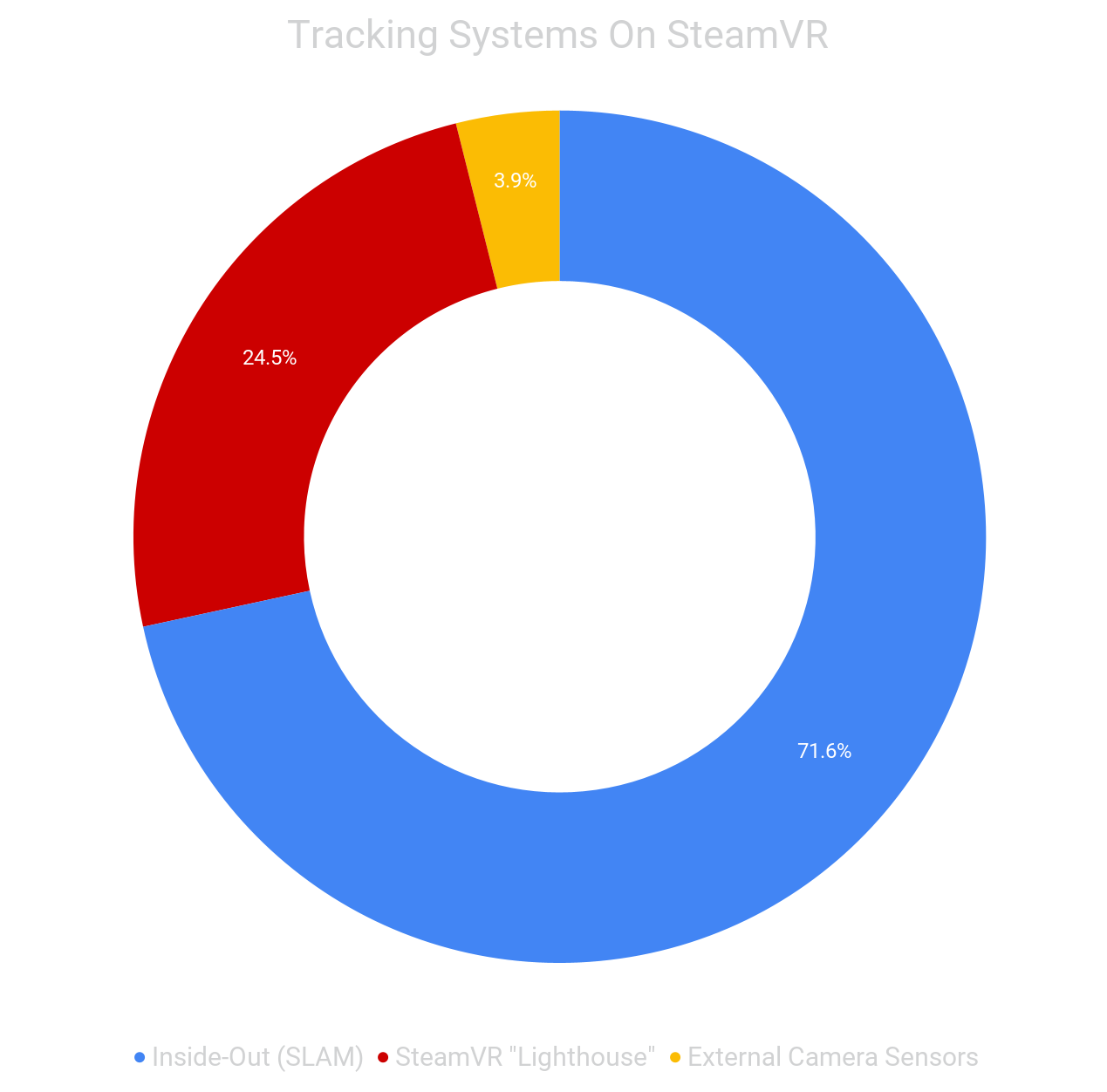
Bigscreen Beyond was used by just 0.15% and Varjo Aero by 0.14%. These headsets remain incredibly niche compared to more the popular headsets from Valve and Meta. Both headsets offer significantly higher resolution than Index, but cost significantly more and still require SteamVR Tracking base stations.

In January Varjo confirmed that Aero is no longer being produced after more than two years on the market, and new stock is now unavailable. Meanwhile, Bigscreen's CEO recently declared the company has reached positive cash flow with Beyond.
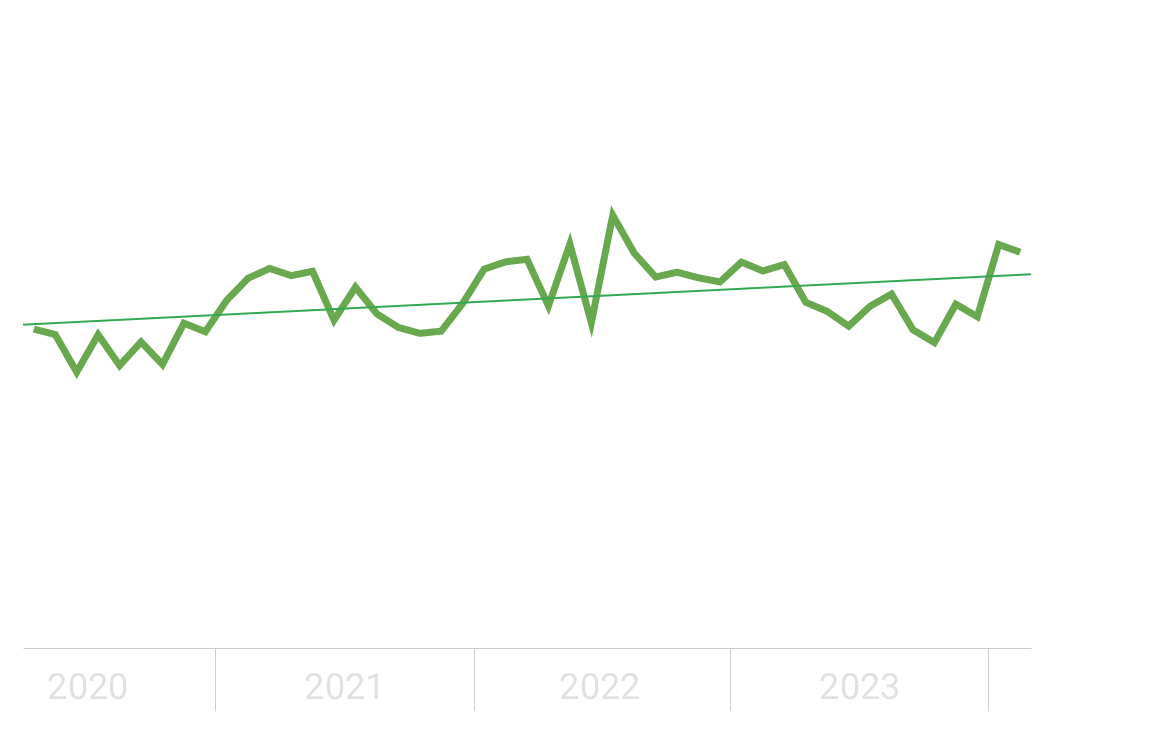
The percentage of Steam users using any VR headset at all decreased slightly, from 2.24% in January to 1.97% in February. Adjusting for China, where most VR headsets aren't sold and most VR games aren't available, the fall was much smaller. January saw the highest usage in almost two years, which likely reflected many users trying out praydog's UEVR mod, a free tool released at the start of January that injects VR support into almost any modern PC game made with Unreal Engine. Clearly this level of support isn't enough to keep everyone coming back though, and PC VR's long-term growth remains extremely slow.


from UploadVR https://ift.tt/qI92Rcr
via IFTTT

The Oniri Forest VR Showcases "Hyper-Realistic" Graphics Standalone On Quest

https://ift.tt/QwabWS3

The Oniri Forest aims to deliver a "hyper-realistic" VR environment that runs standalone on Quest.

Developed by Oneiros, Forest is a free tech demo designed to showcase Oniri, a platform that can convert a highly detailed 3D environment into a Unity scene that can run in real time on standalone VR, with "no limits of poly-count, materials and lights". The Forest Quest demo features an outdoor environment infused with cyberpunk elements.

Using a Quest 3, we went hands-on with Forest but there's not much you can really do. Exploration is limited to teleporting between a few pre-set positions indicated by markers. We were impressed by the environmental graphics quality as we moved past these trees and bushes, but distortions became apparent after moving from the designated areas, and the render resolution is relatively low which results in visible aliasing.

For such a short tech demo, it's worth noting that Forest requires 1.56GB of storage, so this 3D conversion method evidently requires considerable storage space.

You can download the Forest tech demo now on Quest App Lab for free. We'll be interested to see if this technology gets used in future VR projects and whether it can support interactive elements.


from UploadVR https://ift.tt/HfCmQ1U
via IFTTT

Oculus Accounts That Haven't Been Migrated To Meta Accounts Will Be Deleted On March 29

https://ift.tt/eJVxrBW

Anyone still using a legacy Oculus account will need to migrate it to a Meta account by the end of the month.

If they don’t, they'll lose all their purchased apps, games, and DLCs as well as friends, achievements, and other account data on March 29.

Facebook Account Required For New Oculus VR Headsets
From October 2020, Facebook will require anyone using an Oculus device for the first time to log in via a Facebook account. It will no longer be possible to sign-up with a separate Oculus ID. In addition, starting in 2023 the social media giant will end support for existing Oculus

Meta (then Facebook) first announced the end of Oculus accounts almost four years ago in July 2020, a month before launching Quest 2. Instead, new headsets would need to be set up with an active Facebook social media account and existing Oculus account users would have until 2023 to merge a Facebook account, the company said.

Quest 2 Will No Longer Require A Facebook Account From Next Month
Meta headsets will no longer require a Facebook account from next month. In August Meta will “begin rolling out” Meta accounts, which can be used to set up Meta headsets. You’ll still be able to link your Facebook account to your Meta account to message and call Facebook friends

Tying the use of a hardware device to the standing of a social media profile was a widely unpopular decision, and left some users with a paperweight. Responding to this, Meta dropped the Facebook account requirement two years later in August 2022 when the company introduced Meta accounts. Meta accounts are much like traditional Oculus accounts in that they just require an email and password, not a social media profile.

If you still have a legacy Oculus account and haven't yet migrated it to a Meta account, you can do so with a few clicks on this webpage.


from UploadVR https://ift.tt/ZEbro7F
via IFTTT

Meta CTO: Android XR Rejected Due to Google’s “restrictive” Terms & Plans to Fragment XR

https://ift.tt/VcJe3l0

A report from The Information last week alleged Meta and Google held talks in effort to bring Android XR to Quest. Meta CTO Andrew ‘Boz’ Bosworth has now confirmed this report, stating further that not only were Google’s terms too restrictive, but Google is actively planning to fragment the ecosystem with its Android-based XR operating system.

Here’s the full statement from Bosworth via a Threads post from last Friday:

After years of not focusing on VR or doing anything to support our work in the space, Google has been pitching AndroidXR to partners and suggesting, incredibly, that WE are the ones threatening to fragment the ecosystem when they are the ones who plan to do exactly that.

We would love to partner with them. They could bring their apps to Quest today! They could bring the Play store (with its current economics for 2d apps) and add value to all their developers immediately, which is exactly the kind of open app ecosystem we want to see. We would be thrilled to have them. It would be a win for their developers and all consumers and we’ll keep pushing for it.

Instead, they want us to agree to restrictive terms that require us to give up our freedom to innovate and build better experiences for people and developers—we’ve seen this play out before and we think we can do better this time around.

Shortly afterwards, Bosworth re-posted on X (formerly Twitter) a comment made by UploadVR’s David Heaney which seems to sum up Meta’s thought process:

“Meta and Google both launched standalone VR platforms in 2018. Google abandoned Daydream after less than 2 years, while Meta grew Oculus (now Quest) to tens of millions scale,” explains Heaney. “Now years later, after the market is already proven, Google wants Meta to kowtow to its attempt #2?”

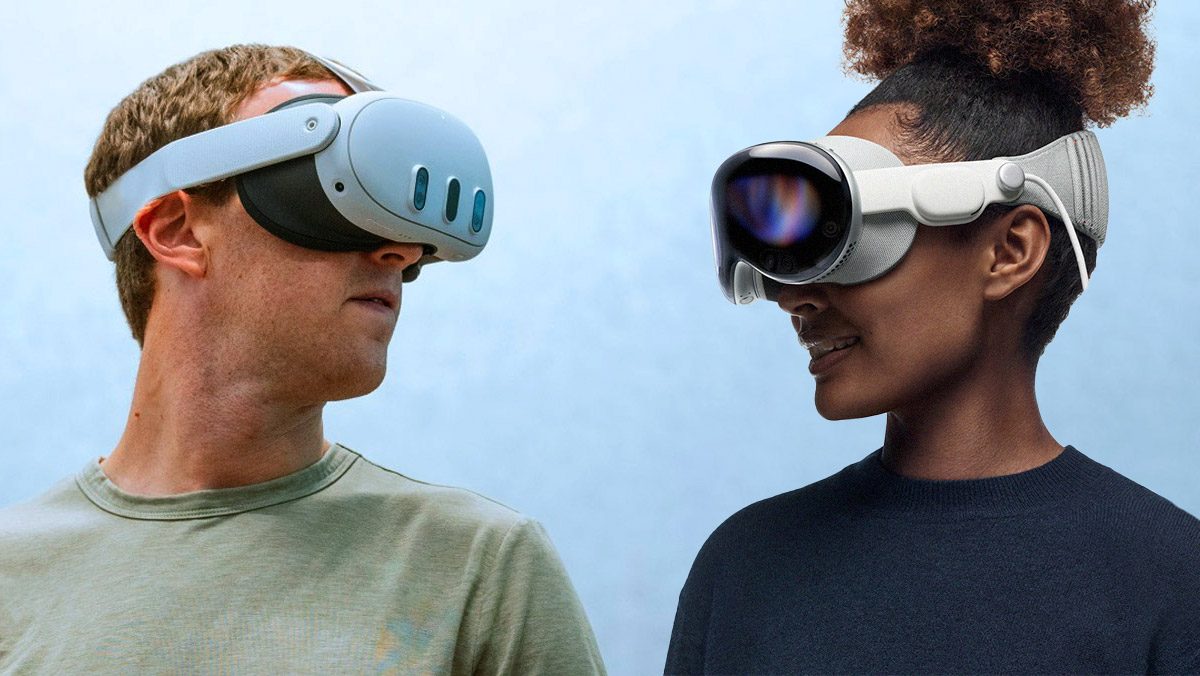
Quest 3 (left) and Apple Vision Pro (right) | Based on images courtesy Meta, Apple

Still, having Android XR on Quest would instantly make Meta’s hardware more competitive with Apple Vision Pro, which boasts 1.5 million apps built for iPhone in addition to 1,000+ visionOS native apps. The price of admission may simply be too high though.

While Bosworth says bringing Google Play with “its current economics for 2d apps” isn’t a sticking point, Meta’s rejection may very likely involve how software revenue would be split in the long-term. Bringing Google Play to Quest in its entirety isn’t such an issue sow since there are only just a few older VR apps built for Cardboard, although that’s probably about to change as companies like Samsung release their own Vision Pro competitors using Android XR as their chosen operating system.

On Quest, this may eventually allow Play store apps to out-compete some of the content created specifically for the standalone XR headset, which would give Google a slice of the pie that (at least in Meta’s eyes) it didn’t rightfully earn. And controlling that revenue stream is likely be one of Meta’s most important XR ambitions moving forward, provided it wants to continue subsidizing Quest hardware and recouping on software sales like it does today.

Meta’s only real hope is to make the Quest platform so big and attractive to developers in the future that it becomes a target platform alongside Android and iOS—not just to XR developers making games and immersive apps, but to every app from your humble calculator, to everyday things like banking apps, productivity software, video chatting apps—all of the things it needs to break out of console territory to become a general computing platform.

The post Meta CTO: Android XR Rejected Due to Google’s “restrictive” Terms & Plans to Fragment XR appeared first on Road to VR.


from Road to VR https://ift.tt/KT3kbua
via IFTTT

Sunday, 3 March 2024

Between Realities VR Podcast ft Bryan Paul of PSVR2 Without Parole

https://ift.tt/84HCYTu

In this week's episode of the Between Realities VR Podcast, Alex and Skeeva host Bryan Paul from PSVR2 Without Parole.

Bryan weighs in on the current state of Sony's headset. Other topics include the fundamentals of VR game design and the quality of the VR community.

— Between Realities Links —
Merch Store: https://teespring.com/stores/between-…
Patreon – https://www.patreon.com/BetweenRealities
YouTube – https://www.youtube.com/BetweenRealities
Twitter – https://twitter.com/BtweenRealities
Discord – https://discord.gg/EvNnj2w
Facebook – https://fb.me/BetweenRealities
Alex VR – https://www.youtube.com/Alex_VR
Alex VR’s Twitter – https://www.twitter.com/Alex__VR
Skeeva – https://www.youtube.com/Skeeva007
Skeeva’s Twitter – https://www.twitter.com/Skeeva


from UploadVR https://ift.tt/JIA6B8y
via IFTTT

Friday, 1 March 2024

One of VR’s Most Sucessful Studios is Building Two Brand New Games

https://ift.tt/gDKIGtL

Cloudhead Games is one of VR’s most senior and most successful studios. Having not launched a new game since Pistol Whip in 2019, the studio tells Road to VR that two brand new VR games are in development.

Cloudhead Games might be old-school as far as VR studios go, but it has always been forward-looking.

Back in the Oculus Rift DK1 and DK2 days (circa 2014), the studio was already thinking about how to design games for VR motion controllers, despite no headsets on the market shipping with motion controllers until 2016. The studio was also instrumental in establishing several VR locomotion mechanics which have evolved into industry standards.

After the launch of The Gallery – Episode 1: Call of the Starseed (2016) and Episode 2: Heart of the Emberstone (2017), Cloudhead was looking ahead to standalone VR headsets. Designing around the opportunities and limitations of the first Quest headset meant finding a careful balance of scope and fun, culminating in the launch of the VR rhythm-shooter Pistol Whip in 2019.

Though not quite the bar-setting success of Beat Saber (2018), Cloudhead’s Pistol Whip has endured as one of VR’s best rated and most popular games.

The title’s success allowed the studio to continuously update and improve the game with more maps, music, and modes. Compared to its original release, Pistol Whip today ships with significantly more content, all of which has been added completely free for existing owners.

Despite its success, the studio has been largely silent about its post-Pistol Whip plans. But at long last we’ve learned that Cloudhead is now building two brand new VR games.

“Part of our growth strategy [after Pistol Whip] was to split our team into two distinct lanes. This opened up the door to Cloudhead Labs, an incubator for internal pitches, prototypes, and the evaluation of new hardware. From there we set up additional internal support structures allowing Cloudhead to responsibly transition from Pistol Whip to two completely new games,” a spokesperson tells Road to VR. “We’re excited to announce that the last few years of prototyping in Labs has led the way to two new titles for our studio. The teams are now several months into production and will be sharing more details in the near future!”

So it sounds like we can expect a proper announcement in the “near future,” but what else do we know at this point? Well, for one, neither project is a Pistol Whip sequel. And considering the studio is “several months into production,” it’s unlikely that either title will be released before late 2024 at the earliest, with a real possibility of pushing well into 2025.

As a studio, Cloudhead has historically been very multi-platform—Pistol Whip is available on every major VR platform (and even some less popular ones). While that’s likely the case with these upcoming projects, the studio’s pedigree would put them on the short list for an exclusive publisher deal, but those have been very rare from major platforms in recent years.

Whatever the case, we’re looking forward to seeing what Cloudhead builds after everything it has learned about the success of Pistol Whip, and where the studio will place its next bets.

The post One of VR’s Most Sucessful Studios is Building Two Brand New Games appeared first on Road to VR.


from Road to VR https://ift.tt/hAlSBfg
via IFTTT

Beat Saber Is Getting A Daft Punk Music Pack Next Week

https://ift.tt/H62Kapj

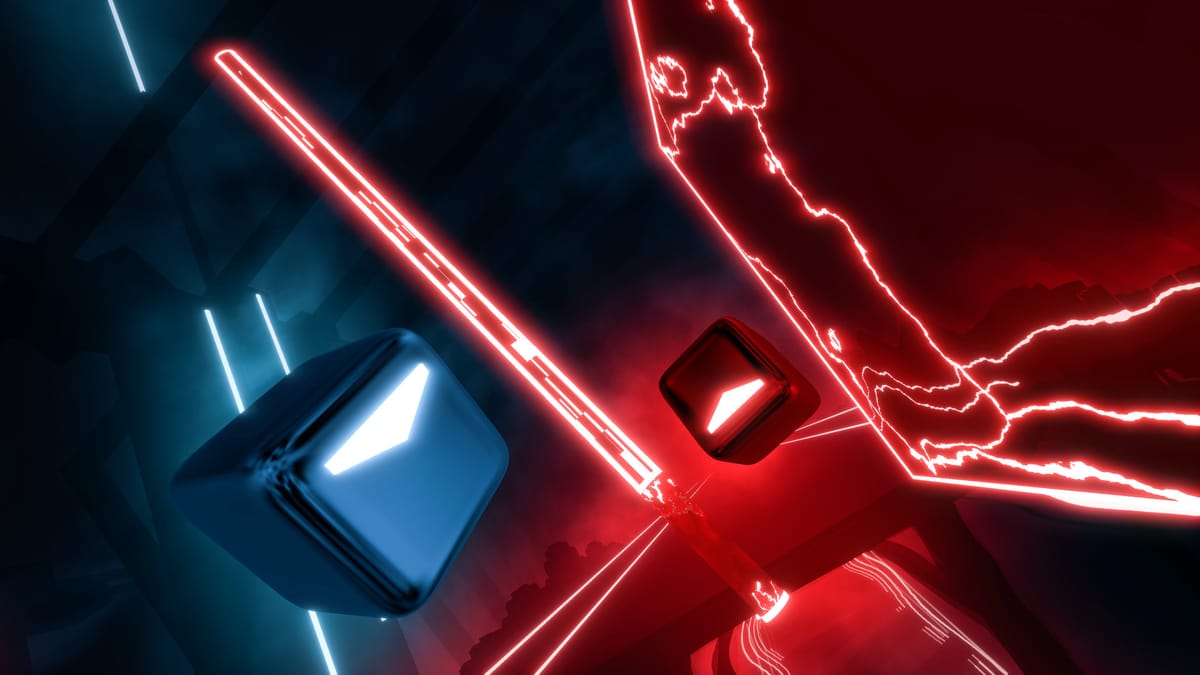
A Daft Punk music pack is coming to Beat Saber next week on all platforms.

Presently, there's little else we can glean from this Beat Saber teaser beyond the fact that it's happening. While "Harder, Better, Faster, Stronger" can be heard in the trailer, no further details were announced about what else is coming in the Daft Punk music pack. "Stay tuned for the full track reveal at launch on March 7," confirms Meta.

Beat Saber's latest DLC announcement follows on from December's free OST 6 update. Adding five free songs from Lindsey Stirling, Dragonforce, Camellia and more, that update also introduced an experimental performance toggle that lets you pick 90Hz or 120Hz refresh rate on Quest 3.

This isn't the only Beat Saber news we've seen today, either. Yesterday, Beat Games' two remaining co-founders, creative director Ján Ilavský and CEO Vladimír Hrinčár, both stepped down from the studio. While Ilavský confirmed he'd "like to return to my roots: working on innovative games," Hrinčár didn't specify his reasons, and it's currently unknown who will succeed them.

The Daft Punk Music Pack DLC reaches Beat Saber on March 7 on Quest, PC VR and PlayStation VR2.

Beat Saber Review 2022: Seminal VR Title Remains As Relevant As Ever
With regular updates, DLC releases and changes to the game since launch, Beat Saber remains VR’s poster child. Read on for our updated Beat Saber review for Quest 2, PSVR and PC VR. Years of Dominance It’s hard to understate Beat Saber’s influence on the VR industry.


from UploadVR https://ift.tt/Hcgdy8m
via IFTTT
Related Posts Plugin for WordPress, Blogger...