Wednesday, 19 April 2023

Report: Apple Racing to Build Software & Services for Upcoming Mixed Reality Headset

https://ift.tt/5TfYDmx

Apple appears to be getting ready to unveil its first mixed reality headset at its Worldwide Developers Conference (WWDC) in June. Now a report from Bloomberg maintains the Cupertino tech giant is also prepping a dizzying number of first-party apps, including gaming, fitness, video and collaboration tools.

Bloomberg’s Mark Gurman is a lightning rod for all things Apple, and in his new info dump it appears we now have a pretty sizable list of first-party content coming to the still very much under-wraps mixed reality headset.

Here’s all of the major apps and features mentioned in the report:

  • iPad apps adapted for mixed reality: Calendars, Contacts, Files, Home control, Mail, Maps, Messaging, Notes, Photos, Reminders, Music, News, Stocks, and Weather apps.
  • FaceTime: conferencing service will generate 3D versions of users in virtual meeting rooms.
  • Freeform collaboration app: will let users work on virtual whiteboards together while in mixed reality.
  • Work apps: Pages word processing, Numbers spreadsheet and Keynote slide deck apps, as well as iMovie and GarageBand for video and music production.
  • Apple TV: both immersive sports content and traditional video content – the latter presented in virtual environments, such as a desert or the sky.
  • Apple Books: will allow users to read in virtual reality.
  • Fitness+: will let users exercise while watching an instructor in VR.
  • Multitasking & Siri: will be able to run multiple apps at the same time, floating within the mixed reality space. Siri voice control is also present.
  • Camera app: can take pictures from the headset.

Provided all of the above is accurate, Apple may be releasing the industry’s most feature-rich headset out of the gate, as it appears to be hauling in a ton of its mature and battle-tested ecosystem of apps.

It’s also said that gaming will be a major focus—a reversal from previous reports. This could mean we’ll see a wider push for Apple to court third-party developers soon after release, which is said to release a few months after is June unveiling, priced at somewhere around $3,000.

As for hardware, as many suggested in the past, Gurman reconfirms the existence of a dial crown similar to the one seen on Apple Watch, which will let the wearer seamlessly switch between virtual and augmented reality views.

Here’s a compilation list of alleged Apple MR headset features scavenged from previous reports—all of which you should take with a heaping handful of salt. We’ve broken them down into specs and design rumors:

Rumored Apple MR Specs

  • Resolution: Dual Micro OLED displays at 4K resolution (per eye)
  • FOV: 120-degrees, similar to Valve Index
  • Chipset: Two 5nm chips. Includes a main SoC (CPU, GPU, and memory) and a dedicated image signal processor (ISP). Chips communicate via a custom streaming codec to combat latency.
  • Battery: Waist-mounted battery, connected via MagSafe-like power cable to the headset’s headband. Two-hour max battery life, although hotswappable for longer sessions.
  • Passthrough: ISP chip contains custom high-bandwidth memory made by SK Hynix, providing low latency color passthrough
  • Audio: H2 chip, providing ultra-low latency connection with the second-generation AirPods Pro and future AirPods models. No 3.5mm and possible no support for non-AirPod BT headphones.
  • Controller: Apple is said to favor hand-tracking and voice recognition to control the headset, but it has tested a “wand” and a “finger thimble” as alternative control input methods.
  • Prescription Lenses: Magnetically attachable custom prescription lenses for glasses-wearers.
  • IPD Adjustment: Automatic, motorized adjustment to match the wearer’s interpupillary distance.
  • Eye Tracking: At least one camera per-eye for things like avatar presence and foveated rendering
  • Face & Body Tracking: More than a dozen cameras and sensors capture both facial expressions and body movements, including the user’s legs.
  • Room Tracking: Both short- and long-range LiDAR scanners to map surfaces and distances in three dimensions.
  • App Compatibility: Said to have the ability to run existing iOS apps in 2D.
  • Price: $3,000 – $4,000

Design Rumors

  • Outer Shell: Aluminum, glass, and carbon fiber to reduce its size and weight. Cameras are largely concealed for aesthetic reasons.
  • Presence Displays: Outward-facing display can show user’s facial expressions and also presumably eye movements. Said to be an always-on display similar in latency and power draw of Apple Watch or iPhone 14 Pro.
  • Dedicated Passthrough Switch: Digital Crown-like dial on its right side to switch between VR and AR.
  • Headstrap: Various available, including consumer-focused headstrap similar in material to Apple Watch sport bands with built-in speakers. Unspecified, but different headstrap targeted at developers.

– – — – –

As you’d imagine, Apple has confirmed absolutely nothing, so we’ll be tuning in for the June 5th keynote to see whether we’ll finally get a big “one more thing” moment we’ve been waiting for.


from Road to VR https://ift.tt/8Zn1xz0
via IFTTT

Meta to Open ‘Horizon Worlds’ Social VR Platform to Kids Ages 13+

https://ift.tt/kaWbQHe

Horizon Worlds, Meta’s social VR platform for Quest, is only open to 18+ users for now, however the company says it’s expanding to include teens aged 13 to 17 in the US and Canada.

Meta says the new policy will go into effect in “the coming weeks,” effectively opening the company’s first-party social platform to its entire user base in those countries; Meta only allows users 13+ to actually use Quest devices.

To prepare for the wave of younger users, the company is also releasing some age-appropriate protections and safety defaults.

Safety features will include the ability for teens to control who they follow and who can follow them back. Profiles are also set to private by default, which obscures active status and location. Worlds and events will have content ratings, so younger teens can’t get in.

A new voice mode feature is also rolling out to everyone, which garbles voices of both unknown people and teen’s voices by default. Raising your hand to your ear temporarily lets you hear other users when voice mode is switched on, Meta says.

“We’re rolling out to teens slowly, so that we can carefully examine usage and are taking a phased approach before expanding more broadly,” the company says in a blogpost. “We can’t wait to see everything these new members of the community bring to Worlds.”

Parents and guardians can use the parental supervision tools to manage their teen’s experience and “support healthy conversations about safety in VR,” Meta says. To learn more, check out the new Family Center.

The company also released a safety tutorial to see the new features in action:

While Meta only just released official word of those changes to Horizon Worlds, the news was actually first reported by The Wall Street Journal in February, which was based on an internal memo that alleged the social VR platform was under performing and needed to increase user retention to keep up with the competition. According to the memo seen by WSJ, Horizon Worlds’ weekly retention rate was 11% in January 2023, which the company aimed to increase to 20%.

A goal outlined in the memo maintained Worlds needed to reach 500,000 monthly active users (MAU) in the first half of 2023, ultimately reaching the one million mark by year’s end. At the time, it was reported the platform was hovering around 200,000 MAUs, or just below the December peak.

There’s no telling when the flatscreen version of Horizon Worlds is due to arrive, however Meta maintained it would be opening the Quest-only social platform to Web and mobile devices “soon.”


from Road to VR https://ift.tt/eo7WmZU
via IFTTT

Tuesday, 18 April 2023

Valve Interview Confirms Its VR Ambitions Are Alive and Kicking

https://ift.tt/ubHVhEy

If you’ve been plugged into the Valve leak-o-verse, you’ve probably come across the name ‘Deckard’, the supposed code name of a standalone headset allegedly under development by the one and only. While Valve isn’t confirming anything about the storied standalone, the company went on record late last year to say they are still have faith in VR, and are critically still working on VR headsets.

Valve product designer Greg Coomer spoke to Korean gaming publication This is Game (Korean) in December, saying that VR is very much still in the works. The interview wasn’t widely shared in the English-speaking side of the Internet until it landed on Reddit, Google-translated to English.

Here’s Coomer’s response to a question about what he can reveal in regard to VR, translated from Korean to English:

There isn’t much (laughter). Nevertheless, I can definitely say that we are continuing to develop VR headsets recently. Valve has a lot of expertise in VR devices and has faith in the medium and VR games.

We hope to remain open on PC platforms rather than having VR games exclusively on a certain platform. While adhering to this belief, we are continuing development.

However, we cannot confirm the existence of specific products or disclose the release date of the results. The same applies to game projects being developed internally. There are certainly many projects underway, but we cannot announce anything today.

As you might gather, Valve doesn’t openly speak about its in-development projects. Hearing that VR is still on the table from Coomer directly though, who has been with Valve since the release of Half-Life (1998), and worked on major games all the way up to Half-Life: Alyx (2020), is just about as good as you can get.

That’s especially so since the last time Valve released any VR hardware was its enthusiast-grade PC VR headset Valve Index in 2019. A year later, the studio launched its only full-length VR game to date, Half-Life: Alyx.

Still, it hasn’t been entirely all quiet on the Valve VR front. In March 2022, Valve chief Gabe Newell called its handheld gaming PC platform Steam Deck “a steppingstone” to standalone VR hardware.

“One of the things [Steam Deck] represents is battery-capable, high-performance horsepower that eventually you could use in VR applications as well. You can take the PC and build something that is much more transportable. We’re not really there yet, but this is a stepping stone.”

At the time, Coomer also noted Steam Deck’s hardware “would run well in that [standalone VR] environment, with the TDP necessary… it’s very relevant to us and our future plans.”

Meanwhile, tech analyst and YouTuber Brad Lynch has been probably the most vocal proponent of all things Steam standalone, having followed the Deckard beat since data miners first found a string in a January 2021 Steam update that mentioned the alleged VR standalone.

Over the following years, Lynch has uncovered mounting evidence in subsequent releases of SteamVR, including his most recent supposition that Deckard may include PC VR wireless streaming capabilities, eye-tracking, and passthrough AR features.

As you’d imagine, there have been no public confirmations from Valve, so we’ll just have to wait and see.


from Road to VR https://ift.tt/hAIVgNX
via IFTTT

Monster Hunter Now Is Niantic’s Next AR Game

https://ift.tt/e0syaEI

Monster Hunter Now Is Niantic’s Next AR Game

A closed beta starts soon for Niantic and Capcom's Monster Hunter Now, a new AR action-RPG releasing this September.

Announced through an official blog post, Monster Hunter Now is the first AR entry for Capcom's popular series. Developed on Niantic's Lightship platform, Monster Hunter Now unsurprisingly uses a similar premise to Pokémon Go, where you encounter Monster Hunter creatures, battle them with different weapons and obtain resources to improve your hunting gear. You can see this in action below:

“Monster Hunter Now is a new and unprecedented Monster Hunter game that entices players to go out with their Palico and encounter incredible monsters in the real world,” claims series producer Ryozo Tsujimoto. Speaking in a GamesIndustry.biz interview, Tsujimoto revealed development began in March 2019, stating: "I can still remember when Niantic told me about this project, I immediately said 'Let's do it' without giving it a second thought."

Niantic is keeping itself busy in recent months with new free-to-play releases. Alongside Pokémon Go, Pikmin Bloom and Ingress Prime, NBA All-World joined its increasing line-up back in January, marking the first official NBA AR game. It’s also developing Marvel World Of Heroes, which arrives later this year and recently went into open beta in New Zealand.

Monster Hunter Now arrives in September 2023 for Android and iOS devices, available through the App Store and Google Play. While there's no guarantee you will receive access, registration for the closed beta test is now open on the official website, which begins on April 25.


from UploadVR https://ift.tt/rxCJ0Xi
via IFTTT

Monday, 17 April 2023

‘Firmament’ Trailer Spotlights Core Puzzle Mechanic Ahead of May PC VR Launch

https://ift.tt/QxYMVXz

Last month we got an eyeful of Cyan’s upcoming VR puzzle adventure Firmament in an extended preview trailer that showed off some of the game’s impressively looming set pieces. Now, prepping for the game’s May 18th release on PC VR, the studio released its first look at some of the game’s puzzle mechanics.

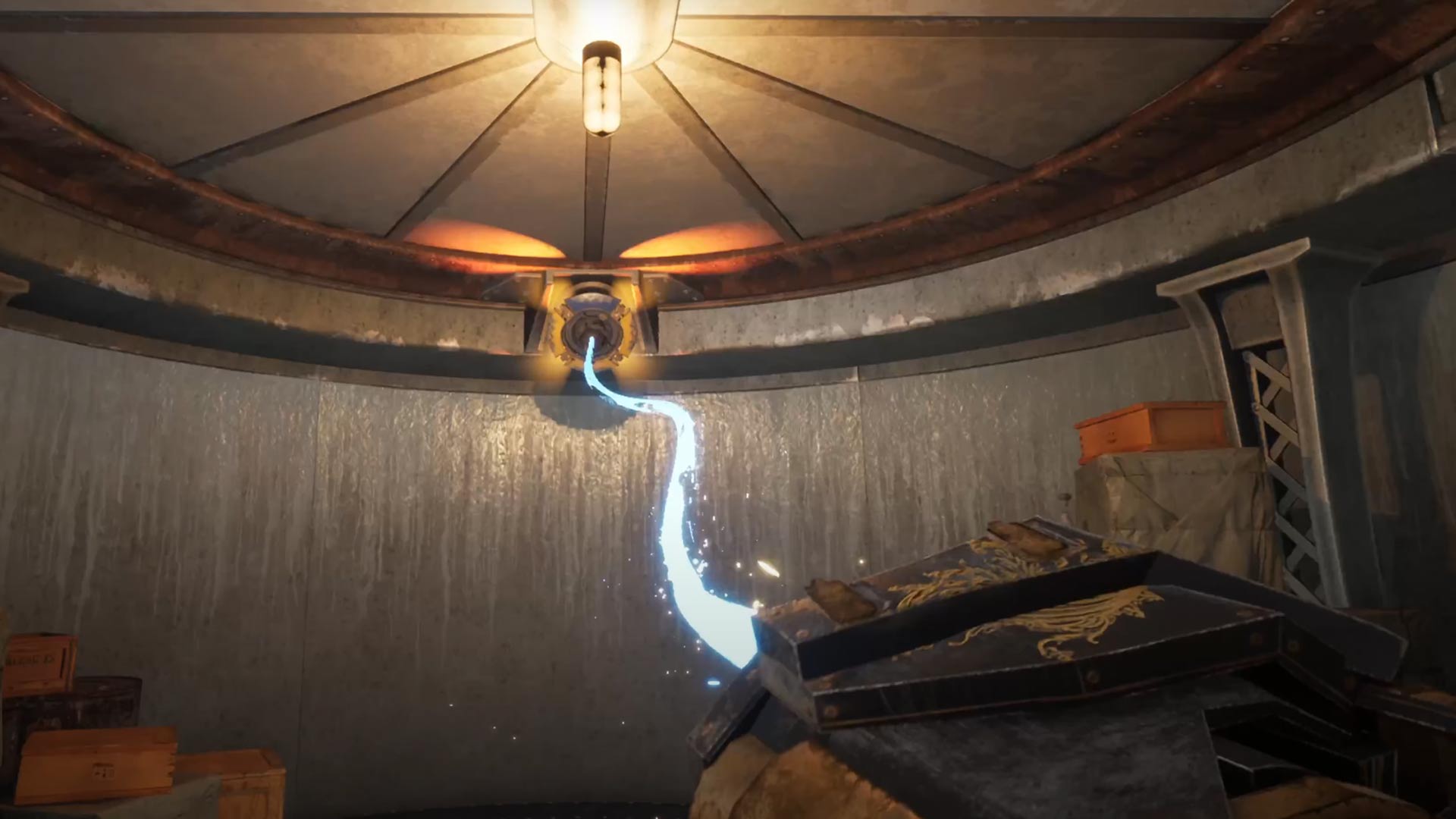
There are a few new things shown in the video that we haven’t seen before, notably what appears to be the final version of the most important tool to your puzzle-adventuring.

Called an ‘Adjunct’, the tool lets you interface with the various devices strewn about the Realm of Firmament, which Cyan says will help you on your quest to unlocking the secrets this place holds.

Image captured via video courtesy Cyan

We previously saw the Adjunct very briefly in Firmament’s initial Kickstarter video, although it wasn’t clear at the time what it was, or whether or not it would be a one-off object. Whatever the case, it’s clear now that the adjunct is a mainstay that ostensibly works like and extension of the player’s arm.

Also, it appears the ability to shoot the bit from the holder has let Cyan develop a wider range of far-flung puzzles, as you can manipulate locks and various receptacles you wouldn’t be able to physically reach otherwise.

Firmament is launching for PC VR headsets and traditional monitors via Steam on May 18th. In the new Steam page, the studio reveals a few more tidbits of info about the narrative and structure of the game:

You are not entirely alone in Firmament. In addition to The Adjunct, you are joined by a mysterious apparition, who has a story of her own to share with you. As you explore you will be introduced to 3 Realms – each with secrets and mysteries to reveal. What purpose do the Realms serve? Can the spirit who accompanies you be trusted?

Are the realms of Firmament abandoned? What are these giant, mysterious machines scattered throughout the world? What is their purpose? What part do you play in this grand mystery? Explore, Discover, Solve, and Reveal the mystery for yourself by playing Firmament!

In the game’s Kickstarter November update, Cyan said Firmament is also set to come to PSVR 2, PS4 and PS5 at some point “down the line.” There’s no word on whether Quest 2 will ever get a native version of the game, i.e. one that can be played without a PC and Link or Air Link.


from Road to VR https://ift.tt/zBc29eL
via IFTTT

Firmament Reaches PC VR This May, PSVR 2 Version Arriving Later

https://ift.tt/iDmwC10

Firmament Reaches PC VR This May, PSVR 2 Version Arriving Later

Five years after its original announcement, Myst developers Cyan Worlds announced that Firmament will reach PC VR on May 18.

Revealed back in 2018 with a Kickstarter campaign arriving soon after, Firmament is the latest adventure game from Cyan, whose previous efforts include 2020's Myst VR remake and Obduction. Set in an abandoned steampunk world, Firmament is a new puzzle adventure that sees you exploring three realms, joined by a clockwork companion and mysterious apparition. Originally targeting a July 2020 release, Cyan eventually delayed this VR-compatible adventure to expand its scope. You can watch the new announcement trailer below:

Releasing for both flatscreen PC and PC VR, Cyan confirms the VR experience includes "Free Roam and Teleport modes." Additional comfort options like smooth or snap turning are also promised, alongside quick travel up stairs & ladders. You can read the story description below:

"You wake in a glacial cavern crowded with metal pipes and adorned with curious clockwork gears. In the middle of a dark chamber you discover is an ancient table – a tea cup on one end and a frozen body slumped over the other. The corpse’s hands hold an exquisite clockwork device, held out like an offering. You reach for it and it comes to life; it hovers above you, watching, before a mysterious apparition appears with a message. You find yourself with an immense and unexpected adventure lying ahead..."

Firmament releases on May 18, 2023 for PC VR, with a PSVR 2 version following at an unknown date. While a PSVR port was canceled last year, flatscreen versions remain planned for PS4 and PS5.


from UploadVR https://ift.tt/DlgpJ06
via IFTTT

Sunday, 16 April 2023

Report: Quest Had 6.37M Monthly Active Players Late Last Year

https://ift.tt/5o9GAcz

Report: Quest Had 6.37M Monthly Active Players Late Last Year

Quest reportedly recorded 6.37 million active monthly users around last October, according a report from The Wall Street Journal.

The new WSJ report cites internal documents from Meta dated around October 2022, confirming that Beat Saber generated $255 million in lifetime sales by October 2022. In that same month, The Wall Street Journal also reports Meta Quest platform saw 6.37 million active monthly users.

Last month, The Verge’s Alex Heath detailed Meta’s internal roadmap presentation from Meta’s VP of VR, Mark Rabkin. That confirmed the company sold nearly 20 million Quest headsets, almost matching Xbox Series X|S sales estimates from December 2022. If both reports are accurate, we could be starting to get a picture of just how many Quest headsets end up in disuse.

Meta dropped the price of its Quest Pro headset down to $1000 recently, after signaling its "next generation consumer Quest" was targeted for release this year. Recent comments from Meta's leadership suggested Quest 2 might still have some time left on store shelves as well.

The VR market will be quite different by the end of 2023. PSVR 2 is progressing past its soft launch and indications suggest Apple could be preparing to announce a headset after so many years of rumors. With changes in store, it will be worth keeping these figures in mind as buyers adopt a new generation of VR hardware.


from UploadVR https://ift.tt/rC3XoLW
via IFTTT
Related Posts Plugin for WordPress, Blogger...