Friday, 13 January 2023

Colossal Cave Interview – How Ken And Roberta Williams Reimagined A ’70s Text Adventure For VR

https://ift.tt/gsJly2G

Colossal Cave, a VR remake of the classic text-based Colossal Cave Adventure, arrives next week on Meta Quest 2. Developed by Sierra On-Line co-founders Ken and Roberta Williams through Cygnus Entertainment, we interviewed these adventure game icons to learn more.

I’m reminded of something Rand Miller once told me. “2014 is like 100 years ago in tech years,” he explained with a smile, after I asked why Cyan remade Myst for VR instead of adapting previous editions. With Ken and Roberta Williams out of game development for two decades until now, I was curious to know how modern development differs from back then.

“It feels the same, like riding a bike. The tools are better but ultimately, the goal is to entertain people. It almost feels like we were never gone,” Ken Williams said.

With Sierra’s sale in the late ’90s, the terms meant Ken and Roberta were tied to a non-compete in gaming for five years, so they explored the world on their own boat. This continued until the COVID-19 pandemic hit, and Ken Williams began looking into programming once more.

“I suggested he wanted to do a game and I suggested Colossal Cave, thinking back to our origins. We started Sierra because I played Colossal Cave,” Roberta Williams explains. “We’d been fish out of water all those years and suddenly, we’re right back into it. It felt right, like the years in between melted away.”

Reimagining a text-based adventure for modern formats isn’t particularly straightforward — how exactly do you adapt an old text game for modern VR?

“I had to figure out how to make it feel like this belongs in today’s world, so I’m really glad I didn’t have to design a game on top of that,” Roberta Williams tells me.

She says it’s not a complex game and it doesn’t require many different buttons, so the end goal is simplicity:

My goal was just to let you get into the game and start exploring this cave without figuring out all kinds of buttons. I wanted it to be easy to get into, it’s not like a hand-eye coordinated thing. You don’t really need quick reactions to play it. It’s just you, the cave, and the designers. You’re trying to figure out what they’re trying to do, and how you’re gonna get around it. Because it’s first person, your character is you, and that makes it more intimate.

So with Colossal Cave appearing on most major platforms, how exactly does it differ on Quest 2 compared to the flatscreen editions?

“The obvious one is that its way more immersive. If you’re playing on PC and you look over a ledge, you don’t get the same feeling of worrying you’re going to fall. The first time I fell off a cliff, when I was walking on a passage, I kind of screamed, I freaked out, and you don’t get that feeling on PC,” Ken Williams tells me, before giving me a sense of the atmosphere.

When I’m playing VR and I go back to a flat screen, I’m really disappointed. Because it’s just not the same feeling. It doesn’t feel like you’re there. The game lends itself to VR perfectly because of being in a cave and the claustrophobic field. Because it’s just tight. If you’re doing real spelunking and you get into a tight place, there’s a feeling of trying to squeeze through cracks. All of that is there in this game.”

Colossal Cave VR

Quest 2 brought the team a new challenge.

“There was many times I didn’t think we’d get there on Quest because there’s a minimum frame rate of 72Hz. On a game this big and complex, that’s a feat,” Ken Williams said, adding that Colossal Cave wasn’t originally planned for VR. They effectively restarted the project upon shifting to support VR.

“We actually restarted the art because getting the framerate we needed with the complexity of graphics we wanted — it’s tough because you’re trying to deliver an image 72 times a second to two monitors on a $500 device, which is not as powerful as today’s modern PCs,” he said.

Ken Williams says he wasn’t a big fan of VR initially, too. “I liked the idea of a first-person game and limited characters; I thought it was a much easier design than it turned out to be. So, when the idea of VR first popped up, I said ‘no way in heck.’ I wanted to do something easier, VR is tough.”

He didn’t think Quest 2 was a good fit for the game but his artist, Marcus Mera, eventually convinced him otherwise.

“I didn’t think it was going to be that bad,” Ken Williams said. “I really didn’t realize how different VR was. But then we hit issues like the user interface for VR and how to do it.”

To tackle this, Cygnus worked closely with Meta, and Roberta Williams explains there were clashing views regarding the control scheme.

It was me holding to my guns, not being able to be convinced. Not that they were wrong, or I was right. [Meta] wanted the real physicality. You’ve got your hands out there, you can grab and manipulate this stuff. I knew that that would be more difficult to pull off. I think they wanted the really physical stuff and it’s not a physical game. This is a more cerebral, exploratory game.”

colossal cave 3D

Despite these directional differences, Roberta Williams concedes that she took the physicality issue to heart, explaining how this adds to Colossal Cave’s immersion. “When you’re going through the game, falling down a cliff, you feel it. There’s places where the only way forward is to slide down, like a child on a playground. You can swipe down and take advantage of things. You feel it in the pit of your stomach when you do that, or you’re walking along a cliff edge.”

Colossal Cave arrives on January 19 for Meta Quest 2, and you can check out our Colossal Cave impressions from PAX West 2022. So far, they seem encouraged by the game’s wider response.

“When I asked the QA team at Meta how they were liking it, they said it was very different from anything they’d seen before,” Ken Williams tells me. “I thought that was the ultimate compliment.”

With all that’s gone into Colossal Cave, I asked Roberta Williams an obvious question; Will they do another game after this? “We want to see how this game does. If it flops, okay, go back on the boat. If it’s a huge hit, well, who knows?”


from UploadVR https://ift.tt/rlB1CgF
via IFTTT

US Congress Halts Orders of Microsoft AR Combat Goggles Amid Reports of Headaches & Eyestrain

https://ift.tt/WdF4R7p

In 2021, Microsoft won a United States Army defense contract worth up to $22 billion which would support the development of an Integrated Visual Augmentation System (IVAS), a tactical AR headset for soldiers based on HoloLens 2. Now Congress has rejected the Army’s request for $400 million to buy as many as 6,900 more of the AR combat goggles this year, a Bloomberg report maintains.

The rejection cites rocky tests conducted last year. Testing was done over a three-week period ending June 18th, where the Army assessed Microsoft’s IVAS with a cadre of 70 Army infantry soldiers, who were tasked with using the device during three 72-hour combat scenarios.

Complaints included “mission-affecting physical impairments,” with more than 80 percent of soldiers experiencing headaches, eyestrain and nausea after less than three hours using the goggles.

None of this comes as a giant surprise though, as Microsoft was reportedly bracing for negative field tests back in early 2022 due to alleged quality problems.

Softening the blow somewhat, lawmakers have earmarked $40 million to develop a new IVAS model, Army spokesman David Patterson said in an email obtained by Bloomberg.

This comes only a few weeks after the Army awarded a $125 million “task order” for the development of a new model, dubbed version 1.2, which is said to include software improvements for better reliability and reduced power demand.

The 1.2 version task order is said to provide “improvements based on completed test events” which aim at a developing a “lower profile Heads-Up Display with distributed counterweight for improved user interface and comfort.”

In the meantime, the Army will be using its first batch of 5,000 goggles for training—only a small fraction of the max 121,000 devices, spares and support services stipulated in the $22 billion deal.


from Road to VR https://ift.tt/M9PuOXc
via IFTTT

Thursday, 12 January 2023

HTC Vive XR Elite Launch Window Games And Apps Confirmed

https://ift.tt/in8ZcaU

Following its Vive XR Elite reveal, HTC confirmed which games and apps will arrive during the headset’s launch window.

Announced during CES 2023, Vive XR Elite is an $1100 Quest Pro competitor releasing next month. It utilizes the same Snapdragon XR2 Gen 1 processor seen across most standalone headsets, featuring dual LCD displays with a resolution of 1920×1920 each. Supporting mixed reality with color passthrough, the Vive XR Elite supports controller-free hand tracking, while an eye tracking and face tracking add-on is also planned.

Now, we’ve got a much more comprehensive look at which games and apps are supported. During its press event HTC said content compatible with Vive Focus 3 should work on the new headset, and further titles are likely to be confirmed soon. So we’ll keep this list updated once we learn more. For now, here’s every game and app confirmed for the Vive XR Elite.

  • 2MD : VR Football Unleashed
  • Amid Evil
  • Ancient Dungeon
  • Angry Birds VR: Isle of Pigs
  • Color Connect 
  • Containment Initiative: Reloaded
  • Cosmic Flow: A Relaxing VR Experience
  • Crazy KungFu 
  • Crisis Brigade 2 Reloaded (formerly Crisis VRigade 2)
  • Curious Alice 
  • Demeo
  • Down The Rabbit Hole
  • Engage 
  • Enhance VR
  • Eternal Notre-Dame (VIVE ARTS deal)
  • Everslaught: Invasion
  • Figmin XR
  • Finger Gun
  • Flow Meditation 
  • Gadgeteer
  • Gesture VR
  • Glimpse
  • Glue
  • Gravity Sketch VR
  • Green Hell VR
  • (Hi)Story of a Painting: What’s the Point
  • Hubris 
  • Hyper Dash
  • Immersed
  • Ironlights
  • Jupiter & Mars
  • Last Labyrinth 
  • Les Mills Bodycombat
  • Librarium
  • Loco Dojo Unleashed
  • Maestro: The Masterclass
  • Magic Keys
  • Mare
  • Mona Lisa: Beyond the Glass 
  • Nature Treks
  • Ninja Legends
  • Noda
  • Open Brush
  • Paradiddle
  • Patchworld
  • Pieces & Peace
  • Player 22
  • PokerStars VR
  • Puzzling Places
  • RemindVR: Daily Meditation
  • RuinsMagus
  • Runner
  • Sam and Max: This Time It’s Virtual!
  • Shores of Loci
  • Silhouette
  • Skyworld: Kingdom Brawl
  • Space Slurpies
  • Squingle
  • STYLY:VR PLATFORM FOR ULTRA EXPERIENCE
  • Sumalab
  • Sushi Ben VR (in development, launches 2023)
  • Swarm – including multi-player Champion’s Update
  • Tea For God (Demo For Launch)
  • The Last Clockwinder
  • Tokyo Chronos
  • Toss
  • Tracing Paint: The Pollock Krasner Studio
  • TRIPP
  • Ultrawings 2
  • Unplugged
  • VeeR: Videos and Movies Platform
  • Vivebrant
  • VIVE Dreaming
  • Virtual Desktop
  • VIVE Browser
  • VIVE Sync
  • Viveport Video
  • Void Room
  • vSpatial
  • Warplanes: WW1 Fighters
  • YouCalligrapher
  • Yuki
  • Zombieland: Headshot Fever

Vive XR Elite pre-orders are available now through the official Vive website.


from UploadVR https://ift.tt/uZHFacs
via IFTTT

Wednesday, 11 January 2023

Timberman VR Hacks Its Way Onto Quest, New Halloween Map Confirmed

https://ift.tt/in8ZcaU

Timberman VR brings Digital Melody’s retro-style arcade game into 3D, and it’s available now on Meta Quest headsets via Apple Lab.

GameFormatic’s Timberman VR follows a previous Steam release last August. Offering three seasonal maps, this 15-level campaign sees you chopping down trees while avoiding branches, unlocking new axes, machetes, and hammers as you progress. You’ll compete for the highest score on a global leaderboard, and you can read the outline below:

TimberMan VR is a simple game whose charm lies in its lack of storyline, while the advantage – is in your skill set. Keep a cool head and your best judgment. Use your axe and chop down some trees while avoiding branches. It sounds simple enough, but that doesn’t mean it’s an easy task. Set records and unlock new tools – axes, machetes, and hammers, which are not only stylish but also give you some special bonus.

GameFormatic is also planning a Halloween map to mark Timberman VR’s Quest release. It’s arriving “soon” through a post-launch update, according to the developer, and GameFormatic is promising it’ll contain “spooky elements” like a ghost clock, witch squirrel, and bat axe, alongside a separate leaderboard and new music.

Timberman VR is available now on SteamVR and the Meta Quest platform via App Lab for $9.99.


from UploadVR https://ift.tt/ws7z5U3
via IFTTT

Tuesday, 10 January 2023

Meta Sharpens the Axe for Quest 1: First-party Social Ends in March, Security Patches in 2024

https://ift.tt/twmgGhF

It seems Meta is finally taking the original 2019 Quest behind the shed this year, as the company announced it’s set to deprecate first-party social features on the device, which includes access to Parties and Meta Horizon Home. Meta also announced it won’t be delivering new features beyond critical bug fixes and security patches until 2024.

The company sent out an email to users of the original Quest detailing the upcoming changes. Here’s that email in full:

We launched Quest 1 over four years ago and we are grateful to the Quest 1 community for pushing VR forwards. As we look to the future, we remain committed to supporting the community of Quest 1 users and will continue to support the headset with a few changes:

  • You will still be able to use your Quest 1 headset and available apps.
  • We won’t be delivering new features to Quest 1.
  • We plan to continue maintaining the system software with critical bug fixes and security patches until 2024.
  • Quest 1 users will no longer be able to create or join a party.
  • Quest 1 users who currently have access to Meta Horizon Home social features will lose access to these features on 5 March 2023. You won’t be able to invite others to your Home or visit someone else’s Home.

If you have any questions about these changes or about your Quest 1 headset, we encourage you to contact Meta Store support here: https://store.facebook.com/help/support/

Thank you to the entire Quest 1 community for helping us get to where we are today.

Launched in May 2019, the original Quest wasn’t just the company’s first 6DOF standalone headset—it was a valuable new platform that sparked an explosion in content revenue, making it the target platform du jour for VR game developers. Many of the hits of today owe their success to having gained foothold on the original Quest.

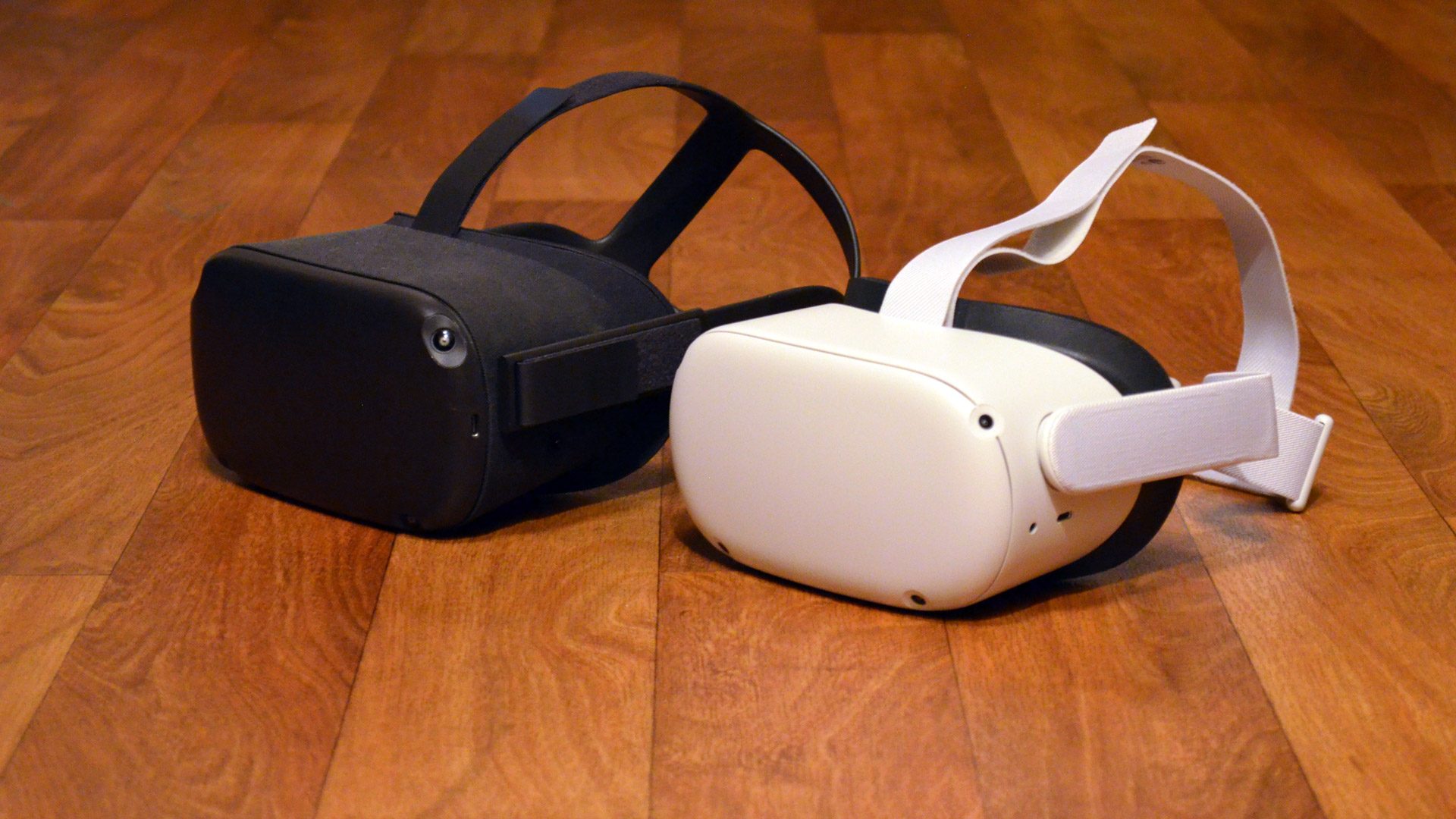
Quest (left) comapred to Quest 2 (right) | Photo by Road to VR

A little over one year later, Meta (ex-Facebook) released its successor, Quest 2, which substantively included higher resolution displays (1,440 × 1,600 OLED vs 1,920 × 1,832 LCD) and a higher refresh rate (72 Hz vs up to 120 Hz), both of which were driven by a Qualcomm Snapdragon XR2—a significant upgrade over the Quest 1’s Snapdragon 835.

Undoubtedly, Quest 2 has since cemented itself as the go-to home for VR developers looking to maximize profit; two years after its launch, Quest 2 content has managed to generate $1.5 billion in revenue.

Although you’d think social function deprecation and a clear end date to security patches  for Quest 1 should come as no real surprise; it’s old and you’d be hard-pressed to find it new in the box anywhere. Still, seven of the top 10 best-rated games on the Quest Store support the original Quest in addition to Quest 2. A majority of them were released after the launch of Quest 2.

Granted, Quest 1 users should only really focus on the security patch death date; even then, the headset will still be able to access all store content in addition to being used as a PC VR headset with Steam.


from Road to VR https://ift.tt/w0zriFU
via IFTTT

Monday, 9 January 2023

Isle Of Pan Brings Supernatural Photography To PC VR

https://ift.tt/iugDwfX

Looking for a VR photography sim filled with supernatural creatures? Isle of Pan might be for you.

Developer Dog0’s debut game, Isle of Pan, is a surreal photography adventure set on a strange Nordic island. Citing Pokémon Snap’s creature photography, Myst and “the high strangeness of a David Lynch movie” as inspirations, here’s the full outline provided by the Steam page:

Document your exploration of a mysterious Nordic island in this open world photography adventure. Guided by your compendium, find and take photographs of the strange inhabitants to unlock pages and learn more about them. On your journey you’ll come across pocket portals hidden across the island. Open them to be transported to dreamlike experiences filled with even more creatures. Take your time and embrace your creativity on a imaginative trip through mythological realities.

From seagulls to banshees, Isle of Pan claims there’s over 100 creatures to photograph, each split between “12 pocket portals to discover and explore.” New camera skins are unlocked as you advance, alongside environment options like creating rainbows and changing the time of day. Flatscreen play is also supported, which can be swapped between first and third-person cameras.

Isle of Pan arrives this week for PC VR via Steam, and a free demo’s available now.


from UploadVR https://ift.tt/JRkIAWr
via IFTTT

Intel Partners with Meta to Optimize Flagship Wi-Fi Card for Low Latency PC VR Gaming on Quest 2

https://ift.tt/OfqFnmt

Quest 2 users have a few choices when it comes to cutting the cable and playing PC VR games over Wi-Fi. You can opt for something like a dedicated dongle, or simply configure your network for the most optimal Wi-Fi setup, which usually means having your PC connected directly to the 2.4/5Ghz router with an Ethernet cable and maintaining line of sight with the router. If your PC has Intel’s latest Wi-Fi 6e AX1690 card though, that’s about to change.

Intel announced at CES 2023 that they’ve partnered with Meta to make better use of its flagship Wi-Fi card by optimizing it for use with Quest 2, which means reduced latency and no need for Ethernet cables connecting to your PC.

As reported by Wi-Fi Now, Intel says its Killer Wi-Fi 6e AX1690 card is now capable of using its Double Connect Technology (DCT) for VR headsets like Quest 2. Although the product of an Intel/Meta partnership, Intel’s it’s likely other standalone headsets will benefit too, including Pico 4 and the newly unveiled Vive XR Elite too.

Intel says AX1690, which is compatible with the Intel’s 13th-gen Core HX platform, is capable of reducing overall wireless PC VR gaming latency from 30ms to just 5ms, essentially making it indistinguishable from conventional wired connections, such as Link. We haven’t seen it in action yet, so we’re reserving judgment for now, but it basically seems like having all the functionality of that slick $99 dongle from D-Link, albeit built into your PC gaming rig.

Image courtesy Intel

“I’m a firm believer that pushing the boundaries of wireless in VR and AR will only be possible if the whole industry work together,” said Meta Reality Labs Wireless Technology chief Bruno Cendon Martin. “I’m extremely happy to see the announce today by Intel Corporation Wireless CTO Carlos Cordeiro of the work we’ve been doing together to get Wireless PC VR to the next level with Meta Quest and Intel Killer.”

Intel also released a video to demonstrate the benefits of using two simultaneous Wi-Fi connections which enable VR headsets to wirelessly access data directly from a PC (1-hop) vs. through an access point (2-hops) for reduced latency and better PC VR gaming experiences throughout the home.


from Road to VR https://ift.tt/htLceMw
via IFTTT
Related Posts Plugin for WordPress, Blogger...