Well, there are cryptic teases and then there’s this. Meta is hinting at something called ‘Questy’s’, set to be announced next week.
The company just posted a teaser video (seen below) that seems to show a pizza restaurant named Questy’s, set to a music track. The video’s description reads: “Pizza, games, and the galaxy’s most popular band. Questy’s is coming Feb 13.”
It’s tough to decipher exactly what all this could mean but it’s worth remembering that ‘Questy’ was the sidekick to Dr. 6DOF in Quest Day, Meta’s bizarre marketing/giveaway event that was hosted in December last year. Questy was a walking Quest 2 with a smiley face that you could also win plush versions of.
It seems likely this event is another marketing experiment rather than some huge new app or feature launch, then. Perhaps Meta could this time be planning some sort of in-VR concert with whoever the “galaxy’s most popular band” is? Their lyrics mention “we’ll always be together” which certainly fits into the messaging for Meta’s push for social VR, too.
There’s also the mention of games and what looks like a potential arcade in the video below, so perhaps there might be some interactive elements to this reveal.
Whatever Questy’s is, we’ll have to wait until next week to find out. In the meantime, give us some of your best guesses in the comments below.
PS5 has now sold 17.3 million units worldwide, Sony confirmed.
The company’s quarterly reports revealed as much this week. PS5 had sold 17.3 million as of December 31, 2021. As industry analyst Daniel Ahmad points out, that’s someways behind the 20.2 million PS4s sold in the same timeframe from launch. That said, PS5 is one of many electronic devices that’s suffering supply issues in the face of the ongoing component shortage.
Still, PS5 sales are an important metric to track just how many PSVR 2 headsets Sony might be able to sell when the device releases later down the line. The new device, which has been named but still not officially unveiled, attaches to PS5 consoles with a single wire, and it’s not possible to play it without one. PSVR, which is similarly attached to PS4, officially sold 5 million units, though that number is likely to have climbed in the two years since it was announced. PS4 itself has sold 116.6 million consoles as of September 2021.
We currently only know specs for the PSVR 2 headset and its first announced game, Horizon Call of the Wild. Sony has not confirmed if the device will release in 2022 — likely due to the same supply constraints PS5 faces — nor the price, which will certainly play a big factor in just how many people buy the kit. You can keep up with everything we know about the device right here.
How do you think PSVR 2 will sell on PS5? Let us know in the comments below!
The dream of the VRMMO has been captured in countless movies and shows, but to date the genre really hasn’t seen its breakout hit in the VR gaming space. Zenith: The Last City is the latest shot at making a great VRMMO a reality, but does it deliver?
Zenith: The Last City Details:
Available On: Steam, Rift, Quest, PSVR Release Date: January 27th, 2022 Price: $30 Developer: Ramen VR Reviewed On: Valve Index, Quest 2
Editor’s Note: This is a Review in Progress. Zenith is a large game with a long progression. We’re publishing some initial impressions here because we want to share what we’ve seen so far, but still have more to explore before we’re ready to give the game a final score.
Gameplay
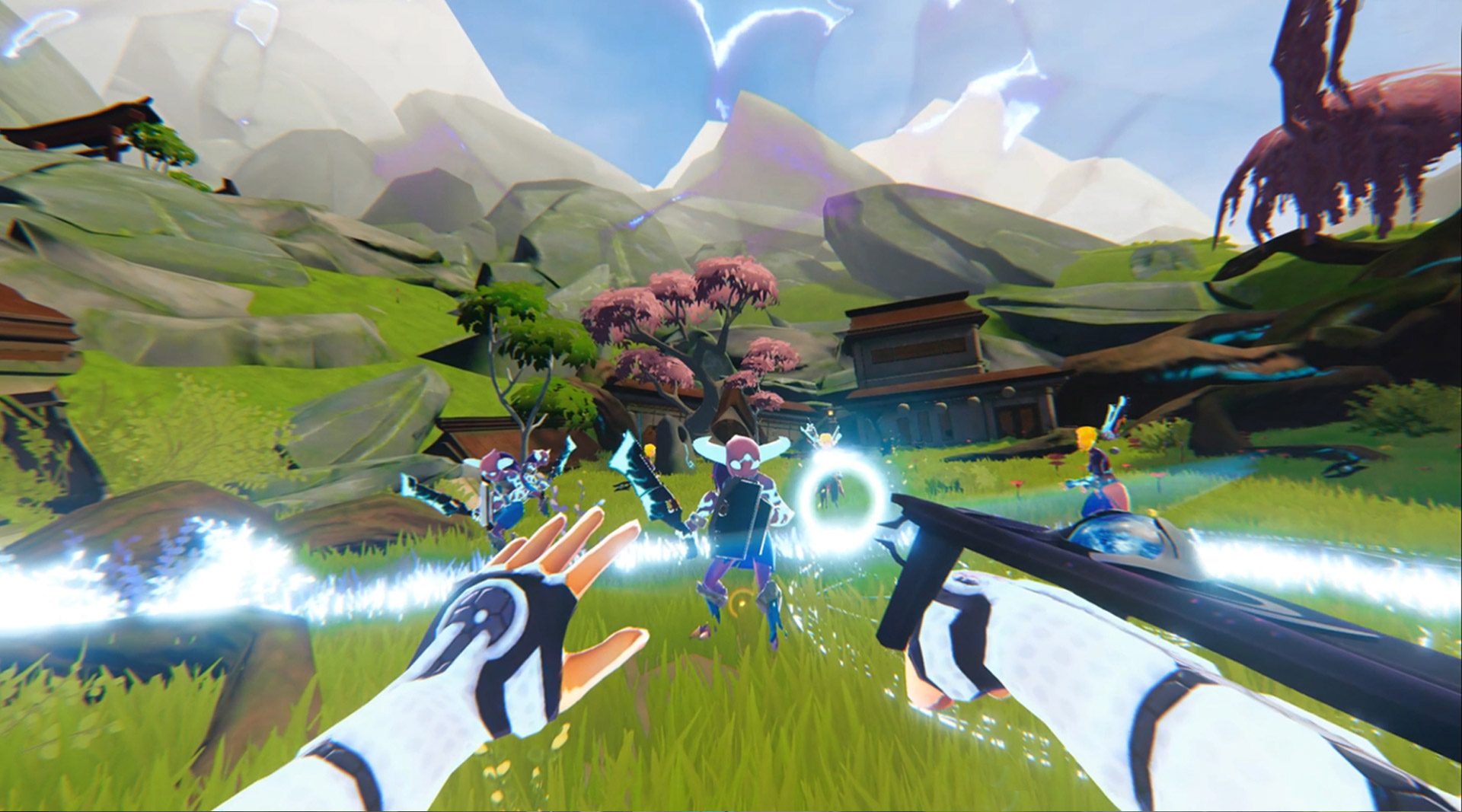
At its core, Zenith: The Last City isn’t doing anything new with the MMO genre. In fact, its foundation takes strongly after MMOs of yesteryear like World of Warcraft. It’s the formula you already know: NPCs with question marks over their head are waiting to give you quests, replete with text boxes and short snippets of benign flavor text; enemies stand around aimlessly in open fields waiting for players to come kill them; when you return to the quest giver you’ll be rewarded with XP which increases your level and grant you the ability to use new items and gear.
If it was a single player game this formula would probably bore us to tears. And yet, there’s an undeniable bit of magic that comes with feeling like you’re doing all of this in a persistent world with other players, a sense which is only enhanced by the immersive nature of VR.
And to that end, Zenith is making it happen. Playing since day one, it’s clear that the game is… well… it’s fully functional. It works… like technically speaking. That might not be saying much—were this ambitious game coming from a veteran studio—but considering that this is a brand new IP from a green studio on a relatively small budget, it’s at least worth recognizing that all the gears are in place and seem to be turning just fine.
Image courtesy Ramen VR
Zenith doesn’t stray far from the MMO formula of yore and attempts to graft VR onto it in ways that are mostly successful, if not particularly well polished.
There’s two major classes in the game, the Blade Master and Essence Mage; the former being a sword-wielder and the latter being a ranged caster. Each class also has three sub-classes—damage, tank, and support—which come have their own abilities and intended roles.
Both classes wield their main weapons in fairly intuitive ways. As a Blade Master you swing your swords to slice enemies, and as an Essence Mage you use gauntlet-looking weapons to shoot at enemies from a distance.
Image courtesy Ramen VR
Both classes can also make use of various abilities which are cast through a coarse gesture system which involves holding down a button and then swinging your arm up, down, left, or right (with different abilities depending upon which direction you choose). Compared to the use of primary weapons, these gestures are less intuitive and not terribly fun. The direction you gesture doesn’t really relate to the ability you’re using, and generally they just cause something to happen at your feet or give you a large circle to place on the ground where your spell will be cast.
While their primary weapons are pretty much point and shoot, Essence Mages have some spells which are actually thrown from the hand (like a baseball), which is a fun way to make casting more ‘realistic’ and dependent on player skill (there seems to be no auto-aim so you need to have decent aim).
The Blade Master class may have you swinging your swords with your arms, but the overall feeling of the melee combat is lacking compared to melee-focused games you may have played in VR elsewhere.
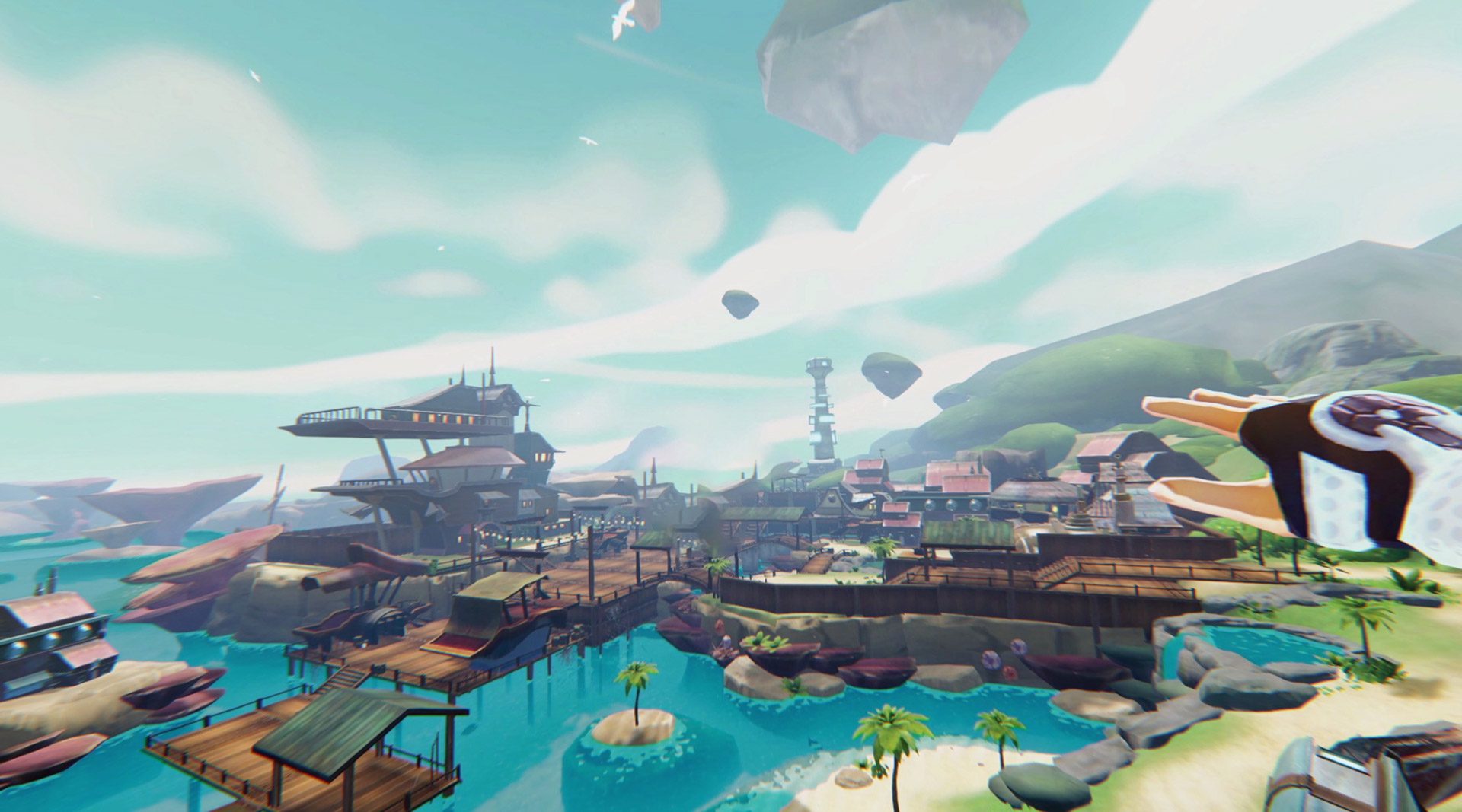
So far, the two other parts of the game that feel most specifically designed with VR in mind are climbing and flying.
Every surface I’ve found in the game up to this point is climbable, including huge mountains that you’d assume would be out of bounds. A stamina bar limits how far you can climb at any one time, but I found it was easy to scale an entire mountain because the game let me stay in place even when I had to let go to let my stamina recharge. It was clear I wasn’t actually supposed to bother climbing the mountain (as there were some holes in the terrain), but on the other side I could indeed see a brand new zone I had never been to, and I would have flown down to it if the game hadn’t warned me that my player level was far too low to bother.
Flying is done by simply holding your arms out to the side like you’re pretending to be a bird (no flapping required, fortunately). After just a bit of practice it feels very natural and quite freeing to fly in Zenith; even for short distances just by using the jump button and then gliding for a bit. Like climbing, flying is also limited by stamina, but you can cross significant distances (hundreds of yards) if you start from a high point. For the most part you can only descend from the point that you start, but in some cases the game encourages you to gain altitude by placing gusts of wind that lift you up and refresh your stamina.
From what I’ve seen so far, quests in the game have been pretty rudimentary in scope. There’s ‘kill this many of that thing’, ‘find this many of that thing’, and ‘go to these places’, or ‘kill this one specific enemy’. On their own they’ve felt mostly like a list of chores without much meaning behind them, but they at least create a framework for adventuring with others and maybe even finding a new friend or two along the way—thanks to this being a world full of other players.
Immersion
Image courtesy Ramen VR
In an MMO you’d have to say that immersion starts with the world that everyone inhabits. And on that front I’d say the look is passable. The detail is a little coarse throughout, but so far the art direction at least looks consistent.
Graphically, the game seems to suffer from the problem of trying to straddle the line between PC and Quest. On PC it doesn’t look quite as good as you might hope (and there aren’t many dials you can crank to make it look better). And on Quest it looks like things have been clamped down a good bit to make it run smoothly, including what looks like some auto-decimated assets that were chopped down too much. Had the game been designed for PC or Quest (and not both), the result probably could have been better, but there’s an argument to be made that less optimized graphics were a fair trade for game being cross-play so you’re more likely to be able to play with your friends.
Beyond climbing and flying—which work fairly well in the game to make you feel like you’re part of a solid world and also have some freedom within it—Zenith is otherwise lacking many immersive details.
NPC and enemy animations and behaviors are rough around the edges, giving them a sense of being puppets more than creatures. Items dropped from enemies or found in chests spawn as floating cubes with a name and an icon instead of looking like the actual item they represent. And once you pick them up they go into a classic flat-screen inventory that you control with a laser pointer.
Image courtesy Ramen VR
The UI is almost entirely based on flat-screen paradigms, including your health, stamina, and mana which float in front of you in a flat plane alongside ability icons that show cooldowns with a text-based timer. There’s been many examples across the VR landscape of presenting this info in an immersive way, but unfortunately Zenith does little on that front. Haptics and audio in the game could also use a significant overhaul to better communicate to players when they’ve done something correctly.
Comfort
Locomotion in Zenith is entirely based around thumbstick movement (save for the aforementioned climbing and gliding), and it expects you to do a lot of it.
Luckily the game has a wide range of comfort options and I appreciate that the game allows you to not only fully customize the vignette (AKA peripheral blinder) strength from 1–100%, but even allows you to do it on a case by case basis. For instance, you can set a 25% vignette for walking and a 50% vignette for flying.
While there’s no traditional teleport option, Zenith includes a fairly novel ‘third-person’ comfort mode which starts in first person and then (when you begin walking) shows you walking ‘out of your body’. Once you stop moving, your first-person view teleports back into your body at the new location. It’s an interesting idea and maybe a bit more immersive than a traditional teleport, but it seems disruptive to the overall flow of the gameplay so I doubt many will make use of it (it might ultimately be better suited for a different kind of game).
Generally speaking, and considering the comfort options at hand, I’ve found Zenith quite comfortable. I’ve yet to run into any instances of the player’s camera being overtly controlled by the game (ie: shakes or knockbacks by enemies), nor any environmental issues relating to comfort (ie: stairs that cause your head to bob up and down). The biggest risk in the game for those sensitive to artificial movement is likely flying and climbing, but fortunately you can choose to dial your vignette up for those things specifically if you find they are causing discomfort.
Summary
At its most basic level, Zenith ‘works’. The essential pieces of an MMO are in place and they’re working as expected and you can play it all using a VR headset. And that’s a great start considering how ambitious this project is for the small studio behind the game.
Were Zenith a single player game, I’d give it a pass pretty quickly. But there’s no denying the unique feeling of being in an interesting world with other players (and possibilities therein) which Zenith has so far managed to capture. While there’s much more the game could do to feel like it really belongs in VR, the ability to climb and fly helps make the world uniquely explorable in a way that MMOs typically don’t.
There’s more I want to see and explore in Zenith before I feel ready to give it a final score. Check back soon!
A big new update for Vertigo Games’ After The Fall focuses on some long-requested fixes for the VR shooter.
The update is rolling out across all platforms today and includes several key fixes. PSVR players will be happy to know that crashes on higher difficulties have been addressed, for example, and a potential exploit that let players glitch through doors has been removed.
Perhaps the most important update, though, is to do with the NPCs. Vertigo says AI players will now try and stay out of the way of the line of fire, should you be using them. That means you, Jimmy (who gets a shameless callout in the patch notes).
Elsewhere there have been some changes to things like persistence, so certain items no longer carry over to multiplayer matches, and you can even replay the game’s intro sequence at any point using a new intro floppy disc. All of this and, of course, there are other minor bug fixes and balancing tweaks.
Outside of the patch, Vertigo is also running a new event to celebrate Chinese New Year, letting you grab a new weapon skin until February 13.
We’re still yet to see the first season of content rollout for After The Fall, but Vertigo has hinted at new areas and enemies for it. We’re looking forward to more content – we thought the co-op FPS offered frantic fun when it arrived last year but needed more levels.
Are you going to check out the After The Fall update? Let us know in the comments below!
Warhammer 40,000: Battle Sister launched on Quest in late 2020, later coming to Rift with cross-buy in mid-2021. Now the epic action-shooter is slated to leave Meta platform exclusivity starting next month.
Pixel Toys today announced that Warhammer 40,000: Battle Sister is coming to SteamVR headsets on March 8th.
In Battle Sister you take on the forces of Chaos with a host of typical Warhammer accouterment, spanning everything from Chainswords and grenade launchers, to powerful Acts of Faith.
Since launch on Quest Battle Sister has gotten a host of updates, including a multiplayer update that brought co-op to the game for the first time and a recent ‘Big Guns’ update late last month which rebalanced difficulty in the ‘Last Bastion’ wave shooter horde mode, and brought three new enemies and three new player weapons to online multiplayer.
Thanks to continual updates, Pixel Toys says the upcoming SteamVR version will be “the most advanced, feature-packed Battle Sister release to date,” the results of which have garnered it a [4/5] star user rating on Quest for its solid multi-hour shooting action.
You can wishlist the game here to be notified when it launches. It’s set to be priced at $20/£15
Looking for the 25 best PC VR games on Steam and Oculus? We’ve got you covered with our top 25 list.
The PC VR landscape has changed dramatically over the years. It used to be the front-and-center focus on an entire industry, but new headsets across different categories have since seen developers and publishers split their attention. But we’re often still rewarded with a handful of new gems every year that push the fidelity of VR experiences in ways you just couldn’t see on lesser hardware.
What’s nice about the list of the best PC VR games, then, is that even some of the oldest games on this list — now some six years old — remain some of the best-looking and playing titles in all of VR today.
You’ll find most of these experiences on both the Oculus Store and SteamVR. Take note, though, that we have included a few Oculus exclusives in this list because we felt the games were simply too good to ignore. We’re also including early access titles in the list for the first time, as some of PC VR’s best games are still in pre-release to this day.
If you’re looking for our other lists, you’ll find those here.
We’re grouping in the first two installments of Cloudhead Games’ compelling adventure series together as the first episode is on the shorter side and the two together cost about as much as a normal VR game. The Gallery has its roots in Henson-esque dark fantasy, transporting you to amazing worlds of impossible landscapes and crazy characters on the hunt for your sister. Imaginative design makes these some of the best PC VR games despite their age. We’re just hoping Cloudhead one day gets to make Episode 3.
It’s hard to make a VR shooter feel genuinely adventurous and not too overwhelming for the player. Compound does this by calling back to a classic era of shooters that set a slower, more manageable pace. The result is a hugely enjoyable roguelite FPS that roots you in the action, with vintage visuals that pop inside VR headsets. Plus, developer Not Dead has kept the game consistently updated since its initial launch in 2018, making this one of the best PC VR games despite still being in early access.
If you’re able to go back and seek out the lost era of Oculus PC VR exclusives (back when, y’know, Oculus was still a thing), we strongly recommend Wilson’s Heart as your first stop. Twisted Pixel’s VR debut is a brilliant throwback to 1940’s horror that makes incredible use of VR motion controls whilst proving out VR storytelling in fresh ways. If Meta had a heart, it’d let the game live again on SteamVR and Quest.
A Fisherman’s Tale remains, to this day, one of the smartest and most striking uses of VR. You’ve no doubt heard its premise, which leans heavily on recursive puzzling as you play cooperatively in single-player, passing things between bigger and smaller versions of yourself. It’s a stunning spectacle, but the game is also anchored by a curious tale of fatherhood and a warm visual style. It’s still a treat and still one of the best PC VR games to date.
The best thing you can say about Wanderer is that it’s an escape room game that doesn’t always feel like an escape room game. Its puzzles make great use of VR interactivity and its ambitious setup sees you jumping between timezones across (and sometimes off) the world at a moment’s notice. It’s also one of the best-looking games to release in recent memory and a real showcase for the power of PC VR. Don’t miss Wanderer – it’s easily one of the best PC VR games.
There have been a lot of decent attempts to bring the survival genre to VR but, with its native mechanics, focused structure, and earthy atmosphere, Song in the Smoke is the best of them by some way. You progress through multiple zones in a prehistoric wilderness, hunting and crafting whilst tackling unique new challenges in every area that teach you new tricks and abilities. If you don’t like the aimlessness of some survival games then you’ll appreciate Song in the Smoke’s focused campaign, making it one of the best PC VR games.
Valve isn’t bringing Counter-Strike to VR anytime soon but, fortunately, we have a worthy replacement in Pavlov VR. Consistently developed over multiple years, Pavlov has turned into the fast-paced competitive shooter to beat, with tons of weapons and environments spanning multiple eras and new game modes being added at a dizzying pace. The future remains bright for Pavlov and, for multiplayer fans, it’s one of the best PC VR games out there today.
Until You Fall isn’t focused on the realistic melee physics of a Saints & Sinners or Boneworks, and it’s all the better for it. This arcade-infused roguelite uses on-screen indicators to force you to hone your reflexes, blocking and attacking with split-second precision. Developer Schell Games nails the moreish gameplay loop, making Until You Fall a game that’s hard to put down. And that’s a good thing considering the game is a fun workout too.
Third-person VR games might not make much sense at first glance, but Moss shows you why the opposite is the case. This platformer action game is a really solid adventure in its own right, but it’s the bond you build with protagonist Quill over its few hours that shines through. Moss is showing its age a little in 2022, but hopefully, Moss 2 will be ready to replace it just as soon as it launches.
We still can’t quite believe Star Wars: Squadrons was a thing. A full Star Wars flight action game with both a single-player campaign and a huge multiplayer component… in VR? Are we sure we’re not dreaming? Well, if we are, we don’t want to wake up because Squadrons’ highly immersive cockpits and blistering space dogfighting make for everything we ever wanted out of VR in the first place, making this, in turn, one of the best PC VR games.
There aren’t many sports that current VR technology can perfectly replicate but table tennis is one of them and, for our money, Eleven: Table Tennis is easily the best realization so far. That’s thanks to the pinpoint precision of its physics and robust multiplayer and single-player options, which ensure we’ll never need another VR table tennis game again.
If Pavlov is VR’s answer to Counter-Strike, then Onward is closer to something like Arma, with a focus on hyperrealism that paved the way for the mechanical complexity VR can add to the shooter genre. Though it’s still labeled as early access, Onward has felt like a full game for years now and is easily deserving of its place on the best PC VR games list.
Another long-in-development early access project, A Township Tale has slowly but surely built up a loyal following thanks to its deep focus on interactive VR mechanics and cooperative multiplayer. You’re tasked with building up a village, gradually adding in new features as you mine ever-rarer resources and upgrade your weapons. A genuine sense of risk to your adventuring and a huge amount of content make this one of the best PC VR games you can currently play.
Skyrim VR successfully transplants the entire RPG into headsets with full motion controls. It’s not the most in-depth implementation, but just that fact alone makes this something you won’t want to miss in VR. Along with bestowing you with a keen sense of adventure, there are bits of Skyrim that genuinely work incredibly well in VR, like the moment you first encounter a dragon or inspect a sword you’ve worked hard to earn in tireless detail. There are better, more native VR games out there, but Skyrim VR is Skyrim… in VR, and that makes it worth a look.
Beat Saber has become such a sensation on basically every headset that’s it’s easy to forget the games’ humble beginnings as an early access PC VR title. But, despite Beat Games’ acquisition by Meta years back, the PC VR version of the game remains the sharpest place to play Beat Saber and its ever-growing catalog of songs. Still one of the best PC VR games, then, but Beat Saber is a must wherever you enjoy VR.
If you’re looking for an uncompromising VR combat simulator that doesn’t spare you any gory details, look no further than Blade And Sorcery. Though still very much in early access, you won’t find more instantly rewarding combat on PC, with truly gruesome results. Plus the recent addition of the Dungeons mode gives the game some much-needed structure and the added power of the PC makes this the version to play over the Quest edition, labeled Nomad.
No Man’s Sky went the extra mile with its VR support. Hello Games honed in on what makes VR integration feel seamless and natural, delivering an experience that almost felt like it had been designed for VR from the start. Add to that the frankly enormous number of new features and upgrades the game’s implemented since launch and it’s impossible to deny No Man’s Sky its place on the best PC VR games list.
You could group in Lone Echo 2 with this pick to get the whole experience but, given that’d be a rather expensive proposition, we’re sticking with the groundbreaking original and its free multiplayer companion right now. Lone Echo paved the way for immersive zero-gravity movement in VR and set a bar for PC VR visuals that arguably still hasn’t been surpassed. It’s slow-paced, but the focus on building a link between your character and those around him pays off, as does the enormous spectacle of it all. We’ll be calling Lone Echo one of the best PC VR games for years to come.
Asgard’s Wrath might not have Skyrim levels of content but, for our money, the focus on native VR sword fighting and character progression make this the more important of the two VR games. This is an immaculately produced Norse adventure split into three parts that captures the heart of the RPG genre and realize it in its full glory using the power of PC VR, helping it vanquish its opponents in the fight for the best PC VR games. Now, how about a sequel? Please?
Of all the physics-driven VR combat and puzzle games out there, Boneworks easily is the most polished and impressive. Its single-player campaign offers plenty of fun sandboxes to experiment with, whether your swinging robotic headcrabs around by their legs or beating up mindless zombies with a broom handle. Or you can just rely on the classics and find a lethally accurate shooter. Boneworks is one of the best PC VR games and a glimpse of where the future of VR interactivity is headed.
Rhythm games are a dime a dozen in VR but, for our money, Pistol Whip is the most inventive and overall best of the lot. The focus on firing to the beat as you duck and weave through blinding neon obstacle courses makes the game a joyous assault on the senses that requires genuine skill to master. With new updates arriving at a constant pace, Pistol Whip has a comfortable position in our list of the best PC VR games.
Fancy board game night in VR? Then Demeo will serve up pretty much all you could want from that concept and then some. This is a brilliant cooperative dungeon crawling turn-based RPG played with friends, letting you roll the dice to tackle its fiendishly difficult levels. But you can also scale the game up and down to your liking, adding an extra dimension to a fantastic social VR experience. With plenty of free content already delivered and more on the way, Demeo still ranks highly on our list of the best PC VR games.
We’ll stop ranking Superhot VR so highly in our list of the best PC VR games (and pretty much all our other best of lists) the moment we play a shooter as intricatly designed to maintain immersion and utilize your full body in ways that you simply couldn’t in a flatscreen experience. The ‘time moves when you move’ mechanic remains ridiculously entertaining to this day, and the game achieves a perfect balance of slapstick action and stylish stunts. At this point we think only a long, long overdue sequel could top it on the list of the best PC VR games.
The Walking Dead: Saints & Sinners doesn’t quite have as robust a physics system as Boneworks, and its campaign isn’t as tightly designed as Half-Life: Alyx. But its best of both worlds approach makes is a game that really communicates the potential for VR action to offer something different whilst giving you hours in a fantastic sandbox to realize that potential. This is a wide-open world which will constantly surprise you with its possibilities, and Saints & Sinners is easily one of these PC VR games on the market today.
Half-Life: Alyx ultimately might not be as groundbreaking an experience as Boneworks or Saints & Sinners, but you simply won’t find a bigger, more polished native VR game on the market today. Valve’s long-awaited return to City 17 lived up to the hype with a varied campaign including ferocious firefights with The Combine and uncomfortable encounters with headcrabs, not to mention some incredible VR-first interactions, an unforgettable ‘boss’ level, and, of course, that ending. Half-Life: Alyx remains the best PC VR game to this day. More, please. Much, much more.
As the most valuable tech company in the world, decisions that Apple makes tend to reverberate throughout the industry. Recent evidence strongly points to Apple planning to support WebXR on Safari and possibly its forthcoming XR headset, which would widen consensus on the standard.
WebXR is a web standard designed to make it possible for developers to deliver AR and VR experiences straight from a web browser. While Safari on iOS devices had some basic support for the precursor standard (WebVR) in the Cardboard era, Apple hasn’t done much to adopt the modern incarnation of WebXR.
But that looks to be soon changing. Developer Maximiliano Firtman spotted four new experimental WebXR features in the latest version of Safari in iOS 15.4 beta:
WebXR Augmented Reality Mode
WebXR Device API
WebXR Gamepads module
WebXR Hand Input Module
Firtman notes that the features, as they exist presently, appear to support external devices only; and postulates “this is preparing the scenario for Apple’s upcoming goggles or headsets.”
This is somewhat surprising considering that Apple has been pushing AR on its iOS devices and would presumably want to use WebXR to allow developers to tap into iOS’s ARKit capabilities. Even if the current experimental features only support external devices, it seems likely that Apple will eventually support WebXR more fully in Safari in the future.
The new capabilities come a few months after an Apple job listing for a ‘WebKit 3D Graphics Engineer‘ which specifically mentions WebXR as part of the role.
You will be responsible for driving the future of graphics on the web. This includes working on 3D and GPGPU standards like WebGPU, AR and WebXR. You will be encouraged to work across all layers of code while maintaining a firm understanding of software architecture. And you will help define the next generation of web standards through participation in governing bodies including WHATWG and W3C.
WebXR support has been brewing under Safari for quite some time, even if not much of it has been built into the browser just yet. WebKit is the browser engine that forms the foundation of Safari; the WebKit bug tracking site shows that the earliest work implementing the core WebXR Device API started in early 2020 and work has been ongoing ever since. It isn’t clear if Apple will adopt all of the WebXR capabilities of WebKit, but given the first glimpses of it in Safari on iOS 15.4 beta, it seems like the company is poised to back the standard in a substantial way.