Tuesday, 1 December 2020

Varjo’s New High-end XR-3 & VR-3 Headsets Expand Retina FoV While Reducing Weight & Price

https://ift.tt/3qhDvIb

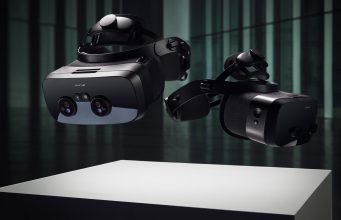
Varjo today announced its latest high-end headsets, the XR-3 and VR-3, with a range of improvements including an expanded field of view, inside-out tracking, and a redesigned headstrap. While still expensive and definitely aimed at large enterprises, the new headsets also get a significant price reduction compared to prior models.

As far as XR headsets go, Varjo’s are quite unique. The company’s headsets use two displays for each eye: a high-density ‘focus’ display at the center, and a larger ‘context’ display to fill out the field of view to immersive levels. The two displays are blended together nearly seamlessly, allowing the very center of the field of view to achieve retina resolution that’s unmatched by any other headset on the market.

The company’s new XR-3 and VR-3 headsets—available for order today and due to start shipping in January—are based on the same concept, but push it further still by expanding the field of view of both the focus display (such that a larger area of the screen is retina resolution) and the context display (for a larger peripheral field of view). At the same time as expanding the field of view, the company has also boosted pixels per-degree across the board.

Boosted Field of View & Resolution
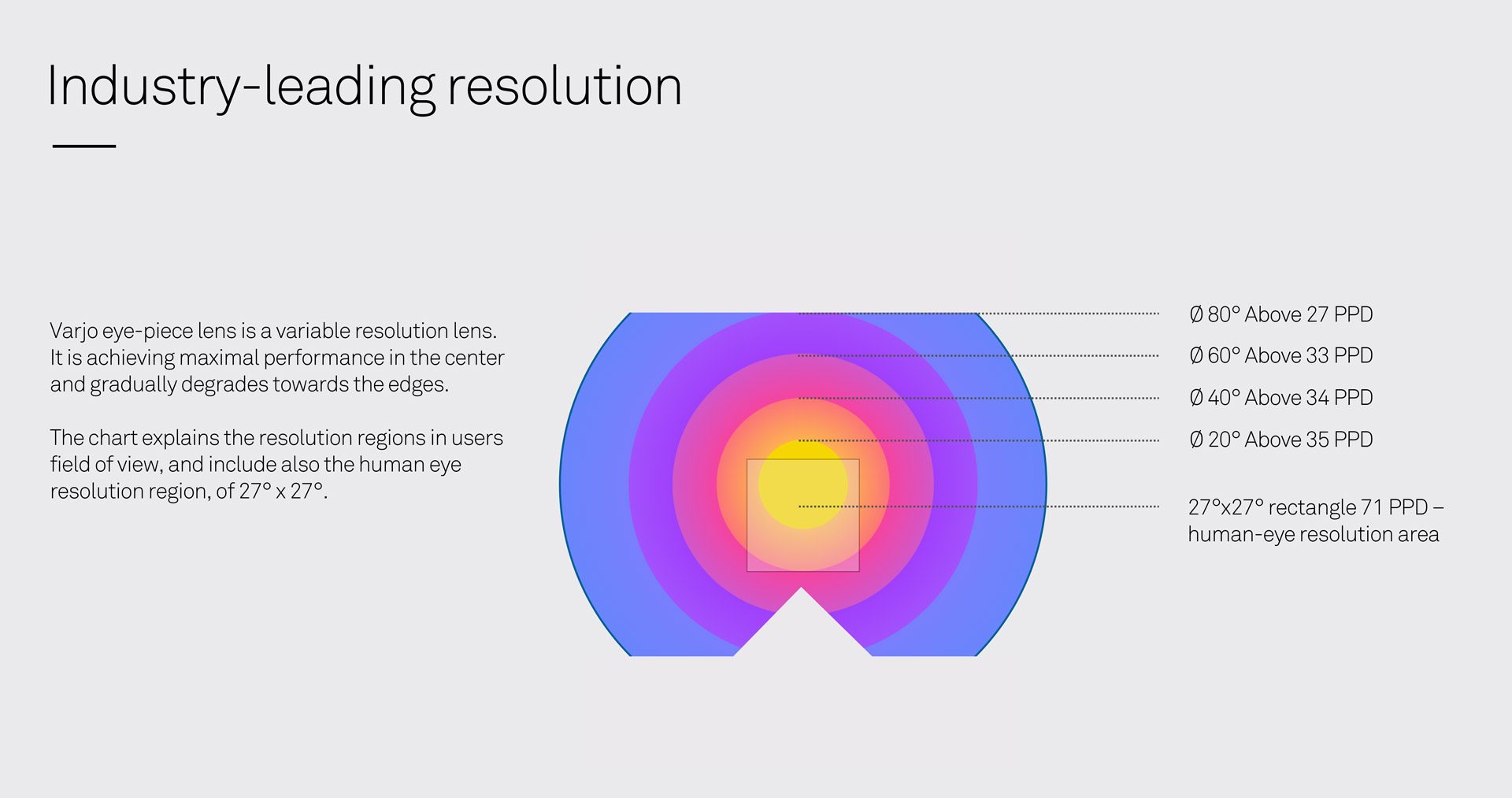
Image courtesy Varjo

Compared to the company’s prior headsets, the XR-3 and VR-3 expand the FoV of the focus display (retina resolution area) from 26° × 16° (30.5° diagonal) to 27° × 27° (38° diagonal). At the same time, the focus display’s resolution is boosted from 62 pixels per-degree to 71 pixels per-degree, offering even finer resolving power (assuming your vision is sharp enough to appreciate it). From a resolution standpoint, the focus display is 1,920 × 1,920 @ 90Hz (compared to 1,920 × 1,080 previously).

As for the context display in the periphery, the field of view is boosted from 87° horizontal on Varjo’s prior headsets to 115° horizontal, the company says. And while the context display hasn’t yet crossed the retina resolution threshold of 60 PPD, it gets its own significant boost from 14 PPD to ~30 PPD. In terms of resolution, that’s an upgrade from 1,440 × 1,600 to 2,880 × 2,720 (both at 90Hz).
Through-the-lens photo | Image courtesy Varjo

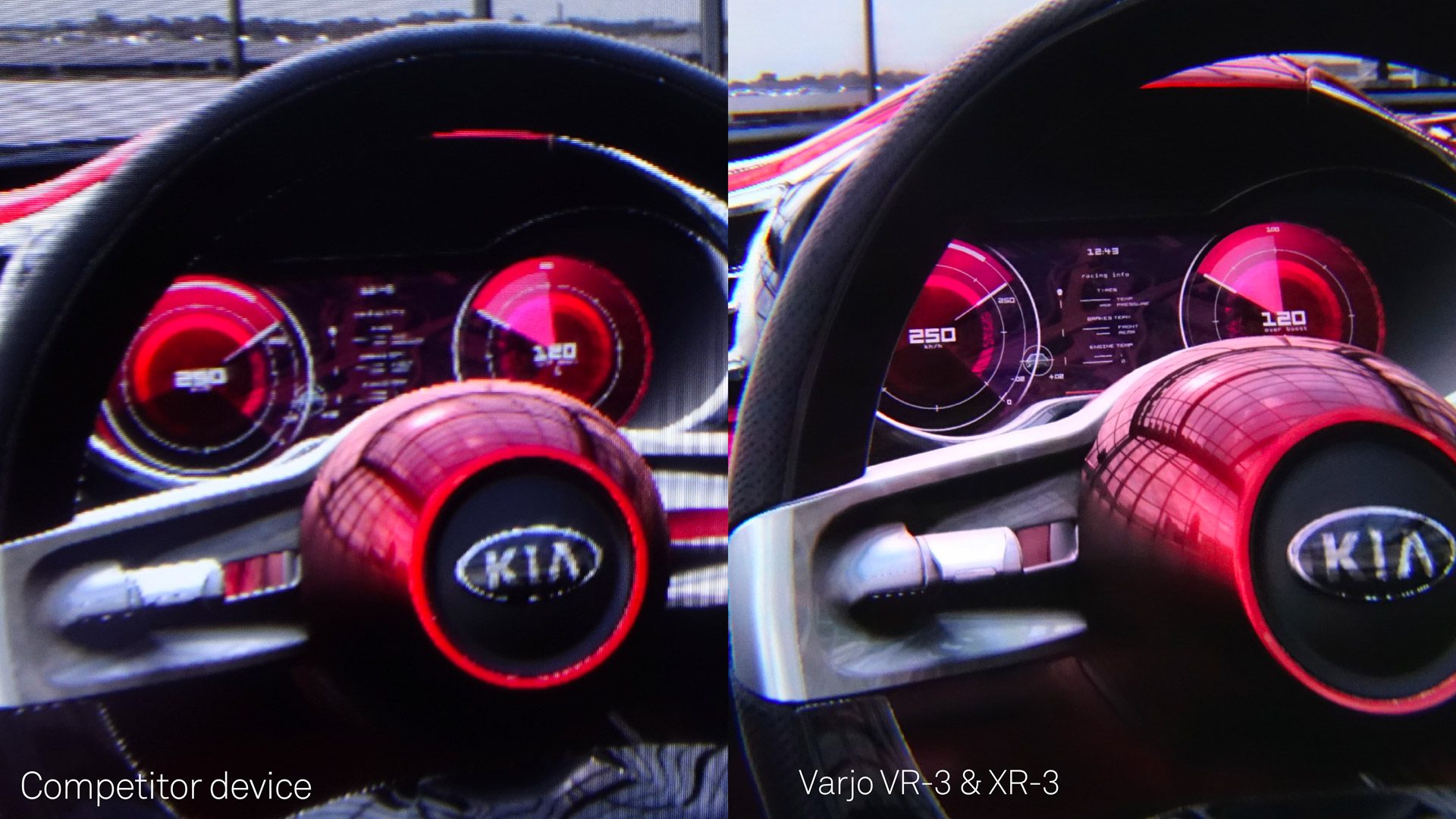
If you haven’t had a chance to look through Varjo’s headsets, it’s difficult to appreciate what all these numbers mean. For a coarse idea of relative resolving power we can consider the megapixels of the displays as compared to consumer headsets:

Headset Megapixels per-eye
Rift DK1 0.5
Rift DK2 1.0
Rift CV1 1.3
Vive Pro 2.3
Rift S 1.8
Quest 2.3
Index 2.3
Quest 2 3.5
Reverb G2 4.7
Varjo XR-3/VR-3 9.7

That is to say: that’s Varjo’s headsets are far beyond anything in the consumer realm. And of course we’d hope so… given what they cost.

Lower Price (but still pricey)
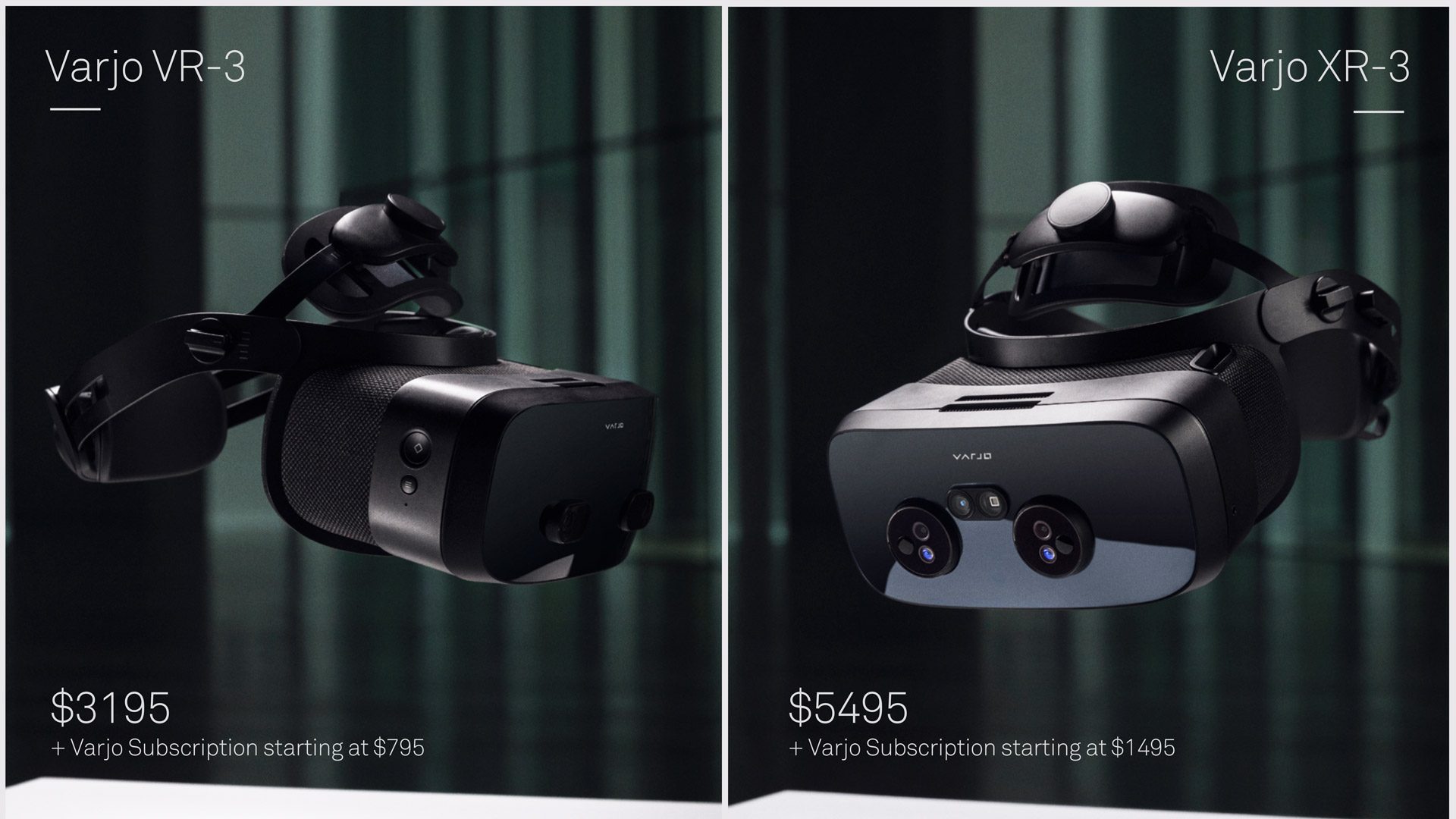
Image courtesy Varjo

While Varjo’s new headsets aren’t cheap by any means, the company has managed to significantly drop the price despite boosting specs. Here’s the breakdown:

Headset Varjo VR-2 Pro Varjo VR-3 Varjo XR-1 Varjo XR-3
Purchase Price $6,000 $3,200 $10,000 $5,500
Support (annual, required) $1,000 $800 $1,000 $1,500
Total $7,000 $4,000 $11,000 $7,000

Both headsets are available for order starting today, with shipments expected to begin in January.

Eye-tracking, Automatic IPD, & More

Image courtesy Varjo

There’s no doubt these headsets are expensive, but Varjo is loading them full of premium features.

Like the company’s prior headsets, the XR-3 and VR-3 both feature 200Hz eye-tracking tech developed in-house, which the company claims is the “world’s fastest and most accurate” integrated eye-tracking solution. Eye-tracking is also used for foveated rendering and automatic IPD adjustment, allowing the bi-convex lenses (not Fresnel) to align themselves with the user’s eyes for optimal clarity and comfort. Both headsets also include hand-tracking from Ultraleap.

XR-3 and VR-3 see a brand new industrial and ergonomic design, reducing weight by 40%, according to Varjo. The new headstrap uses a halo-like design with tightening dials on both the back and top strap.

Both headset’s displays also now boast pro-level color reproduction with 99% sRGB and 93% DCI-P3 color gamut.

Continue on Page 2: XR-3 is Built for High-quality Mixed Reality »

The post Varjo’s New High-end XR-3 & VR-3 Headsets Expand Retina FoV While Reducing Weight & Price appeared first on Road to VR.


from Road to VR https://ift.tt/3lt3n00
via IFTTT

Marvel Powers United Shutting Down, Already Removed From Sale – Report

https://ift.tt/eA8V8J

It looks like Oculus Rift exclusive Marvel Powers United could be shutting down in the near future, with the game seemingly no longer on sale.

A Reddit user posted what they claim to be an email from Facebook’s Oculus and Powers United developer Sanzaru Games. The email notes that the “time has come for us to say goodbye to Marvel Powers United VR,” adding that the game will no longer be playable from March 1, 2021. It also claims that the game has already been removed from sale on the Oculus Rift store and, sure enough, we can’t find it there.

Marvel Powers United No More?

We’ve emailed Facebook to confirm that this is indeed the case. No reason was given for the move in the email, though it’s possible that inactivity online or an expiring licence with Marvel itself are behind the news.

Marvel Powers United released in mid-2018, published under Facebook’s own Oculus Studios label. It’s a multiplayer experience in which up to four players choose from a range of iconic Marvel characters and then head into arena-style maps, working together to complete a series of objectives. Characters included fan favorites like Spider-Man, Rocket Raccoon, Wolverine and Deadpool, although Iron Man was never included. Two years later, he got his own VR game.

“We recommend that you delete the game prior to March 1, 2021 to avoid dead space taken up on your device,” the supposed email concludes. The game did have a single-player mode, but it only activated if you couldn’t find people online and replaced them with AI partners. It seems like that requirement could keep you from accessing the single-player portion too.

While it was definitely empowering to embody some of our favorite Marvel characters, we felt the game was far too repetitive in its design.

“Ultimately it’s a little more of a muted take on the superhero VR genre than we were hoping,” we said in our 6.5/10 review. “It’s carried by its best characters, heroes with truly unique abilities that evoke sheer blockbuster comic book joy you’ll keep coming back for. But much of its cast struggles to stand out from a set of templates that limit their capabilities and the repetitive mission structure and forgettable boss battles put a ceiling on the fun.”

The game did see a few updates past its initial launch but, despite a tease from Facebook itself in 2019, an Oculus Quest version of the project never materialized. If the game is shutting down, it seems likely that any lingering hopes for a standalone version are dead.

What do you make of Marvel Powers United possible shutting down? Let us know in the comments below!


from UploadVR https://ift.tt/3fWTKpy
via IFTTT

These next gen professional headsets have INSANE resolution! – Varjo XR-3 & VR-3

https://ift.tt/eA8V8J


from UploadVR https://ift.tt/3qeheuS
via IFTTT

Varjo VR-3 Has Industry-Leading Resolution, XR-3 Model Gets LiDAR

https://ift.tt/2HVPgTi

The new Varjo XR-3 and VR-3 headsets feature automatic physical IPD adjustment with eye-tracking and foveated rendering, and that’s just for starters.

The enterprise-level headsets also include inside out tracking (but you can use SteamVR base stations too). There’s even Ultraleap hand tracking. All that comes together with Varjo’s (pronounced var-yo) latest dual resolution “bionic” display. The company pitches it as having a “Focus area (27° x 27°) at 70 PPD uOLED, 1920 x 1920 px per eye” with a “Peripheral area at over 30 PPD LCD, 2880 x 2720 px per eye.” The XR-3 also features LiDAR and stereo RGB video passthrough said to be running at 90 Hz.

Varjo XR-3 And VR-3 Announced

What’s that LiDAR being used for? Varjo says its depth awareness will help enable the “seamless merging of real and virtual for perfect occlusions and full 3D world reconstruction.” The combination may power some of the best mixed reality experiences possible today; we’ve been very impressed by Varjo’s tech in the past — but we haven’t had a chance to see the new headsets yet.

XR-3 is available for pre-order now with plans to ship in “early 2021”. It is only available to enterprise buyers priced at $5,495 together with a Varjo Subscription “to replace the previous software and support services” priced at $1,495 for one year. That’s a pretty significant price cut from the original XR-1, which sold at around $10,000 (there was never an XR-2).

The VR-3 ditches the mixed reality features (like LiDAR) to bring the price down to $3,195, plus subscription.

Varjo XR-3 and VR-3 Comparison

The new XR-3 and VR-3 are likely competing against HP’s upcoming Omnicept edition of the Reverb G2 in 2021. HP’s headset, though, turns its sensors inward for facial tracking. XR-3 looks designed to understand its environment in ways other headsets can’t yet.

Varjo representatives said the company employs around 130 people now, with large teams working on software.

Varjo XR-3 Technical Specifications:

Display & Resolution:
Full Frame Bionic Display with human-eye resolution.
Focus area (27° x 27°) at 70 PPD uOLED, 1920 x 1920 px per eye
Peripheral area at over 30 PPD LCD, 2880 x 2720 px per eye
Colors: 99% sRGB, 93% DCI-P3
Field of View:
Horizontal 115°
Refresh rate:
90 Hz
Mixed reality:
Ultra-low latency, dual 12-megapixel video pass-through at 90 Hz
XR Depth:
LiDAR + RGB fusion, 40 cm–5 m operating range
Hand tracking:
Ultraleap Gemini (v5)
Comfort & Wearability
3-point precision fit headband
Replaceable, easy-to-clean polyurethane face cushions
Automatic IPD 59–71mm
Weight
594 g + headband
Connectivity
Two headset adapters in-box
Two USB-C cables (5 m) in-box
PC Connections: 2 x DisplayPort and 2 x USB-A 3.0+
Positional Tracking
SteamVR™ 2.0 tracking system
Varjo inside-out tracking utilizing RGB video pass-through cameras
Eye tracking
200 Hz with sub-degree accuracy; 1-dot calibration for foveated rendering
Audio
3.5mm audio jack with microphone support
Varjo VR-3 Technical SpecificationsDisplay & Resolution
Full Frame Bionic Display with human-eye resolution.
Focus area (27° x 27°) at 70 PPD uOLED, 1920 x 1920 px per eye
Peripheral area at over 30 PPD LCD, 2880 x 2720 px per eye
Colors: 99% sRGB, 93% DCI-P3
Field of View:
Horizontal 115°
Refresh rate:
90 Hz
Hand tracking:
Ultraleap Gemini (v5)
Comfort & Wearability
3-point precision fit headband
Replaceable, easy-to-clean polyurethane face cushions
Automatic IPD 59–71mm
Weight
558g + headband
Connectivity
Two headset adapters in-box
Two USB-C cables (5 m) in-box
PC Connections: 2 x DisplayPort and 2 x USB-A 3.0+
Positional Tracking
SteamVR™ 2.0 tracking system
Eye tracking
200 Hz with sub-degree accuracy; 1-dot calibration for foveated rendering
Audio
3.5mm audio jack with microphone support


from UploadVR https://ift.tt/2HV7kNl
via IFTTT

First 10 Minutes of Pistol Whip 2089 Campaign

https://ift.tt/eA8V8J


from UploadVR https://ift.tt/2VqFJXm
via IFTTT

Hinge: First 23 Minutes of New Gorgeously Spooky Horror VR Game!

https://ift.tt/eA8V8J


from UploadVR https://ift.tt/2VoIBEs
via IFTTT

Destroying EVIL ROBOT DUCKS! | VR Roulette

https://ift.tt/eA8V8J


from UploadVR https://ift.tt/3qg4Zht
via IFTTT
Related Posts Plugin for WordPress, Blogger...