Community Download is a weekly discussion-focused articles series published (usually) every Monday in which we pose a single, core question to you all, our readers, in the spirit of fostering discussion and debate. For today’s Community Download, we want to know which superhero you’d love to see in a dedicated VR game next after Iron Man?
With Iron Man VR releasing in just a few short days on July 3rd, this Friday, it’s an exciting time for PSVR gamers. One of the most well-known and truly iconic superheroes of all-time is entering the immersive realm of VR with his own, dedicated game complete with a robust campaign and lots of depth — at least, according to the developers.
We’ve gotten the chance to take on the role of lots of iconic superheroes over the years in VR, such as Batman in Arkham VR, several Marvel characters in Marvel Powers United VR, and even as Spider-Man specifically in the free Far From Home VR experience. But now we want to imagine what another fully-fledged made-for-VR superhero game would be like that focuses on a single hero.
Superman is one of the most notoriously difficult characters to get right in games, but maybe playing as him in VR would offer that sort of empowerment you’d seek. Or, perhaps a full game building on the web-slinging of Spider-Man could be fun. Teleporting between dimensions and using your hands for magic, like Doctor Strange, could be a blast too.
Let us know what you think! Which superhero do you think deserves their own dedicated VR game next after Iron Man VR?
Scott Eastwood narrates this educational AR 360-degree experience from QuantumERA.
This Wednesday marks the historic 157th anniversary of the Battle of Gettysburg, a gruesome three-day conflict fought in and around the town of Gettysburg, Pennsylvania during the American Civil War. Often considered a turning point for the Union Army, Gettysburg remains one of the deadliest battles in American history, claiming the lives of roughly 46,000 – 50,000 Union and Confederate soldiers in a span of 72 hours.
Ahead of its 157th anniversary, immersive content studio QuantumERA has launched Gettysburg: A Nation Divided, a brand new app available on iOS that uses a combination of AR and 360-degree technology to transport you back in time to the year 1863 and onto the front lines of a jaw-dropping battle of epic proportions.
Users have the opportunity to immerse themselves in the chaos of battle from the perspective of both a Union and Confederate soldier via fully-animated 360-degree animations. Using their smartphones as 360 way-finders, users can explore 10 key locations scattered across the massive battlefield, each of which providing additional details such as the locations of each army and who was in command. You can also discover hidden artifacts as well as golden coins which can be used to rank up from Private all the way to General.
In addition to shining a light on the battle itself, QuantumERA’s app allows you the opportunity to learn more about the people effected by the conflict. Brought to life as animated avatars, you’ll hear stories from soldiers, African American journalists, and various local women just to name a few. Of course, it wouldn’t be Gettysburg without an address from the man himself. Gettysburg: A Nation Divided offers an AR recreation of President Lincoln’s famous Gettysburg Address at the Gettysburg National Cemetery.
“I was able to stand next to President Lincoln as he delivered the Gettysburg Address and joined forces at McPherson’s Ridge when the first shot in the battle was fired, all without leaving my living room,“ said history enthusiast and University of Texas student, Jed Golman.
“Honoring the Battle of Gettysburg is just as important today as it was 157 years ago,” added Michael McGar, president of QuantumERA, the content creation company that developed Gettysburg: A Nation Divided. “It was the turning point in the Civil War and the fight that led to freedom for slaves. Gettysburg shaped who we are as a people and as a country. It’s critical that we take time to remember what those before us fought for and what they achieved.”
There’s also some additional narration provided by Scott Eastwood for some reason.
“When you watch it or you interact with it, you really can retain a lot more of that information,” stated the actor (Fury, Pacific Rim: Uprising). “I think that by being able to be a part of it and be a participant, it allows you to get a perspective I think is really helpful and gives scope.”
Facebook published new research today which the company says shows the “thinnest VR display demonstrated to date,” in a proof-of-concept headset based on folded holographic optics.
Facebook Reality Labs, the company’s AR/VR R&D division, today published new research demonstrating an approach which combines two key features: polarization-based optical ‘folding’ and holographic lenses. In the work, researchers Andrew Maimone and Junren Wang say they’ve used the technique to create a functional VR display and lens that together are just 9mm thick. The result is a proof-of-concept VR headset which could truly be called ‘VR glasses’.
The approach has other benefits beyond its incredibly compact size; the researchers say it can also support significantly wider color gamut than today’s VR displays, and that their display makes progress “toward scaling resolution to the limit of human vision.”
Let’s talk about how it all works.
Why Are Today’s Headsets So Big?
Photo by Road to VR
It’s natural to wonder why even the latest VR headsets are essentially just as bulky as the first generation of headsets that launched back in 2016. The answer is simple: optics. Unfortunately the solution is not so simple.
Every consumer VR headset on the market uses effectively the same optical pipeline: a macro display behind a simple lens. The lens is there to focus the light from the display into your eye. But in order for that to happen the lens need to be a few inches from the display, otherwise it doesn’t have enough focusing power to focus the light into your eye.
That necessary distance between the display and the lens is the reason why every headset out there looks like a box on your face. The approach is still used today because the lenses and the displays are known quantities; they’re cheap & simple, and although bulky, they achieve a wide field of view and high resolution.
Many solutions have been proposed for making VR headsets smaller, and just about all of them include the use of novel displays and lenses.
The new research from Facebook proposes the use of both folded optics and holographic optics.
Folded Optics
What are folded optics? It’s not quite what it sounds like, but once you understand it, you’d be hard pressed to come up with a better name.
While the simple lenses in today’s VR headsets must be a certain distance from the display in order to focus the light into your eye, the concept of folded optics proposes ‘folding’ that distance over on itself, such that the light still traverses the same distance necessary for focusing, but its path is folded into a more compact area.
You can think of it like a piece of paper with an arbitrary width. When you fold the paper in half, the paper itself is still just as wide as when you started, but it’s width occupies less space because you folded it over on itself.
But how the hell do you do that with light? Polarization is the key.
It turns out that beams of light have an ‘orientation’. Normally the orientation of light beams at random, but you can use a polarizer to only let light of a specific orientation pass through. You can think of a polarizer like the coin-slot on a vending machine: it will only accept coins in one orientation.
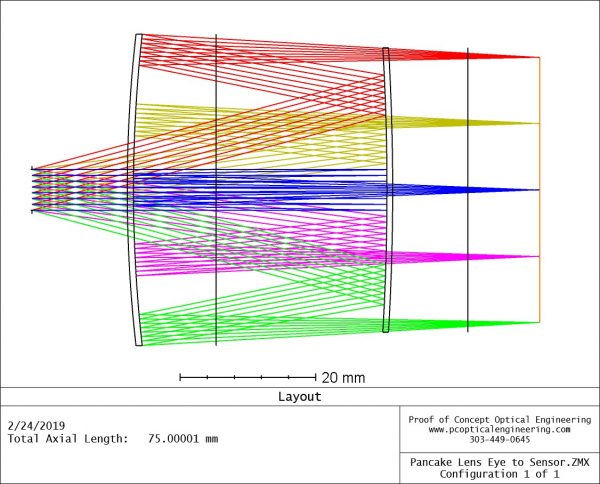
Using polarization, it’s possible to bounce light back and forth multiple times along an optical path before eventually letting it out and into the wearer’s eye. This approach (also known as ‘pancake optics’ allows the lens and the display to move much closer together, resulting in a more compact headset.
But to go even thinner—to shrink the size of the lenses themselves—Facebook researchers have turned to holographic optics.
Holographic Optics
Rather than using a series of typical lenses (like the kind found in a pair of glasses) in the folded optics, the researchers have formed the lenses into… holograms.
If that makes your head hurt, everything is fine. Holograms are nuts, but I’ll do my best to explain.
Unlike a photograph, which is a recording of the light in a plane of space at a given moment, a hologram is a recording of the light in a volume of space at a given moment.
When you look at a photograph, you can only see the information of the light contained in the plane that was captured. When you look at a hologram, you can look around the hologram, because the information of the light in the entire volume is captured (also known as a lightfield).
Now I’m going to blow your mind. What if when you captured a hologram, the scene you captured had a lens in it? It turns out, the lens you see in the hologram will behave just like the lens in the scene. Don’t believe me? Watch this video at 0:19 at look at the magnifying glass in the scene and watch as it magnifies the rest of the hologram, even though it is part of the hologram itself.
This is the fundamental idea behind Facebook’s holographic lens approach. The researchers effectively ‘captured’ a hologram of a real lens, condensing the optical properties of a real lens into a paper-thin holographic film.
So the optics Facebook is employing in this design is, quite literally, a hologram of a lens.
Facebook’s VR research division is presenting prototype VR optics smaller than any we’ve seen yet for the annual SIGGRAPH computer graphics conference.
The ideas behind the “holographic near-eye display” could one day enable VR headsets with sunglasses form factor- but for now this is solely research with limitations.
Why Are VR Headsets So Bulky?
The primary driver of the size and bulk of today’s VR headsets is the optical design. Magnifying a display over a wide field of view requires a large, thick lens, and focusing it at a viewable distance requires a long gap to the display. After adding the housing needed to contain this system, even the most minimal designs end up over 350 grams.
The standalone Oculus Quest, with a battery, mobile chip and lens separation adjustment, weighs 571 grams. Many people find it hurts their face after a few minutes.
Panasonic and Pico have shown off prototypes of compact headsets using “pancake lenses”, and Huawei has already launched this as a product in China. Without a tracking system or battery, these headsets end up around 150 grams.
Huawei’s VR Glass, sold in China, weighs 166 grams
However, these current pancake lens designs have a number of unsolved flaws. They block around 75 percent of light which can make the image look dim and washed out. They may also show faint ghost versions of the image slightly misaligned, and this “ghosting” only gets worse as you try to improve the image with a brighter source.
Holographic Lenses
Facebook Reality Labs’ new approach is a thin film where focusing is done by holographic optics instead of by the bulk of the lens. ‘Hologram’ in this context just means a physical “recording” of how light interacts with an object- in this case a lens rather than a scene.
Facebook claims the research may be able “to deliver a field of view comparable to today’s VR headsets using only a thin film for a thickness of less than 9 mm.” The total weight of the display module is claimed as just 18 grams. However, this does not include the actual laser source, and nor do any of the images Facebook provided. “For our green-only sunglasses-like prototype, we measured an overall maximum field of view of approximately 92◦ ×69◦,” according to the research paper.
By using polarization-based optical folding, these ultra-lightweight lenses can be placed directly in front of the display source.
Because holographic elements disperse light, the only practical illumination source is lasers used at specific angles and wavelengths. The researchers were able to “inject” laser light into a 2.1″ 1600×1600 LCD, replacing the backlight.
The prototype is currently monochrome, only capable of displaying the color green. The researchers have a tabletop-sized proof of concept for multi-color, and believe bringing this to the sunglasses prototype is “viable” with further engineering.
The range of colors laser light can deliver (known as the color gamut) is significantly wider than LCD displays, and in fact slightly wider than even OLED, so this would represent a milestone achievement if it could be moved into a head-worn system.
Early Research, Lofty Goals
It’s important to understand that what’s being presented here is just early research for a new kind of display system. If it ever becomes a product, it will also need a tracking system. And unless it connects to your phone with a cable, it’d likely need a battery and mobile chipset too.
Facebook describes this research as being on the same miniaturization research “path” as Half Dome 2 and 3, which it presented at Oculus Connect 6 back in October.
Those headsets are much larger than what’s being shown here, but achieved a wider field of view while also having eye tracking and variable focus. FRL says future iterations of this sunglasses prototype could also be varifocal by moving the lenses on a range of just 1 millimeter. This could theoretically be achieved with tiny piezoelectric actuators.
For virtual reality to reach Mark Zuckerberg’s lofty goal of 1 billion users, headsets need to get significantly more comfortable while increasing realism. While designs like the Rift S “halo strap” can redistribute weight, this is more of a bandage than truly addressing the issue of bulk.
Like all early research, this idea may never pan out. Practical issues may emerge. Facebook is simultaneously exploring a number of novel compact display architectures. If it can make even one work, it could do to VR what LCD panels did to CRT monitors and televisions.
Facebook’s research paper concludes:
“Lightweight, high resolution, and sunglasses-like VR displays may be the key to enabling the next generation of demanding virtual reality applications that can be taken advantage of anywhere and for extended periods of time. We made progress towards this goal by proposing a new design space for virtual reality displays that combines polarization-based optical folding, holographic optics, and a host of supporting technologies to demonstrate full color display, sunglasses-like form factors, and high resolution across a series of hardware prototypes. Many practical challenges remain: we must achieve a full color display in a sunglasses-like form factor, obtain a larger viewing eye box, and work to suppress ghost images. In doing so, we hope to be one step closer to achieving ubiquitous and immersive computing platforms that increase productivity and bridge physical distance.”
The company behind Oculus is moving closer to mixed reality glasses that can be worn all day, though there are still visual challenges yet to be overcome.Read More
As good as VR gaming can be, much of it assumes full mobility — and that risks leaving behind people with physical disabilities who’d love to play. That might not be an issue in the future for at least some games. 2MW has released WalkinVR Driver, a...
from Engadget RSS Feed https://ift.tt/3eIEivv
via IFTTT
Last week Iron Man VR developer Camouflaj told us that the upcoming PSVR exclusive featured around ‘8 – 10 hours’ of AAA VR gaming. Now the Iron Man VR trophy list gives us an idea of how that time is divided up.
The trophy list debuted on Exophase over the weekend. If you want to avoid spoilers then we wouldn’t recommend reading it, but the list and icons indicate that Iron Man VR is comprised of 12 missions and an opening prologue.
We got to see that prologue and the first mission in the demo that released on PSVR a few weeks back. Remember, though, that Camouflaj is kitting out the game with optional extras and challenges, taking part in which is likely to push the game to the developer’s estimations.
Other trophies confirm that the game will feature more Flight and Combat Challenges and that you’ll have star ratings at the end of each mission. You’ll also be rewarded for killing a certain number of enemies with specific weapons and completing the campaign of different difficulties. There’s also a trophy for catching a grape in your mouth which will probably be as hard as the basketball trophy in The Walking Dead: Saints & Sinners.
Not long to go now; Iron Man VR debuts on PSVR on July 3rd. Publisher Sony has been releasing a bunch of developer diaries for the game in the run-up to launch and Camouflaj shared plenty of other details with us in our interview.
Will you be chasing every trinket on the Iron Man VR trophy list when the game launches on Friday? Let us know in the comments below!


 , the content creation company that developed Gettysburg: A Nation Divided. “It was the turning point in the Civil War and the fight that led to freedom for slaves. Gettysburg shaped who we are as a people and as a country. It’s critical that we take time to remember what those before us fought for and what they achieved.”