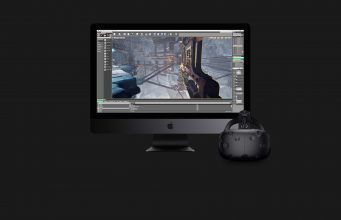
Valve is calling it quits on macOS support for its virtual reality platform. A Valve employee posted an update to the company’s SteamVR forums noting that “SteamVR has ended macOS support so our team can focus on Windows and Linux.”
Apple introduced “Metal for VR” back in June 2017 and highlighted a partnership with Valve. At the time, Valve was pushing VR as a platform and working with HTC on its Vive system; fast forward to 2020 and Valve has its own high-end headset and has just released its highly-anticipated title Half Life: Alyx.
This impacts developers more so than actual gamers.
Almost no games supported Mac and even Apple’s highest end MacBook Pros failed to meet minimum specification requirements for Oculus or SteamVR.As the folks atUploadpoint out, Valve’s recenthardware surveyshowcases that just 4% of gamers on the platform use macOS to begin with, suggesting a pretty small sliver of actual gamers even fit in the Mac-owning VR user Venn diagram.
Game developers building VR content on Mac likely enjoyed the ability to develop and test on a single machine. As Apple aggressively chases professionals with high-priced gear like the Mac Pro and iMac Pro, it’s not a great look when a major software platform decides you’re not worth the effort.
How will modern retail adapt to a post-COVID-19 world?
Retail in early 2020 will see a decade of digital transformation compressed into a year due to COVID. But how can digital replace the physical? We are physical beings. We need physical goods to live our daily lives. There’s no replacing this. But we have been forced into a situation where augmented reality is necessary for us to cheat our physicality.
Today AR is being used from the point of conception all the way to the post-purchase customer experience. It gives us the ability to create and sell physical goods using virtual and digital tools to speed things up.
Driving Online Traffic
To make up for the lack of foot traffic and brick and mortar revenues, retail will have to focus on driving more traffic from digital channels if it wants any chance to stay afloat.
With more people inside, more internet devices, and growing online communities, there are new ways to reach people.
AR experiences are a new form of marketing that can generate buzz around product launches and interest in purchase.
OnePlus just released their new device in an AR unboxing on Instagram.
From a OnePlus forum post:
“We’re using simple AR tech to bring a virtual experience of our new products to the community. We’re launching two AR filters on our Instagram channels. One for the OnePlus 8 and the other for the 8 Pro. These filters are a sweet setup to help you virtually unbox the OnePlus 8 Series at any place and at any time.”
These filters allow for a richer connection between the customer and the product, further communicating the brand or product’s value.
Driving Foot Traffic to Brick and Mortar
For retailers to stay alive following COVID, there will be a great need to get people back into their physical stores. Location-based foot traffic, in-store dwell time, and brick and mortar buying habits have all been thoroughly disrupted. So what are retailers to do?
In-store experiences will be vital in adding value and attracting customers. AR can help here by:
Having affiliated AR games or experiences that place virtual objects or tasks in store. According to YES Marketing study, 57% of consumers said they were using smartphones and mobile devices to enhance their in-store shopping experience.
Having specialized AR campaigns that are geofenced in the store like Pokemon Go’s characters are hidden in the real world. This can be discounts that are only revealed through your phone while in store and provided to the customer in a way that communicates the brand in a special way.
What happens to a company that has the most interesting, rich, and mature AR environment designed as a virtual layer in its physical stores? Will they increase dwell time? Will brand loyalists be reinvigorated and stay loyal? Will employees enjoy the working environment more? Will conversion rates for in-store purchases rise?
Online Conversion
AR is now essential for the customer buying experience. According to this USA AR survey:
72% of customers purchased items they didn’t plan to buy because of AR.
71% of customers shopped more when they used AR.
61% preferred stores with AR experiences.
The best quality product models in AR are coming from M-XR who have mastered lighting of virtual objects to make them real. For example, the shoe you see below is not really there. Can you tell?
Facebook’s campaign with Michael Kors saw a 14% lift in incremental purchases.
Ikea’s Place AR app is changing how furniture is sold.
Macy’s
Macy’s furniture app increased Average Order Revenue by 60%. And maybe more impressive: shoppers who used VR had less than a 2% return rate on transactions.
AR for Post Purchase
Completing the move to cheat physicality, AR will also transform and become the standard for post purchase product experiences. It can be used for instruction guides, product information, and training. It can also become part of the product experience, further developing a brand’s impact in everyday life.
Assembling furniture and other complex products has been a problem for consumers and brands alike. Beautiful tables in store or in photos are meaningless if you can’t put it together as advertised. Product assembly like the conceptual mobile app called AssembleAR allows people to see the optimal setup and steps for assembling furniture at home once they take the product out of the box:
Product Training
AR also allows for the spatial layout of information, making it easier for the brain to process individual parts and how they fit together. This can help customer support professionals and technicians better access information they need in the field.
AR and 3D Asset Management
It’s clear that AR is becoming prevalent throughout the product design and purchase journeys. So how can your organization best take advantage of this transformation? Find a team like Shape Immersive to lead you through the journey and help you build your assets and experiences.
Organization Tips:
All your physical products should be created in multiple 3D formats and made accessible across the organization.
A common CMS (content management system) should be employed org wide.
3D Asset Creation
You should create a working group that meets periodically to assess and synthesize your 3D asset activities. 3D artists produce most 3D assets for AR manually. While parametric modelling programs like Revit, AutoCAD or Rhino can be used to quickly generate 3D objects from CAD, STEP, or STL files, no matter which technology is used these initial 3D models will require additional tuning to achieve photorealistic results and highly skilled 3D artists in order to produce the best 3D models.
Bringing together engineers, marketers, designers, software developers, and customer experience leaders will allow you to create cross-functional strategies for best managing your virtual assets.
If you need help selling more with 3D commerce, developing 3D assets for AR and VR, or immersive brand experiences feel free to email me at james@shapeimmersive.com.
For Valve’s part, the company had continually updated SteamVR alongside Windows and Linux versions. Simply adding MacOS support to SteamVR didn’t mean existing SteamVR content would suddenly work on MacOS, developers would still need to spend plenty of time porting their games to the OS. With the vast majority of the VR audience (and gamers in general) on Windows, it seems few developers thought it would be worth their time to do so; less than two dozen SteamVR games offer support for MacOS now three years after support landed.
This week Valve quietly announced that it has ended support for SteamVR on MacOS, “so that our team can focus on Windows and Linux.” The company advised that legacy builds will remain, and that developers and users can opt into the SteamVR [MacOS] beta branch via Steam to continue to use those builds.
SteamVR was the only major VR platform to support MacOS since early Oculus development kits; since then Oculus has steered clear of MacOS.
We discuss Oculus Quest coming back in stock, Half-Life: Alyx getting mods, AI Beat Saber Maps, Quest 2’s possible specs, and the layoffs at Magic Leap.
Unlike regular video podcasts, The VR Download is broadcast from virtual reality! Our team are together in a virtual space, giving us many of the benefits of a studio even though we live on different continents.
Oculus Quest turns one year old this month. Since its launch on May 21, 2019, the standalone VR headset has grown by leaps and bounds beyond its original release.
Facebook CEO Mark Zuckerberg says Quest surpassed his expectations and there’s more than 170 pieces of content available for it officially through the Quest store. In addition, a growing sideloading ecosystem led by SideQuest offers developers a route onto the headset with experiments in hand tracking or early testing releases meant to build community without explicit approval from Facebook for store release. We’ve also heard from a number of developers who are seeing some of their strongest sales in VR ever on Quest. Facebook bought Beat Games and Sanzaru Games, and leaks have revealed the “Del Mar” developer kit and “Jedi” controllers.
Still, it is a difficult time for casual technology watchers to understand market viability in VR. While headlines in mainstream publications like Wired and the New York Times are waking up the general public to the standalone VR revolution, Facebook still sells (at the time of this writing) its severely limited Oculus Go hardware. Meanwhile, clickbait writers hungry for pageviews turn off comfort settings in Half-Life: Alyx and cry foul even when one of the best VR games ever made was carefully designed to on-board a wide range of people with maximum comfort.
So what exactly is going on and what’s likely coming in the next couple years?
We believe Facebook is selling its Oculus Quest hardware ($400 or $500 depending on storage) either at cost or even at a (large) loss. Combined with Facebook’s significant ongoing investment in content, and the billions spent annually on research and development, Facebook is making it difficult for competitors to justify entering a hardware market just to lose money for years trying to catch up to what’s already more than half a decade into Zuckerberg’s long-term bet on VR.
All this to say that while Facebook’s non-advertising-related revenue from things like VR still only amounts to roughly $300 million over three months, compared with nearly $18 billion for its overall business in the same period, its unique approach to the market for standalone VR means there’s little to keep that number from growing significantly — already up 80 percent over the year ago quarter — in the years to come.
How will Facebook do it? By making what makes Quest great even better. Here’s what I think that likely means for a future headset that might be based on the “Del Mar” codename.
Before I go any further, let me be clear that demand for the current Quest outstripped supply even before the COVID-19 pandemic. That likely means the priorities for Facebook’s VR division in 2020 are simply to make enough Quests for people to buy, improve the headset with software updates and help developers make or polish apps for the current system.
What comes after that? Here’s what I’d expect to see from Facebook’s next Quest:
No Visual Sacrifices
The first generation of high-quality PC VR headsets set a standard using OLED displays refreshing 90 times every second and recommended specifications for software and PCs meant to make that mark the bare minimum for comfort.
Next generation VR headsets that released in 2019, like the Quest, and even Rift S, fall short of those refresh rates (72 and 80 respectively) while Valve Index can refresh up to 120 or 144 times per second with a superpowered PC. Those refresh rates aren’t the whole picture, though, because some modern headsets also use LCD panels that feature lower persistence than their OLED counterparts. Lower persistence equates to less noticeable blur (aka smearing), but LCD displays also sacrifice deep blacks that can turn dark VR environments into muddy grays.
We think it’s likely Oculus Go goes away soon and the eventual “Del Mar”-based successor to Quest might be able to display visuals up to 90 frames per second — either in standalone mode or PC VR mode. I’d even bet on an OLED to get those darker blacks. No matter the actual number on a specification sheet for a finalized Quest successor, I think Facebook is likely making it a priority to make the next Quest not a visual step down from either its first or second generation of PC VR. It is just too valuable to Facebook for them to be able to market a future Quest as being their best VR display ever, and for it to work at increased fidelity compared to their current offerings either in standalone or PC VR modes.
Better Hand And Controller Tracking
Oculus Quest controller-free hand tracking carries an “experimental” tag and, though it does appear to be an active goal at Facebook to improve the fidelity of the input system such that some games will gain support for it — it remains an open question how far Facebook can take the technology on current generation hardware.
A next generation Quest, though, might feature cameras that sample the environment at higher rates (or feature more cameras) to track both hand movements and controllers faster and with greater reliability. Our recent analysis of the “Jedi’ driver code suggests there could in fact be such a mode for next generation Oculus Touch controllers. While I also hope for better haptics in future Oculus controllers, tracking is believed by some researchers to be the single most important feature of any VR system. And that means any improvements in Quest hardware to the tracking of hands and controllers will pay dividends to immersion, and therefore Facebook’s revenue growth.
Better Balance
Removing weight from the front of Quest is probably the first thing anyone who uses a Quest wants after even five minutes of usage. We’ve found great success with the VR Power battery pack and building our own Frankenquest just by counterbalancing this front-heavy design.
If Facebook engineers can fix this problem in the next Quest by, say, moving certain parts of the system to the back of the head (like the battery) we think that’ll be a huge improvement all on its own. If they can do it while achieving the other improvements listed above? That’s going to not only make standalone VR more comfortable and inviting for a wider range of people, but would also encourage a lot of original Quest owners to upgrade while selling or passing on their original systems to new VR owners.
Conclusion
Facebook’s Quest could also use improvements to its audio experience. The Index off-ear speakers are a revelation and there’s even a well-funded Kickstarter project looking to make that approach to audio an add-on for any VR headset. Still, while I’d love the built-in audio on Quest to improve, I’m not convinced it’s as important as the other things the next Quest is likely to have.
Product design is about making trade-offs and Facebook designers have shown they’re ready to make shrewd and smart choices about what features to focus on in their products. Making VR easier to use by making software do incredible things — like rapid room-scale setup — all while decreasing the price of the overall package is the theme of Facebook’s first few years of VR product development. I expect that trend to continue into the next generation.
If “Del Mar” truly becomes a Quest successor — or perhaps an add-on to its product line — and hits these notes in the next two years, would Rift S stay in market even as a severely discounted PC-only option? Ripping the beta label off Oculus Link or building a wireless link might make the original Quest a formidable entry level PC VR headset with the considerable benefits of standalone and a price discounted below its current $400 level. Meanwhile, whatever “Del Mar” becomes could take the $400 and $500 VR pricing tiers while making fewer comfort and visual tradeoffs as compared to the gap between the current Rift S and Quest.
If Facebook is having trouble making enough Quests, focusing their VR efforts even further around the Quest product line might enable them to actually keep up with demand. To be clear, I’m not suggesting an end to the Rift or Go product lines — I believe there are markets for PC VR and lightweight social connections wherever you are — but I think Facebook is likelier to focus near term on hitting more home runs in the Quest ballpark than playing those other games. VR headsets which are comfortable to wear all day or sense more of your face movements for better social connections anywhere could certainly see the light of day in the long-term, but I think the next two years for Facebook are all about superpowering the Quest lineup.
As if we all needed something to terrify us right now; indie developer Come Over Gaming has announced its first title, a horror game called DreamBack VR.
In this psychological horror, players embody an electrician still in shock (pun not intended) after being called to a mysterious mansion to repair an electrical power line. It’s not long before your routine job transforms into a nightmare, one that the protagonist suppresses from their mind. That is until they seek our a psychiatrist to reawaken those memories and face them head-on, which is where you come in. Check out the trailer below.
Yup, looks like another chance to ‘nope’ out of a VR game! Gameplay will be comprised of exploration and puzzle-solving; there’s no combat. DreamBack is built for VR using Epic’s Unreal Engine 4. Judging by the trailer and screenshots, the world appears detailed and fully interactive. We’ll have to wait and see if it will really send shivers down our spines, though. Let’s hope it’s more Resident Evil 7 than it is Weeping Doll.
For now, DreamBack is aiming to release in 2020. It will carry official support for Oculus Rift, HTC Vive, Valve Index and Windows VR headsets. No word on possible Oculus Quest or PSVR versions yet. Elsewhere in VR terror, stealth horror game Follia is launching on headsets today. Because what could we all use more right now than a little existential threat?
Espire 1: VR Operative (2019) launched late last year on all major VR headsets, offering up some very Metal Gear Solid style stealth action to VR players. Now developers Digital Lode have announced a major update, called ‘Assimilation’, which is slated to bring to the game a host of new weapons, challenges, and features next week.
Launching on May 5th, the update will be available on all supported platforms, which includes Oculus Quest, Oculus Rift, HTC Vive, Valve Index, Windows VR headsets, and PSVR.
Check out the changes coming to the game below:
New Weapons
Vector SMG: This semi-auto weapon is an excellent choice for mid-range combat, providing for accurate and quick bursts of controlled fire with one bullet firing upon the first trigger press and the last bullet firing upon release. With an extended clip of 45 rounds and very low recoil, it is the weapon of choice for the new “SMG” weapon challenge mode.
Sawed-off Shotgun: Get up close and personal with this new shotgun, boasting a wider spread fore close quarters combat. Its compact design allows for the shotgun to be holstered as either a sidearm or primary weapon — and reloads via magazine clip instead of individual shells.
New Virtual Challenge Game Modes: Experienced Espire agents can also look forward to three new Virtual Challenge game modes, featuring new stealth gameplay not featured in the campaign. These new Virtual Challenges focuses on Weapon mastery, Climbing, and Intel gathering stealth skills essential to completing missions quickly and efficiently. Test your skills against players around the world with an improved leaderboard.
Weapon Challenges: Run, weave, duck, climb, jump and zipline your way through seven courses designed to test your mastery with each weapon class. Rack up the highest combo while eliminating static, moving and explosive targets, as well as enemy combatants in order to reach the top of the leaderboard.
Climbing Challenges: Overcome climbing puzzles where speed and timing is paramount to completing the course with the highest score. Make sure to avoid getting squashed by the fast-moving crushers!
Intel Challenges: Explore four completely new environments. Locate and hack intelligence from all workstations in the area, and reach the extraction point. This game mode builds on the core Espire gameplay from the campaign.