Thursday, 30 January 2020

Blood, Sweat, And Physics: How Boneworks Turns Your Body Into Its Key VR Game Mechanic

https://ift.tt/36Fs1TX

When Boneworks (read our full review) released late last year from Stress Level Zero it led the charge in redefining how we interact with virtual objects in digital space. We took some time to speak with Brandon Laatsch from Stress Level Zero about the game’s innovations and successes.

By all accounts, Boneworks seems to have single-handedly ushered in a new era of interaction in VR games. For the next year or two I’d imagine we’ll often discuss types of interaction systems in terms of “pre” and “post” Boneworks. Or in other words, Stress Level Zero did some really impressive and immersive things with the way the game handles physics.

In most VR games before Boneworks when you reach out to touch something your virtual hand passes through it or becomes a silhouette of some kind to indicate you can’t do that. If you try to push open a door it doesn’t work unless you grab the door knob. If you want to shove an enemy you need to grapple them in the right spots and if you want to hit something hopefully you’ve found the right item and swing at something that’s assigned as having collision properties.

It was almost as if we were in the middle ground between traditional video games, limited by buttons and thumbsticks, and VR games, ideally limited only by the range of your body movement. It’s demonstrated best in this pseudo “Museum of VR” you find in the opening moments of Boneworks.

“After Duck Season we had a lot of ideas for what we could do that we felt would be much more mainstream and really push the medium forward, especially physics interaction in VR,” says Laatsch. “We had a lot of ideas from making YouTube videos [with Node] and seeing what people are responding to. Viral marketing is what sells games. What’s gonna sell new technology to people is seeing what their peers and people they relate to are playing and what they think of things. So we’re like, well, it’s very important to consider presentation inside the headset, as well as presentation outside of the headset.”

Boneworks Review 2

That’s on display immediately in Boneworks. When you pick up something that’s clearly heavy, like a metal barrel or a two-handed sledgehammer, you have to treat it as such. An early sign posted during the tutorial segment instructs you to pretend you’re lifting something in real life even though there’s not actually anything in your hands. Mime it, if you will.

That not only tricks your brain into moving accurately, but also makes it more entertaining and believable to watch for a viewer — which is crucial not just for selling VR to a consumer, but demonstrating it to friends too.

boneworks flashlight pistol

“We went after the genre of a physics action adventure FPS because it has a long tradition in the game industry of being a strong performer,” says Laatsch. “It’s what Sony goes after for a lot of their big tent pole releases.

“So we wanted to go after that and beyond and really tried to take a stab at being what we think action-adventures genre could become in VR, like, what does VR enable and that’s where the marriage of physics came in. Physics for a game can only go so far with a keyboard and mouse, you know. Following the launch of Half-Life 2 in 2004, you would say, ‘Oh, wow, the  keyboard and mouse is really spectacular for physics input!’ But since then, in over 15 years, not a ton of expansion on physics has happened. You can list off some, like The Legend of Zelda: Breath of Wild, you have  Red Faction, a handful of fitness games that have risen to the top, there’s Bioshock, There’s a handful of them, and then in terms of game design, a lot of that stuff somewhat stagnated over the last few years.”

If you draw a line charting the changes in how players interact with digital worlds using keyboards and gamepads since Half-Life 2, that line doesn’t have many fluctuations in it other than the titles Laatsch cites specifically.

Imagine playing a game like The Elder Scrolls V: Skyrim (VR or otherwise) with an actual physics-simulated world rather than just a bunch of geometry you walk across and pick up a few items in. Bethesda does a great job of selling illusions, but when you craft a world full of physical interactions the illusion starts to become reality, at least virtually.

“Then we looked at VR input devices, like we have this three 6-DOF tracked devices between the headset and controllers and they’re very accurately tracked,” says Laatsch. This is the input we’ve been waiting for to be able to push things further, right? To push to beyond what’s out there in traditional gaming. And the nice thing too is because it’s your actual body, there are real world limitations to how fast those tracked devices can move. It’s not like the flick of a mouse where you can send your character spinning in a circle super rapidly because in the real world you can only move your hands so fast and you can only accelerate your hands so fast or whip your head so fast. Like there’s actual real world constraints which are tied to your own anatomy, right?”

boneworks holding gun

This is where the miming of actions becomes even more important. In a lot of video games your character learns new abilities and can suddenly swing weapons faster, hit harder, and do unnatural maneuvers that defy the laws of physics. But to instead flip things around and use the laws of physics as the basis for your gameplay puts added stress on your actual body. What looks cool and feels cool are often very different things in VR.

“So we figured this is ultimately where physics can take the next step. Boneworks is not saying, ‘Here’s a complete exploration of what can be done with physics in VR’ though, like no, we think of it as this is the beginning of it.

“And it’s our job and everybody else’s job, hopefully, to now try to go and, as much as I hate to say it, make Boneworks age poorly. Like, we want to look back in 10 years and say, ‘Dang! It was awesome for the first time, but it’s unplayable now!’ That just means that we’ve done a great job here and now.”

“We had to figure out what a longer form VR gameplay session looks like,” says Laatsch. “Like, how fast can you move and how quickly can you do things? Eventually playing just gets way too tiring for long sessions. We had that experience and compared to something like Sprint Vector, where it’s like, everyone only has a few good a few races in them where they’re trying their hardest before they get too tired…In that case, it’s a race. It’s supposed to be exertion. But looking at the action-adventure genre and looking at how we can encourage people to play for an hour-long session or two-hour long session or, you know, whatever…To try to stand, you know, try to be on your feet all day is like a very full day at work, and you come home, then you’re exhausted.”

As someone that often binges VR games to get through them for reviews, I can personally confirm how exhausting many of them tend to be. But as the medium continues to evolve and grow, making room for more physical games (without leaving behind less intensive experiences) is important for innovation.

“Design-wise we wanted to make something, reckoning back to what I was saying earlier about reading well to the 2D viewer as well as to the in-headset viewer,” says Laatsch.

“Ultimately, where does it go? It seems like VR is, you know, we’re getting to a great point in terms of the amount of installed hardware on the PC side of people having CPUs and GPUs powerful enough to buy it. They’re just a headset away and we’re seeing the headset conversion starting to really ramp up with a good assortment of quality headsets out there for them to buy.”

boneworks scope test chamber gun


For more on the evolution of physics in VR, make sure and check out The Walking Dead: Saints & Sinners, which recently released, and Half-Life: Alyx, which is coming soon. You can also read our editorial on why these three games, including Boneworks, are so important.

Boneworks is available on Steam with support for all major PC VR headsets for $29.99. Read (or watch) our full review right here at UploadVR.

The post Blood, Sweat, And Physics: How Boneworks Turns Your Body Into Its Key VR Game Mechanic appeared first on UploadVR.


from UploadVR https://ift.tt/2RGxLZh
via IFTTT

Facebook CEO: “On Christmas Day, People Bought Almost $5M Worth Of Content In The Oculus Store”

https://ift.tt/2uPVzBa

Mark Zuckerburg reveals interesting new sales figures during a Q4 2019 earnings call.

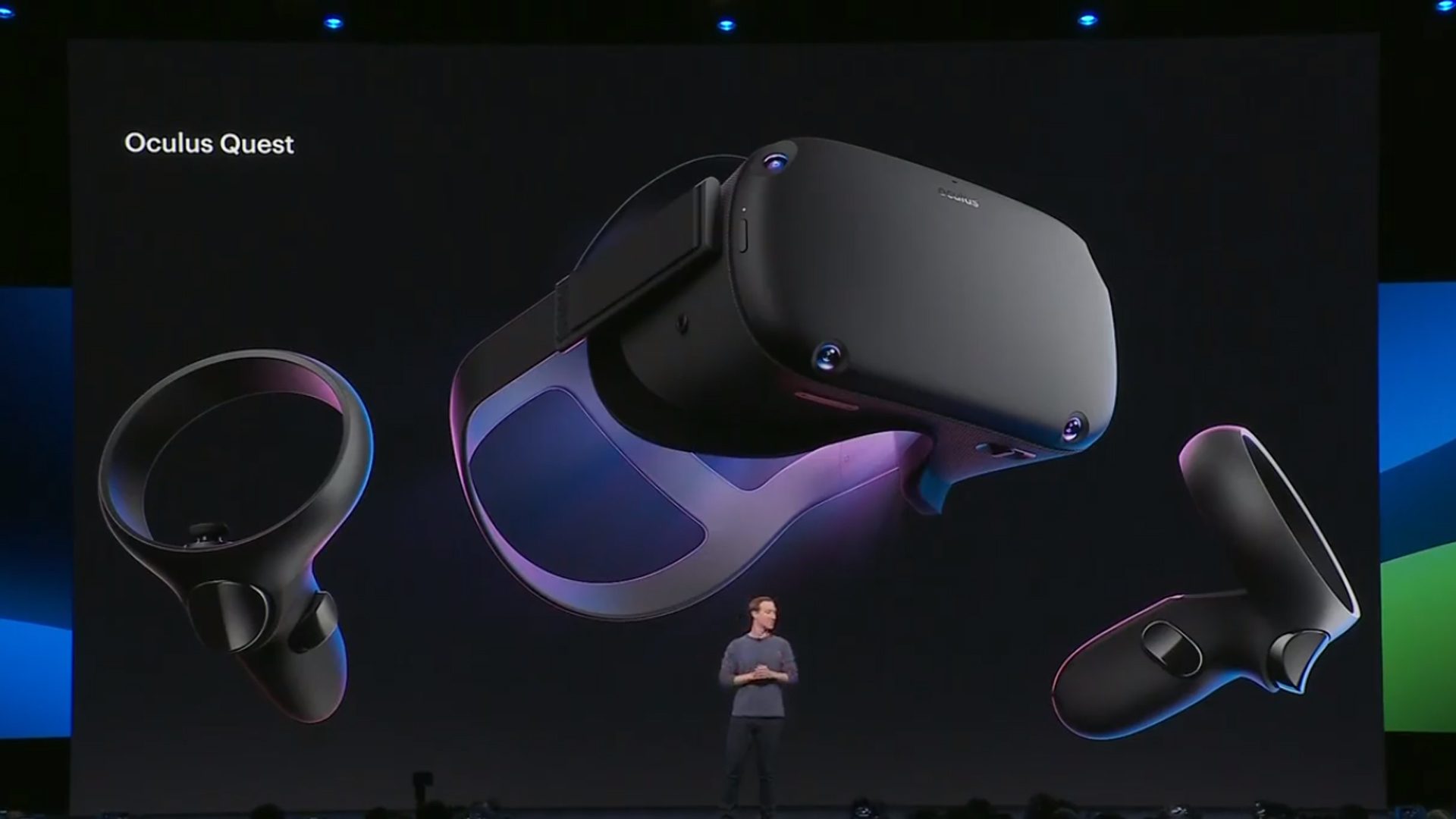
If you were one of the poor souls desperately trying to purchase an Oculus Quest this holiday season, you know better than anyone how difficult it’s been to locate a headset whose price hasn’t been inflated hundreds-of-dollars by third-party sellers. It’s clear Facebook’s standalone headset was a go-to gift this year, but a recent Q4 2019 earnings call delivered by Facebook CEO Mark Zuckerburg sheds a little more light on Oculus’ success these past few months.

According to the Zuck, nearly $5M worth of VR content was purchased on the Oculus Store on Christmas Day; no doubt due in large part to the influx of new users who had been gifted their first Oculus headsets just that morning. 

Image Credit: Oculus, Facebook

“We’ve also been focused on delivering the next computing platform with augmented and virtual reality,” stated Zuckerburg after briefly shining the spotlight on small businesses. “This is the holy grail of social experiences and it’s going to let us build things we’ve only dreamed of for the last 15 years — like letting people interact as if they’re in person together no matter where they are, or letting people live wherever they want and hologram into work so they can access opportunities anywhere and don’t have to move to a city or another country for a job.”

“We hit a real milestone for virtual reality with Quest,” he continues. “Sales are stronger than we expected and people are buying and engaging with more content than we’d expected too. On Christmas day, people bought almost $5 million worth of content in the Oculus Store. That’s an outlier day, but still this is real volume by any measure and it shows the progress this ecosystem is making. The experience also just keeps getting better. Last quarter we shipped hand-tracking, which almost no one thought we’d be able to pull off with the Quest hardware. And we shipped Oculus Link so you can run all your Rift content from your PC on Quest.”

Zuckerburg also took some time to reaffirm the company’s commitment to AR technology as well. 

Image Credit: Nielsen Company

“On the AR side, while we’re working on the long term hardware and operating system, it’s worth noting that our Spark AR platform is the most widely used AR platform in the world with hundreds of millions of people interacting with effects every month. Artists are using this to create new face filters and other tools that are going viral across Instagram and Facebook. We’re well positioned here overall and we’re going to keep developing this platform.”

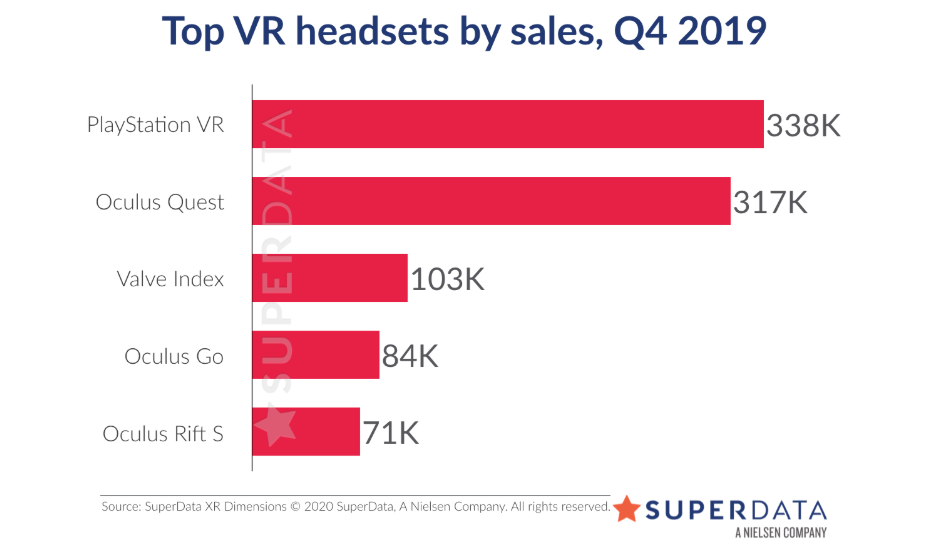
According to a recent SuperData report, Oculus sold over 705K Quest units in 2019, more than both the PC-powered Oculus Rift S and 3DoF standalone Oculus Go combined. Of course, there’s no way to confirm whether these figures are in fact accurate, a fact Oculus VR founder Palmer Luckey is quick to point out. 

For those interested in learning more about Oculus’ progress during Q4 2019, you can read through the entirety of Zuck’s earnings call here.

Feature Image Credit: Facebook Oculus

The post Facebook CEO: “On Christmas Day, People Bought Almost $5M Worth Of Content In The Oculus Store” appeared first on VRScout.


from VRScout https://ift.tt/2OeFcVz
via IFTTT

Arizona Sunshine’s Free Old Mine Update Adds Terrifying New Horde Map To Oculus Quest

https://ift.tt/2u3lrt7

Take on endless waves of Freddies in one of the campaigns scariest locations, the Old Dutchman Mine.

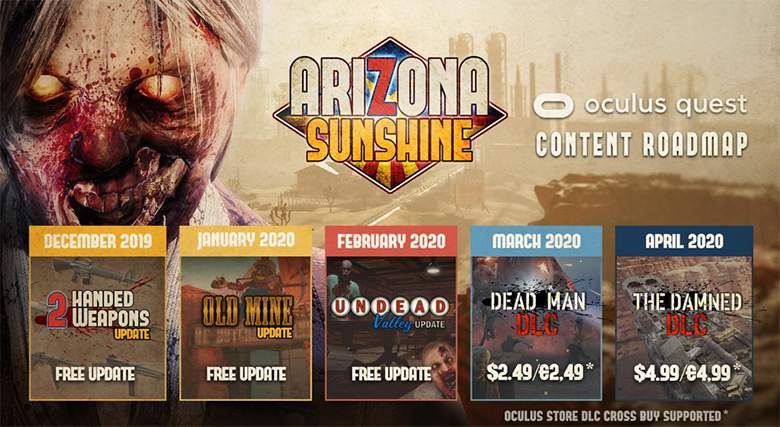
This past December, popular VR zombie shooter Arizona Sunshine made its way to the Oculus Quest, offering standalone users the chance to mow down hordes of undead flesh-eaters across a handful of captivating locations without the need of a beefed-up gaming PC. Later that month developer Vertigo Games released the Two-Handed Weapons Update, the first in a series of free updates heading to the Oculus Quest; this update introduced a handful of two-handed weapons such as the AK-47 and M1A1 Thompson. 

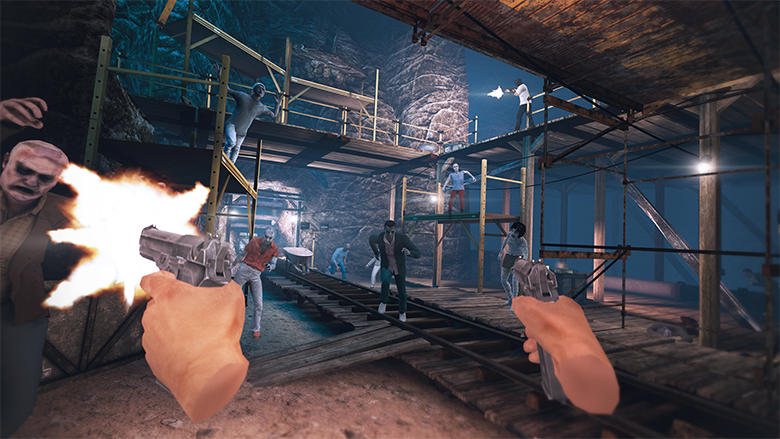
Today we received our second free helping of content, The Old Mine Update. Available now to all Quest users, this latest DLC release adds a new horde map to the mix, the Old Dutchman Mine. Lauded as one of the most unsettling locations featured in the main campaign, this underground network of bridges and tunnels is hands-down one of the worst places you’d want to find yourself stuck in during a zombie apocalypse. 

Image Credit: Vertigo Games

After playing a couple of rounds this morning, I found myself approaching each wave of enemies with a bit more strategy than I had while playing the original horde map. Tight corners made it easy for Freddies to sneak up on my team and me undetected and the maze-like system of ramps and platforms made ammo caches difficult to access. Of course, the biggest challenge is the map’s lighting.

Armed with a single flashlight, I kept my eyes fixated on the shadows around me, each one serving as the perfect cover for a flesh-hungry zombie. Even with my head on a constant swivel, it was difficult to keep track of the dozens of zombies that were spilling out of every crack and crevasse of the decrepit underground shaft.

Image Credit: Vertigo Games

To assist players in surviving this nightmarish map, Oculus has provided a handful of survival tips that should prove useful while navigating the Old Dutchman Mine:

  1. Get to know the map. Explore as much as you can early on. Knowing where the ammo will be is a big advantage when the Freddies are coming.
  2. The Freddies are endless. Before you can clear the first wave, another wave is already incoming! So keep moving and keep collecting ammo—you will definitely need it.
  3. Build a solid loadout. A shotgun and a pistol is a good combo. Try to aim for the head to conserve ammo, and when they get too close, use your shotgun to get rid of them fast.
  4. Bring a friend—or three. You’re stronger in a party. Having someone watch your back while you reload is vital, and getting that new weapon from a difficult spot is easier with someone at your side.

Arizona Sunshine’s next free update, Undead Valley, will offer yet another free horde map to standalone users when it arrives on Quest headsets next month. Following the release of Undead Valley will be the first of Arizona Sunshine’s two paid DLC add-ons, Dead Man DLC, for $2.49.

Arizona Sunshine is available now on Oculus Quest for $34.99.

Feature Image Credit:

The post Arizona Sunshine’s Free Old Mine Update Adds Terrifying New Horde Map To Oculus Quest appeared first on VRScout.


from VRScout https://ift.tt/2OdpNox
via IFTTT

A Gorgeous Center for Photography, Far From Picture Perfect


By Arthur Lubow from NYT Arts https://ift.tt/2vBubHl
via IFTTT

Join Us LIVE On YouTube To Discuss The Week’s News & The XR/VR/AR/MR Debate

https://ift.tt/2raxovc

UploadVR’s weekly podcast, The VR Download, is LIVE on YouTube today at 10:30am PST (18:30 UTC)!

Unlike regular video podcasts, The VR Download is broadcast from virtual reality! Our team are together in a virtual space, giving us many of the benefits of a studio even though we live on different continents.

This week’s Hot Topic: What do the terms VR AR MR & XR actually mean? Does it matter?

If you want to know more about The VR Download, head on over to our new webpage for the show!

As always, we’ll also be making it available for audio-only listening on Apple, Google, Spotify, TuneIn/Alexa, Stitcher, and more within a couple of hours of airing.

Watch In VR With Bigscreen!

Every episode, you can watch The VR Download LIVE in virtual reality with an audience of other VR users on any major VR headset (including Oculus Quest and Oculus Go!), via the Bigscreen platform.

Click on the image above to subscribe to the event.

The post Join Us LIVE On YouTube To Discuss The Week’s News & The XR/VR/AR/MR Debate appeared first on UploadVR.


from UploadVR https://ift.tt/2GAJtOX
via IFTTT

Facebook’s Non-Advertising Revenue Growth ‘Driven By Sales Of Oculus Quest’

https://ift.tt/2S25Rpt

During Facebook Q4 2019 earnings call, CFO David Wehner revealed that ‘Other’ revenue growth in 2019 was driven by the company’s room scale standalone VR headset, Oculus Quest.

“Other revenue was $346 million, up 26%. Year-over-year growth was driven by sales of Oculus Quest.”

Additionally, CEO Mark Zuckerberg stated that Quest sales “are stronger than we expected” — a statement he has not made about any other Oculus headset.

It’s important to note that “Other” is the smallest section of Facebook’s revenue. The company’s main business is still targeted advertising, which brought in over 98 percent of revenue.

Facebook did not give specific sales numbers for its consumer VR hardware products, and it has never done so.

Comparing To Go & Rift Statements

A year ago, during the Q4 2018 earnings call, Wehner stated that Oculus Go, the company’s previous standalone headset, “contributed” to growth in that quarter. Go is a low end headset which can only track your head’s rotation, not position.

However, Go was also mentioned as also being a notable contributor to costs, in the form of marketing. This likely referred to its celebrity campaign featuring Wiz Khalifa, Jonah Hill, Adam Levine, Leslie Jones, and Awkwafina.

Oculus Go celebrity marketing
Oculus Go sales were notable in holiday quarter 2018 when the company launched an expensive celebrity marketing campaign.

The Quest statement from this week’s call is more significant because it referred to the entire year, not just the holiday quarter. Both Quest and Go launched in May (of 2019 and 2018 respectively). Quest driving non-advertising growth for 2019 despite launching almost half way through the year is thus fairly significant. However, this has to be balanced with the fact that each Quest sale earns twice the revenue of a Go sale.

Unlike Go, no mention was made of Quest contributing significantly to marketing costs. While Facebook has taken a more games-focused approach with ads such as Defy Reality, the ads without celebrities have also been blasted pretty widely across many channels.

In 2016 after the Rift launch Wehner had very different news, simply stating “It’s not going to be material to our financials this year.” That is the only time the Rift line’s financials have been referred to in Facebook earnings calls.

Quest: The Ideal Middle Ground?

The Oculus Rift delivered a high end positional tracked VR experience back in 2016, and the Rift S continues that category of PC-based VR. But the relatively small existing ownerbase and high cost of gaming computers limit this market’s size.

The $200 Oculus Go delivered on a low cost, completely standalone experience in 2018. But its lack of positional tracking and limited laser pointer controller meant it just doesn’t have the immersion or active content that 6DoF VR can deliver.

Quest appears to deliver on the ideal middle ground. In many ways, it is the type of VR headset Oculus always wanted to build, even before the Facebook acquisition. Fully standalone and wireless, but with room scale positional tracking and tracked controllers.

This lets Quest play the same kind of active room scale games as PC VR, while still remaining relatively affordable. The combination of these factors is the product’s unique offering.

oculus quest

Quest has been consistently backordered since late November. In the US, a Rift S order placed on the official sales site at this time of writing would arrive on Monday, whereas a Quest would arrive four weeks later. Facebook executives stated on multiple occasions that it is building Quest “as fast as we can”.

When Quest was formally announced as a product in September 2018, many in the industry were skeptical that its smartphone processor could deliver compelling enough experiences to drive consumer interest. Those doubts seem to have disappeared as many of PC VR’s most popular titles have been ported to the standalone headset. The graphics are much less detailed of course, but they retain the full body movement and hand-based interactions which work at any level of graphical realism.

The post Facebook’s Non-Advertising Revenue Growth ‘Driven By Sales Of Oculus Quest’ appeared first on UploadVR.


from UploadVR https://ift.tt/319zmdq
via IFTTT

Mark Zuckerberg: ‘people bought nearly $5M in Oculus Store content on Christmas Day’

https://ift.tt/2GBqiEW

In Facebook’s quarterly earnings call yesterday, company CEO Mark Zuckerberg revealed that the Oculus Store had sold nearly $5 million worth of content on Christmas Day alone.

Zuckerberg says in the Q4 2019 earnings call that the Christmas Day boom was an “outlier day,” although it represents what he calls “real volume by any measure” and that it shows the progress the ecosystem is making.

While the Oculus Store provides hardware-specific VR content for the ‘tethered’ PC VR headsets Rift & Rift S, the 6DOF standalone Oculus Quest, and the more diminutive 3DOF standalone Oculus Go, this year’s holiday winner seems to have been Quest.

The standalone headset provides many of the top games made famous on PC VR headsets, albeit tailored to fit onto Quest’s humble Snapdragon 835 mobile chipset. Releasing support for Oculus Link a month before Christmas, Quest users can also now play Rift games too by connecting to a VR-ready PC with a USB-C cable.

Image courtesy Facebook

All of this combined with its $400 price point, and Facebook has managed to create a strong enough draw with Quest to send it out of stock since well before Christmas, with back orders still projected to ship in late February as stocks rebound from the holiday rush.

Facebook hasn’t released any info on whether its holiday bump in content sales was primarily due to Quest or Rift S owners, although the PC VR headset refresh did experience a much smaller backlog during the holiday season. It’s unclear if this was based on higher supply or lower overall demand, however our analysis of the Steam’s hardware survey month-over-month for the year of 2019 reveals that Rift S increased its VR market share on the Steam platform by about 4% from November to December, which represents roughly 18.46% of total connected headsets through Steam. With most VR games, save a few Oculus Rift exclusives, purchasable through Steam, it’s very likely the Quest ‘walled garden’ approach has garnered the company most of its content sales during that Christmas boom.

You can read the whole transcript on Mark Zuckerberg’s Facebook post.

The post Mark Zuckerberg: ‘people bought nearly $5M in Oculus Store content on Christmas Day’ appeared first on Road to VR.


from Road to VR https://ift.tt/3aOfnFk
via IFTTT
Related Posts Plugin for WordPress, Blogger...