Immersive storytelling could be the future of brand marketing.
Social media platforms are optimized for every pixel and millisecond of content. As we approach the end of 2019 and look back at the most successful advertisements and marketing campaigns of the year, not one of them has involved the use of VR or AR technology.
Advertising metrics, like the platforms that use them, have been carefully quantified and qualified for user experience, impressive statistics, and micro-analysis. Companies that use AR and VR commercial content like Ikea, Disney, and Warner Bros are using this medium for advertising performance.
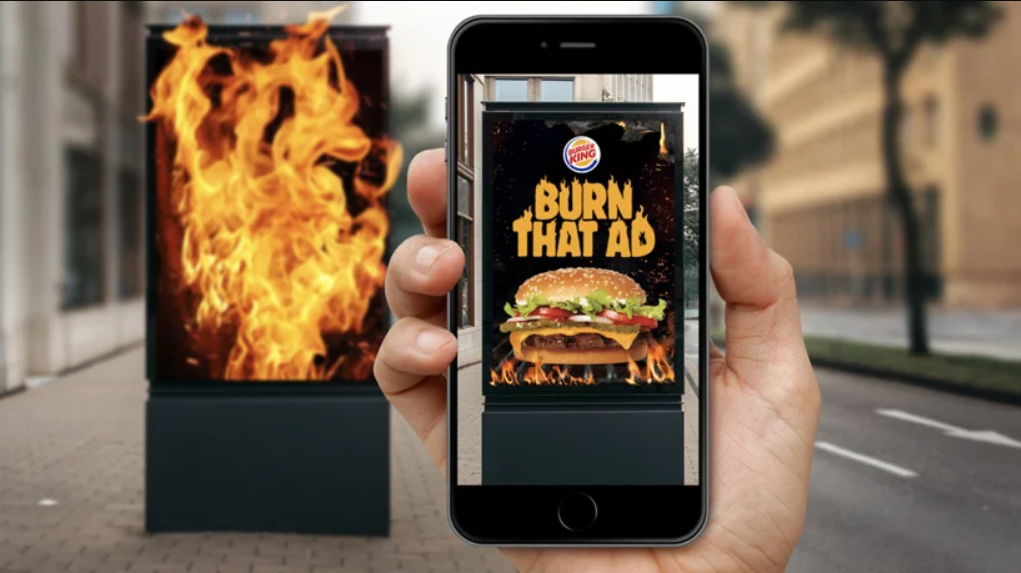
Burger King promotional campaign in which users could light McDonald’s ads on fire in AR / Image Credit: Burger King
Studies on the psychology of VR and AR have proven beyond doubt that immersive technology leads to the most effective and impressionable form of content. It increases the ability of a viewer to recount key facts, enables them to engage with content for longer periods of time, and has a more significant impact on the hearts and minds of the user than 2D video. At the Digital Entertainment World Expo this year, Tony Parisi, Head of AR/VR Ad Innovation at Unity, listed the following formats from most to least effective across mediums:
Live event content activation (as most effective)
VR/MR experiences
AR apps
AR ad
Mobile video
While there are many doomsday-like reads out there for VR and AR—their capabilities as advertising tools and their effect on consumers—it’s time to re-think advertising with this new medium. How can we create advertising as experiences that enhance our lives rather than interrupt it? How can we make content development a race to the top?
With a saturated video market, it’s been fascinating to watch Netflix and its contenders regurgitate plots, actors and old content while at the same time spewing out original shows and series. Today’s audience has the option to multitask. They can watch TV, scroll on a phone or tablet, or even stream what a friend is watching in real-time. With VR and AR, the same rules don’t necessarily apply—at least not yet. It’s one person for the most part and content is transfixing. It’s a focal point instead of background noise or a time-ticker; t’s significant, interesting, and new.
One of the primary challenges of VR and AR advertising is showing potential investors that it actually works. In the last two years, and especially in 2019, the perception has changed as VR and AR analysis has widely entered the global market after a round of educating B2B consumers. And it’s not just the traditional quantifiers of 2D advertising that these agencies offer. Eye-tracking, camera access, interactive content, facial expression capture, and emotive response are valuable new measurements that can all be garnered using VR and AR. However, while results and insights are great rewards to be had from VR and AR, this new technology also introduces new concerns around privacy.
In addition to leading the way for a new generation of advertising that improves the lives of digital consumers, VR and AR content creators, advertisers, distributors, and software builders must also take the lead to establish effective privacy standards. How long should this information be stored? How much detail is captured and who can access this? Can data be bought and sold if reduced to simple words and numbers as is the norm?
The groundbreaking technology introduced to us in 2019 is only a small glimpse into a much larger future. As spatial web with 5G brings the metaverse and digital content into the real world with life-like 3D models, those who offer experiences to consumers now will find that this virtual impression makes an augmented impact. Today, VR is timeless.
As high-profile companies continue to adopt immersive technology in their promotional campaigns and advertisements, who knows what kind of shifts we will begin to see. Will Nike suddenly be competing with Netflix? Will physical space become digital playgrounds as the next Hollywood blockbuster builds out mini-portals into shop windows? In 2020, let’s redefine and rethink advertising for virtual and augmented reality. Boxing week sales might soon be a boxing week showcase at home and in stores.
Attention is a resource, and we only have so much of it. Thank you for reading.
We’re officially in 2020 and there are plenty of upcoming Oculus Quest games to be excited about.
2019 was an amazing year Facebook’s incredibly popular standalone VR headset. Some fantastic original games were propped up with a slew of ports from other headsets. That trend looks to continue in 2020, with some of VR’s best games still to arrive on the platform and some brand new titles on the way too. This is what you’ll need on your shopping list heading into this year.
Some of these games you can already pre-order on the Oculus Store, and others will be coming a little later in the year.
Upcoming Oculus Quest Games In 2020
Boneworks Spin-Off – TBA
Stress Level Zero’s Boneworks saw off 2019 in style for PC VR headsets. The game’s fantastic physics system and sandbox combat made it a hit with Rift, Vive and Index owners. But we also know a new game set in the same universe is on the way to Quest. We’ll be incredibly interested to see just how much of Boneworks’ hardware-intensive rules can survive that transition, and how the team expands its fledgling universe. This is easily one of our most anticipated upcoming Oculus Quest games for 2020.
Eclipse: Edge Of Light – Early 2020
Now that Google’s Daydream platform is basically done and dusted, we can confidently crown Eclipse: Edge Of Light as the best game to ever grace its store. Thankfully, developer White Elk is finally bringing the experience to other platforms in 2020. Eclipse is a moody, atmospheric piece of sci-fi exploration, with smooth controls, fascinating sites and an earnest sense of discovery. We can’t wait to dive back into it on more advanced headsets.
Down The Rabbit Hole – Early 2020
Down The Rabbit Hole’s hotpot mix of different storytelling styles and gameplay elements promises one of the most experimental VR experiences of the year. Set in the world of Wonderland (though, notably, not starring Alice herself), you play as a young girl that makes her way through a series of scenes, solving puzzles and meeting crazy characters. The game mixes third and first-person sections with curious invention.
Ghost Giant – January
Originally set to release last December, one of our favorite PSVR games of 2019 is taking just a little longer to reach Quest. Ghost Giant offers an endearing world to immerse yourself in and one of VR’s very best friendships. You embody the imaginary friend of a young boy, quickly forming a strong bond that sees you both through a grand adventure. But, for all its pleasantries, Ghost Giant hides a story with emotional heft and deft handling, making it an essential piece.
Echo VR – TBA
Echo VR is one of those games we might have assumed probably couldn’t work on Oculus Quest’s tracking tech. But Ready at Dawn Studios is ready to prove us wrong, even if this anticipated port was delayed out of 2019. Echo VR is the online portion of the studio’s excellent Lone Echo series, taking place in zero-gravity arenas in which you compete in Tron-style esports. It’s addictive, active and will hopefully find a great home on the platform.
Onward – TBA
The shooter sim that emerged as one of VR’s first true success stories should find a fitting home on Quest this year. Onward was one of the first games for headsets to offer a compelling multiplayer shooter experience and has since only grown with constant updates from developer Downpour Interactive. Playing this one without the tether tugging at our heads should make for a much more immersive experience.
Population One – TBA
Population One has taken a little longer to get out the gate than we were expecting, but we’re still hopeful for a full release in 2020. This is perhaps the most promising attempt yet at mashing VR with the battle royale genre and, even though the craze surrounding the last man standing style of play has subsided a little, Population One could well reinvigorate it for headsets. The game promises liberating traversal and, of course, plenty of ‘splosions.
Phantom: Covert Ops – TBA
Phantom’s premise might seem initially ridiculous but the game actually offers a very considered, thoughtful take on VR stealth. You infiltrate enemy bases by water, wading through rivers in a kayak. The seat-based gameplay, paired with paddling traversal, make for incredibly immersive sneaking, though questions remain over the kind of mission variety and enemy AI to hold the experience up.
Spaceteam VR – TBA
There haven’t been many VR party games that have surpassed the strained collaborative brilliance of Keep Talking And Nobody Explodes, but Spaceteam VR could certainly measure up to the task. Based upon the mobile classic, the game has you teaming up with up to four friends to repair your ship as you venture through the galaxy. You’ll need to listen out for orders from your teammates and issue commands to them too, all while trying to put out fires. It’s safe to say there’s a lot of shouting involved.
The Room VR: A Dark Matter – Early 2020
Fireproof Games’ The Room series made a name for itself on mobile devices by creating puzzles that truly consider the nature of the platform. Innovative interactions make The Room one of the most popular series for phones and tablets. We’re hoping Fireproof brings that same level of invention to the series’ VR debut, which offers a full story with detailed environments and puzzles on a scale the series hasn’t yet seen.
Snow Drift – TBA
Very little is actually known about Snow Drift, save for some glimpses we saw at Oculus Connect 6. The game seems to be promising a chilly survival-based adventure in which you find yourself against nature in frozen wastes. Developer Perilous Orbit is best known for its work on Sports Bar VR, so we’ll be interested to see how the team adapts to an all-new genre.
Doctor Who: The Edge Of Time – January 23
Maze Theory’s fun-filled adventure is on its way to Oculus Quest a little later this month. The Edge Of Time is a little like an extended episode of a Doctor Who show, taking you on a tour of time and space as a companion to Jodie Whittaker’s Doctor. Iconic enemies can be found around every corner along with an assortment of puzzles and other problems. For fans of the show, this isn’t one to miss.
Audica – TBA
Harmonix’s likable rhythm action game has found solid footing on PC and PSVR, but in 2020 the game will finally make the jump to Quest. Audica is basically Beat Saber with blasters, and much closer in tone to BS than, say, Pistol Whip. With new tracks arriving and the developers offering fun tie-ins to other games, Audica should offer some polished fun on Quest.
Solaris: Offworld Combat – TBA
First Contact Entertainment made a name for itself with 2018’s seminal online shooter, Firewall: Zero Hour. That game offered a mix of arcade action with tactical realism, going on to become one of PSVR’s best titles. For its next title, First Contact is leaning into the arena shooter genre with a fast-paced action game. We’re still yet to see a lot of Solaris, but what we know about it really excites us, making it one of our most anticipated upcoming Oculus Quest games.
Paranormal Activity: The Lost Soul – TBA
No one does cheap scares better than the Paranormal Activity series and that’s especially true of The Lost Soul, a VR experience so unconcerned with player’s heart health it might well be a murderer. Think jump scares, loud bangs and big screams with a supernatural twist and you’re on the money. It’ll be an ideal addition to the library of any horror VR fan.
Five Nights At Freddy’s VR – TBA
Speaking of scares, Five Nights At Freddy’s is also on the way to Quest at some point this year. The VR adaptation of the infamous collection of games — which features content both old and new — originally hit PSVR and PC VR last year. No word yet on if the Halloween DLC for the game will also come to the Quest version, but fingers crossed.
The Walking Dead: Saints And Sinners – Q3 2020
Zombie shooters are a dime a dozen on VR platforms, but The Walking Dead: Saints and Sinners is hoping to stand out with a sharp level of polish and focus on storytelling. Set in the ruins of New Orleans, you take the fight to hordes of gory walkers, managing inventory supplies and securing stealth kills as you go. Archangel developer Skydance Interactive has been working on this for a while, so we have high expectations.
What are your most anticipated upcoming Oculus Quest games? Let us know in the comments below.
Facebook recently released the experimental controller-free hand tracking feature for the Oculus Quest and a week later they released the hand tracking software development kit, allowing developers to start to experiment with the feature.
While no official apps on the Oculus store support hand tracking yet, many developers have released demos, games or proof-of-concept applications on SideQuest that utilize the new hand tracking SDK and features.
These experiences are not fully-fledged applications or games, but just small and experimental projects that aim to show off the potential of what hand tracking applications and games might look like in the future.
All of the apps and games below are available through the SideQuest store.
MRTK (Mixed Reality Toolkit) Hands
MRTK Hands by Eric Provencher (an extension of the original Mixed Reality Toolkit by Tarukosu) is a simple environment that lets you resize, move and play around with different items. It acts as a way to demonstrate and play with all the different interaction types in the SDK. You can check out a video of us playing with the app above. This app will also let you switch to using controllers instead of hand tracking midway through the app, but you’ll have to go back to the Quest menus to switch back to hand tracking again.
The original MRTK app by Tarukosu is also available on SideQuest, which largely offers similar capabilities.
Out of all of the apps, I’ve personally found MRTK Hands to be the most reliable when it comes to the hand tracking implementation itself, but your mileage might vary.
VirtualPiano
VirtualPiano is exactly what it says – a virtual reality piano that you can play with your hands… kind of. This app definitely falls into the proof-of-concept category and is quite buggy at times. Don’t expect to be banging out some Mozart – the technology isn’t nearly good enough to be representative of an actual piano, and you can forget trying to play with more than just one finger at a time. Without haptic feedback, it is incredibly hard to simulate actually playing a piano, but it is a fun example of where we could be heading in the future.
Might of the Gods: Sun Shard
This amusing demo is a proof-of-concept game that sees you play as a giant god that swings your hands around to kill little creatures approaching the center of the level. While the implementation is not perfect and it’s not the most stable game available, it is a cool way to get a peek into what kind of controller-free games we might see emerge in the future.
You can view footage of the game in the video embedded below, alongside Cubism.
Cubism
Cubism is a short demo of a full game that is expected to launch into early access at a later point in time. It is a fun puzzle game that allows you to use your hands to fit different sized objects together to solve puzzles. It can also be played with controllers, but was recently updated to include experimental hand tracking support.
Hand Tracking Floaty Blocks
We haven’t tried this one ourselves yet, but it’s inspired by the Leap Motion Blocks demo, allowing you play with some blocks and gravity using hand tracking. If you give it a try, let us know what you think.
SDK Hand Tracking Demo
The SDK comes with a demo app for developers that sees you control a small train on a track, pressing buttons with your fingers to speed up or slow down the train, or have the objects in the environment makes noises. It’s a very simple demo, but might be a fun one to play around with as a starting point.
HyperBuild
We haven’t tried this one either yet but “HyperBuild is a prototype of our “Block’ based visual scripting interface you can control and interact with using your hands!” The demo is listed as an alpha release with only a few simple math blocks included.
Those are all the apps we’ve seen available on SideQuest that implement experimental controller-free hand tracking. Have you seen anything else or want to let us know about another hand tracking app? Email us at tips@uploadvr.com
For a list of official Oculus store apps that are planning to implement hand tracking at a later date, see our list here.
Doctor Who: The Edge Of Time originally hit PC VR and PSVR headsets in November 2019. At that time, developer Maze Theory had planned to bring it to Oculus Quest in December. You’ve probably noticed that didn’t happen.
But, fear not, you shouldn’t have too much longer to wait.
Doctor Who Oculus Quest Delayed (A Little)
A recent tweet from the studio confirmed that the team is now targetting a January 23 release for the Quest edition. “We’re just trying to ensure we do everything we can to make this game as good as it can be,” the tweet says, “plus include all the recent fixes and improvements. Thanks for you [sic] patience.”
We are targeting a release date of 23rd Jan for the launch of #DoctorWho#edgeoftime on @oculus Quest. We’re just trying to ensure we do everything we can to make this game as good as it can be, plus include all the recent fixes and improvements. Thanks for you patience. pic.twitter.com/wyoe3EwbzD
It’s not surprising to see the Quest edition delayed a little given that the platform isn’t as powerful as a PC or a PS4. Lots of games hold their Quest version off for a month or two to give the team time to properly optimize.
The Edge Of Time should make for a worthwhile addition to any Quest library, though. In the game you play as a companion to the Doctor that heads off on a universe-spanning trip to stop an ancient enemy from releasing a deadly virus. Jodie Whittaker lends her voice as the Doctor and famous foes like the Daleks appear throughout.
In our 3/5 review, we said the game does a good job of bringing many of Doctor Who’s most beloved elements to VR, though it’s lacking the spark of innovation that the best episodes of the show have.
Will you be picking up Doctor Who on Oculus Quest? Let us know in the comments below!
2019 was an incredible year for VR. Join us at 10:30am PST (18:30 UTC) tomorrow LIVE on YouTube to find out our top picks for the year.
We’re using the same virtual space we use for The VR Download, our weekly podcast. Our team are together in a virtual space, giving us many of the benefits of a studio even though we live on different continents.
Since we’re live, you can weigh in with your opinion via the YouTube comments and your comment may be read out on air.
While Oculus Quest and Valve Index were backordered through the holiday season as far as February 2020, it remains extremely difficult to get a handle on the actual size of the market opportunity for a VR project.
Did Facebook and Valve just have a very small number of headsets on hand or is VR finally on a path toward true mainstream appeal?
Lack of understanding of the market opportunity in VR is not a new issue but the lack of solid information remains a huge problem for many VR developers. Without knowing what works and the scale of success, developers cannot reliably judge what content they should emulate, which marketing strategies to employ and which platforms they should target first.
Breaking Down The VR Market
The consumer VR market is roughly five years old and the number of headsets in regular use remains an elusive figure.
Sony’s PlayStation VR headset is one of the only ones offering firm numbers. In March 2019, Sony provided an update to say that 4.2 million PSVR headsets sold since its debut in late 2016 and, during holiday season of 2019, it was possible to get both a PS4 and a PSVR headset for $400 all in — the lowest price we’ve ever seen for the console leader. We believe now it is likely there are well over 5 million PSVR headsets which made it to homes around the world.
The problem with this number is that some percentage of even the most popular VR headsets remain unused most of the time. This means a non-trivial number of VR headset owners very quickly just stop buying VR games entirely. Samsung, for example, provided indications years ago that its now-unsupported Gear VR headset passed 5 million “sold” and Facebook’s CEO Mark Zuckerberg touted that more than one “million” people were using VR every month.
Unfortunately for builders of VR content, neither the PSVR figure nor the Gear VR number nor “one million” provides a sense of the actual market opportunity available in VR development. This die off in usage of Gear VRs was so high — many of them bundled free with the sale of a phone — that lots of these headsets were thrown out or never used more than once or twice.
Working Toward Frictionless VR
“Friction” is the reason why phone-based VR headsets like Cardboard and Daydream and Gear VR are now unsupported or open source. Some examples:
— You can’t interact with virtual worlds in compelling ways without fully tracked hand movements.
— Many people feel uncomfortable without the freedom to lean forward, backward or to the sides and see that movement matched in VR.
— Your phone can overheat.
— Your phone’s battery can drain quickly.
— Distracting dust can get behind the lenses.
These problems mean that one of VR’s earliest and highest selling systems is also one of the first to be retired and abandoned.
PSVR features comparatively less friction, but I don’t ever wear one of VR’s most comfortable headsets because its tracking system — a single dual-eye camera — limits people to only facing forward. You lose your hands if you turn around and block the camera. I suspect many others encounter this limitation as well and it is a major cause of disuse by some VR buyers.
Does this all mean that VR itself is dead? Absolutely not. It definitely means that phone-based VR is a dead-end and, probably, 180-degree tracking systems like PSVR are far too limiting come 2020 and beyond.
For these reasons and others, some people worked for months or even years on projects only to find markets totally disinterested in their work. For some, selling less than a dozen copies of a piece of software actually happened. Only a few developers have been able to crawl through these difficult years and find enough revenue from sales to keep themselves going.
Building The VR Market Back Up
Too many wires in 2016, 2017 and 2018.
Investment in the VR market boomed and then busted driven in part by Facebook’s 2014 acquisition of Oculus VR for billions of dollars.
Facebook’s big bet on VR was only part of the inspiration for so many people making bad bets on poorly positioned VR projects in the consumer technology’s first few years. What exactly led to the creation of hundreds of poorly made 360-degree video projects and the cameras which captured them? A significant roadblock to VR developers was Facebook’s early promotion of limited VR systems like the Oculus Rift with Xbox gamepad and Gear VR — and even the $120 bargain price for the Oculus Go in 2019.
“We had to launch Rift as quickly as we could to get dev kits out there, you know, and to get Rift into the marketplace to learn from the marketplace. We launched Touch a little bit later, unfortunately, I think we should have launched it with launch,” Facebook’s Jason Rubin told us at E3 in 2019. “But we were racing to get VR to be real so that developers…could start prototyping.”
These limited systems combined with the choice to not release units sold for the Rift, Rift S, Index, Vive, Windows MR headsets, and Quest, still means developers building in VR generally don’t know what they should focus on or what opportunity is available to them. Certain developers may be privy to this information having earned headset maker’s trust, but it’s still not widely-available information between studios.
In early 2016, Valve partnered with HTC to ship the Vive room-scale VR system and it set the benchmark for high-quality VR people actually want to use on a regular basis. 2019’s Valve Index represents a refinement of this vision while the Oculus Rift S and Oculus Quest are designed around the reality that Valve got right from the outset. Let there be no more debate about it. More people prefer the freedom to turn around when they want to and use their fully tracked hands in software they want to pay for and experience regularly with a VR headset.
Honing Around Success
Make no mistake: VR development is extraordinarily difficult and most people fail. Competition is fierce and standing out on digital storefronts is not easy.
“No platform holder actually has your back,” warns Hot Dogs, Horseshoes and Hand Grenades developer Anton Hand. “At best you are convenient to what they want, and can occasionally provide useful input to them. At worst they will just lie to your face, fuck you out of a bunch of money, and/or ghost you. You don’t matter.”
While it might look like bragging to see Superhot VR — one of VR’s earliest and most successful games — saying they grossed $2 million in the week surrounding Christmas 2019, it is also a clear indication that a well-made product with broad appeal and quickly accessible gameplay can achieve significant sales in VR in a short time. In September 2018, Schell Games said its early VR title I Expect You To Die cleared $3 million in revenue over its lifetime. Boneworks developer Stress Level Zero said more than 100,000 people played the $30 game in the first week. Seeing VR games clear millions in revenue while Beat Saber made Steam’s overall top sellers list indicates that, at least, some VR projects are able to find real success.
But what about smaller projects?
Developer Nathan Rowe is the driving force behind SculptrVR — a multiplayer sculpting app that’s something like a creative playground akin to Minecraft. Rowe says the product is built by himself working full-time and a contractor working about 1/4 time. He launched SculptrVR on practically every major VR headset — including ones with lots of friction — and competed against Medium, a high quality product developed at Facebook before the team transferred to Adobe. He also was able to win Facebook’s approval for release on Oculus Quest in 2019.
“Depending on how big my PS4 holiday sales were, total sales could be slightly higher than expenses, or slightly less. But I also had some contract income, so my company is definitely profitable this year for the first time ever,” Rowe explained in an email. “This year’s revenue by platform (approximate and rounded to nearest 5%): Steam: 10%, Rift: 5%, Go: 5%, PSVR: 25%, Quest: 55%.”
He says 3DoF VR (like Oculus Go) is something he won’t support in future titles. His next title will target PC, Quest and PSVR in that order. PC appeals “for ease of development, and a great early-access market,” while Quest, he says, offers a great market as well with full room-scale tracking, and “PSVR for its strong and passionate userbase.”
“The Go provides a great experience for certain sorts of activities, but not for the games I want to make going forward,” he wrote. “Every single VR game that has had great success creates an intense experience that gets the user to move around their hands and body. I think someday there will be room for more contemplative VR game successes, but probably not until VR headsets are so comfortable that we don’t mind sitting in them for hours.”
Hot Dogs, Horseshoes and Hand Grenades (H3VR) launched from RUST LTD. for the HTC Vive via Steam in 2016 and it is developed by a core team of four developers and assorted contractors and collaborators. In 2018, Hand and his colleagues at RUST LTD. sold via Steam their 100,000th copy of a $20 VR game that’s never been discounted. Sales accelerated since then, according to Hand, and the game’s been updated dozens of times with significant additions. He also refuses to allow Facebook software running on his computers, asking “Why on Earth would anyone trust Facebook?”
RUST LTD. is one of a handful of studios — perhaps one of the only — to find success for its project and build out a runway while not making any deals with Facebook (or Sony) nor distributing a VR project via their channels. You can still play H3VR on an Oculus Quest (via Oculus Link) or Oculus Rift, of course, but the game is only distributed via Valve’s Steam.
“Not enough of the discussion of these challenges is grounded in the reality of how hard it is to succeed in Indie Gaming (and media in general) PERIOD,” Hand wrote. “The only battle is for people’s eyeballs and product allegiance, not their dollars. A huge consolidation is occurring right now in gaming in general, with Sony & Microsoft buying up studios. We should expect Facebook to do more of that.”
Hardware Recommendations For 2020 And Beyond
Rowe is susceptible to simulator sickness, as I am, and he echoes my sentiment when it comes to recommending VR headsets to people in 2020.
“VR sickness is something that hits me hard. It’s unclear what causes it for me in each headset, but there’s only one headset I can use for extended periods of time: The Valve Index,” he wrote. “I love the ease of the Oculus Quest, but I can’t personally recommend it to people since it makes me sick in ~30 minutes. If you can afford it, get the Index. If you can’t, see if you can borrow a headset for a week to be sure it doesn’t make you sick before buying.”
For those unfamiliar, simulator sickness occurs for a variety of reasons and can be invoked by something as simple as not sleeping well or not eating a full meal before spending time in VR. It is yet another form of friction affecting regular usage of VR and early enthusiasts and developers spent years arguing on forums like Twitter and Reddit about how best to address the situation.
One way of addressing simulator sickness is through hardware design. As noted in my review early in 2019, Valve Index features a series of nobs, sliders and straps that provide some of the most finely tuneable optics I’ve ever seen.
Dialling the optics in just right with Index allows me to have a headache-free trip in VR that lasts much longer than I’ve seen in other systems — though Valve’s headset commands a costly premium of around $1,000. Some other headsets, like the $400 Rift S, cut cost by tossing some of this fine-tuned fitting out the window. Instead, a headset like Rift S seems to target the average person Facebook expects to be wearing the headset and designs the optics to fit those people just right.
What happens if your face isn’t shaped like the average person then? That’s why Rowe’s recommendation above is so valuable. There is no replacement for testing VR headsets before you buy them.
“Do your own research and don’t just defer to people’s suggestions,” wrote Hand. “There is no clear overall best system/HMD to get. They’re all better for different types of content, play patterns, budget, amount of space, etc.”
Current VR Buyers Are Still Mainly Gamers And Many Have Steel Stomachs
When it comes to software, popular products like Job Simulator and Vacation Simulator — even Beat Saber — are built in such a way that they don’t simulate movement for players at all or use instantaneous teleportation to decrease the mismatch between what somebody feels and what they see with their eyes.
Any mismatch runs the risk of making some percentage of VR headset owners feel uncomfortable, and some types of mismatch invoke discomfort more quickly than others.
Even so, Boneworks found a pathway to become one of the most popular VR games of 2019 by employing “smooth locomotion” with a default of snap turning. This means you can push a stick on the controller in your left hand to move in some directions while the stick on the controller in your right hand instantly turns “or snaps” the body to new positions at regular increments.
In some games, this method of simulating movement is sometimes combined with other systems, like vignetting the view into the world by artificially decreasing how much you see. My favorite game of 2019, Pistol Whip, splits the difference between Beat Saber’s no movement and Boneworks’ smooth locomotion. It drags the player through its levels at a constant rate of speed only in a straight line. It sends bullets directly at the player’s head to demand heart-pumping constant physical movement. In Pistol Whip, then, very few people feel discomfort while simultaneously experiencing intense and constant action.
Some developers put options in menus to let players tweak a game to their liking. Rec Room, for instance, introduced a new gameplay mode in 2019 called “Stunt Runner” that sees players running, bouncing and climbing across an obstacle course. The Seattle-based developers also introduced an extreme comfort mode we’ve seen in a few other VR games that essentially gives you the sense of being in a world within a world. The main virtual world anchors you in place while the inset world still flings your senses all over the place.
Check it out here:
Boneworks, developed by Los Angeles-based Stress Level Zero, found a significant audience exclusively in VR responding positively to the work of its small development team while not employing all these options. We rated it 4/5 stars, it carries very positive reviews on Steam and yet it employs intense climbing mechanics that sees you grasp simulated walls and ladders and “pull” your body to new places — mechanics that, when they go wonky, can make some VR enthusiasts so uncomfortable they need to rip off the headset and then crash into their bed for 45 minutes with their eyes closed.
Boneworks also simulates the physics of everything in your environment — a rare joy in VR right now as it turns the environment into a playground. You can grab a trash can lid to shield yourself from turrets or grab a threatening creature out of mid-air and then bash it against a virtual wall. When you need to go through a door you can “push” it open with your hand, or any object in your hand. Stress Level Zero helped ensure success for its title partially by teasing to a significant YouTube audience for much of 2019 the many fun things you could do in Boneworks environments. This level of simulation is somewhat reliant on powerful PC processors to calculate the physics of everything and we expect similar levels of simulation from Valve’s highly anticipated upcoming game Half-Life: Alyx in 2020.
The takeaway is that there’s a vast audience of early headset buyers who don’t necessarily need lots of comfort or movement options. Stress Level Zero picked a set of defaults that fit perfectly with people who have steel stomachs (or will just fight through discomfort because they want the experience badly enough) and want exactly what Boneworks gave them. Incorporating too many comfort options, too, can split the multiplayer audience in some VR games and tear apart a community. It is a running joke, for instance, in Rec Room that players using teleport to play a game of paintball are cheaters. Plenty of players have been kicked out of online games for using this built-in feature to play.
Of course, there’s also a large audience of early headset buyers who get uncomfortable easily in some VR games. True, this issue presents tough questions for VR developers and it remains an ongoing challenge. Do you offer lots of movement options to players? How do you balance multiplayer without fragmenting the player base with multiple movement styles available?
But I argue we are past the phase of “poisoning the well” when developers make shrewd choices about which comfort and movement options to support. Instead, we’re informing buyers by setting expectations and educating them. Boneworks warned players at every step how intense it would be and our reviews here at UploadVR.com include sections to inform players of comfort options before they dive in.
We have a lot we’d like to accomplish in 2020 helping developers shine spotlights on interesting projects as well as helping the people buying these headsets find exactly what they want to do in VR.
As always, email tips@uploadvr.com with anything you think we should know about.
Nearly three years on from its original release, Resident Evil 7 remains an enticing glimpse through the keyhole at AAA VR. Some of its more dated design decisions may creak louder than a floorboard in the Baker Mansion but, even in 2019, you’ll struggle to find a VR game as slickly produced, let alone as darkly and delightfully terrifying as this.
You’d hope, nay expect, that a location-based prequel, neatly hidden away behind a giddy haunted house-style set in Capcom’s impressive new Tokyo-based arcade, would live up those standards. Sadly this isn’t such a warm welcome back to the family.
Resident Evil: Walkthrough The Fear tries to capitalize on the uncompromising new brand of terror that 7 established for the series (whereas the Resident Evil 2-themed experience, Valiant Raid, plays to its shooter roots), but doesn’t demonstrate the same understanding of its new format that the original game did. It’s a 10 – 15 minute multiplayer adventure that initially teases potential escape room-style elements that would be well-suited for brave puzzle masochists, but ends up opting for rudimentary point-and-shoot action.
You find yourself trapped once more in the haunting confines of the Baker basement, following along with a desperate escape attempt turned game of cat-and-mouse. In its initial moments, when the menacing cackle of Jack Baker fills the room as he offs a non-playable character by typically unpleasant means, it’s easy to find the fear of RE7 gripping you once more, so much so you might consider ripping your headset off.
But, even for a self-confessed VR coward, the threat doesn’t linger. Walkthrough The Fear is played on an HTC Vive with a single controller. A guide instructed me to hold the kit with two hands, but I could never mirror my placement with the virtual hands grasping my gun. It’s a clumsy bit of on-boarding (I got the sense the staff didn’t have to do it much), made worse when myself and a partner (in this case a member of store staff, as no one else would play it with me) fail to kill the first monster we’re locked inside a room with using the bullets provided. Our NPC guide continued to tell me to grab non-existent ammo while I awkwardly side-stepped around the room. After about 5 minutes the monster conveniently died all on its own. Not the best start.
But things pick up, if never reaching the spectacular heights of the game this is based off of. You follow a tour of the basement, occasionally stopping to pick off more monsters with limited ammo. Your familiarity with the source material — and the sneaking suspicion you’re just witnessing a lot of recycled assets from it — does away with much of the mounting tension, but I still couldn’t stop my heart from racing when dodging a lumbering swipe from an enemy and quick-footing it to the other side of the room.
In fact there’s an ironic touch of Resident Evil-style tank controls given you’re told not to run (why wouldn’t you run!?) and you’re fitted with a heavy backpack PC. This is a strained experience, which does play to the slower pacing, but also robs you of a full sense of immersion. And yet, despite the given precautions, there was one moment I managed to walk into a wall with no in-VR warning. An unpleasant surprise in the middle of a horror game especially, but surely a far more ugly error for anyone that has this as their first VR experience.
More memorable touches include the use of external audio that add a nice sense of space. Walking over to one corner in a room with running water reveals a trickling sound effect that appears as if it could be right in front of you, while you’ll occasionally hear Baker taunt you while stomping around other rooms.
Resident Evil 7 VR Arcade Review Final Verdict
Again, its all a little haunted house, but this should have been more. As welcome as it was to return to the unwelcome world of Resident Evil 7, Walkthrough The Fear lacks many of the revelatory moments of unbridled horror that make the original an essential staple in any PSVR collection and doesn’t hold the same assured grasp on immersion throughout. There was a chance to do something truly terrifying here; perhaps a series of Saw-style games to save your friends lives or new monsters designed specifically to play to VR’s strengths. But Walkthrough The Fear just doesn’t take the invention that RE7 was built upon to heart.
There are plenty of people out there who’ve been hoping to see Resident Evil 7 on PC VR headsets but you’d be better off waiting for a proper home release of the full game, or buying a PSVR, rather than springing on a ticket to this watered-down version in Tokyo.