Saturday, 2 March 2019

Oculus Quest ‘Significantly Faster’ Than Oculus Go, 6DoF Tracking ‘Doesn’t Affect’ Performance

https://ift.tt/2SzKwlC

oculus quest rear

Oculus Director of Ecosystem Chris Pruett revealed in a forum AMA yesterday that Oculus Quest will be “significantly faster” than Oculus Go:

Quest is significantly faster than Oculus Go from both a CPU and GPU perspective. Part of this is just the raw performance of the chipset itself, but a lot of it has to do with the effort we’ve put into the design of the headset and the core rendering architecture. Tracking isn’t in contention with and doesn’t affect the performance of your application.

Oculus Quest is essentially a VR games console. Like Go it is standalone with all the compute onboard, but unlike Go it has room scale tracking and Touch controllers.

Whereas Go features a Snapdragon 821 chipset, Quest uses the newer and faster Snapdragon 835. It’s around 30% more powerful, or can achieve the same performance with around 40% less energy.

It’s All About The Cooling

But the chip itself likely isn’t the main reason for the “significant” performance improvement. Like Pruett’s comments suggest, it’s also the design of the headset.

A key element often overlooked in computing hardware performance is cooling. The limiting factor in smartphones for example is not the chip’s raw capability, but the fact that when running at full speed it will very quickly exceed its maximum temperature. To avoid hardware damage the chip must then downclock itself until it cools down more, or even shut down. This is called thermal throttling.

Oculus Go features a heatpipe, but not a fan

Thermal throttling is arguably the core flaw of smartphone VR. It can limit graphically intense experiences to a matter of minutes. To overcome this, Go used a heatpipe and the entire front is metal, allowing it to act as a heatsink.

This cooling system allowed Facebook to overclock the Snapdragon 821, and to sustain that performance for hours. The result was that Oculus Go performs “significantly better” than a Galaxy S7 using the same chip.

Quest goes even further with cooling by adding an active cooling fan. This has rarely ever been done with ARM processors. The new Apple TV and the HTC Vive Focus are the only instances on the consumer market we know of.

With the active cooling system, Quest should be able to have higher clockspeeds than smartphones or Oculus Go. Everything still needs to be rendered for each eye but the higher clock speed should provide more complex and detailed virtual worlds compared with Go. Of course, Quest will still not come close to the power of a PC.

Hardware Accelerated Tracking

Interestingly, Pruett confirmed that the 6DoF headset and controller tracking “doesn’t affect” performance. Developers seemingly won’t have to worry about it when optimizing their game.

This is because tracking is not done on the CPU, but rather on the Hexagon DSP- digital signal processor. DSPs are dedicated programmable chips designed specifically for sensor and image processing. Smartphones mostly use the DSP to enhance the photos taken by their cameras- Quest uses it for VR tracking.

Tagged with: , , , , ,

The post Oculus Quest ‘Significantly Faster’ Than Oculus Go, 6DoF Tracking ‘Doesn’t Affect’ Performance appeared first on UploadVR.


from UploadVR https://ift.tt/2GUdE5Q
via IFTTT

Vive Focus Plus Doesn’t Feel Quite Ready For Prime Time

https://ift.tt/2tJ4yjJ

Vive Focus Plus Hands-On

I got to HTC Vive’s booth at 10am on the first morning of Mobile World Congress. My first order of the day was an interview with General Manager Dan O’Brien, which took me to around 10:45am. Then I got my hands on HTC’s 5G demo, which used a Vive Focus Plus to stream PC VR. It was now 11am. The booth had been open for two hours. I was ready to go in search of more Focus Plus demos.

The problem is, they were all out of batteries. All three of them.

I had some pretty conflicting experiences with HTC’s new standalone headset at MWC. The trouble is it’s tough to know whether this speaks more to the quality of the headset or the difficulties of demoing inside-out tracking on a busy show floor.

My 5G demo, for instance, seemed quite positive at first glance. As I wrote about in my preview earlier this week, streaming over HTC’s 5G hub added on some noticeable latency, but tracking overall seemed solid. The redesigned headset, meanwhile, was comfortable to wear. According to HTC, Focus Plus also features improved optics. It was hard to see much difference without the old model right next to me. It felt around the same quality as a Vive Pro, either way.

My experience was considerably worse in my other demo, though. Around 20 minutes after finding out all the headset’s batteries were flat I returned to find medical company SimforHealth with a fresh device. The company was showing a medical training app that teaches nurses to change dressings when in a patient’s home.

Things started off fine, as I busied myself teleporting around the house and gathering requested items. Focus Plus’ new six degrees of freedom (6DOF) controllers feel a little cheap compared to most other VR controllers. Tracking was occasionally wobbly, but usable. However, a short while into the piece things got inexplicably worse. I didn’t start to wobble so much as glide until I was in an entirely different part of the room. I started to wrestle with trying to stay in one place as I performed simple tasks like holding my hands out to wash them. This persisted on-and-off for about five minutes. Then the headset told it me had less than 15 percent of its battery left.

Having seen enough, I took the headset off perhaps to find the source of my woes. A SimforHealth representative was standing right in front of me, helpfully making sure no one bumped into me or that I didn’t walk into a wall. As appreciated as his help was, I’m this is likely what was causing havoc on the headset’s front-mounted sensors. A group of visitors huddled right next to me too. That surely didn’t help.

A reasonable explanation, perhaps, but it brings up legitimate concerns about Focus Plus. This is an enterprise headset. It’s likely to be used in situations where people are trying VR for the first time and need to be supervised just like I did. The tracking is much easier to confuse than that of the SteamVR base stations. If the Vive Focus Plus can’t handle an MWC show booth without being strictly monitored, is it really ready for prime time?

I’m also unconvinced that this needed to be a new headset. The original Focus launched in the west just three months ago. HTC had already engineered an add-on solution for the controllers. I had an interesting chat with O’Brien on the nature of the enterprise market this week. All the same, I can’t understand the reasoning for releasing an inferior headset such a short time ago when a better model was clearly already in the works.

The Vive Focus Plus is due to launch in Q2. We don’t have a price just yet. Seeing as the original Focus is $699, we don’t expect it to be cheap.

Tagged with: , , ,

The post Vive Focus Plus Doesn’t Feel Quite Ready For Prime Time appeared first on UploadVR.


from UploadVR https://ift.tt/2HbSDTo
via IFTTT

Rift and Windows VR Continue Growth Streaks at Expense of Vive in Latest Steam Survey

Friday, 1 March 2019

Modders Bring Half-Life To Oculus Go Via Quake’s Engine

https://ift.tt/2EHfC7d

half life

Thanks to the efforts of open source developers and modders, you can now play the original Half-Life on your Oculus Go. Well, sort of. It actually works by importing the game’s files into Quake’s engine.

Video from MrNeitey

Half-Life’s engine, GoldSrc, was actually just a modified version of the Quake engine. That engine was written by John Carmack and Michael Abrash in 1996 for Quake itself. Coincidentally, both now work on VR at Facebook. Carmack in particular was heavily involved in the creation of the Go headset.

The open source project QuakeGVR adds the Oculus SDK to a 2002 modification of the original engine.

So modders figured out that you can import the assets from Half-Life to the VR Quake app’s directory and actually play Half-Life. It’s not perfect, but the engine is similar enough that it does mostly work.

Source: UploadVR

It’s a little awkward to move around with Go’s touchpad, but that’s just the limitations of the platform. We didn’t try playing with a gamepad when testing it.

The developer of QuakeGVR stated they plan to bring the project to Oculus Quest– so hopefully you can play Half-Life on Quest too with full 6DOF head tracking when it releases.

The fact that a game released in 1998 using a modified engine from 1996 can be played on a standalone VR headset from 2018 says mountains about the value of open source software. Hopefully the VR development community adopts more open source principles so 20 years from now we can play Superhot VR in the Holodeck.

Installation

Want to get this running on your Go? As QuakeGVR isn’t available on the Oculus Store (likely due to copyright reasons), you’ll need to sideload it.

To learn how to do that, follow our guide: How To Sideload Apps And Games On Oculus Go

Once you know how to sideload:

    1. Download the latest release of QuakeGVR on your PC
    2. Connect your Oculus Go to your PC and use the ADB command to sideload
    3. Launch Quake in the Unknown Sources section of your Oculus Go library. Make sure it works properly, then close it.
    4. Sideload the Amaze File Manager if you do not already have a file manager on your headset
    5. Download the Half-Life 1 game files from the Oculus Browser in the headset. Alternatively, download them on your PC and then drag it into the Download folder on Go (but the USB transfer may take some time).
    6. Put on your headset and launch the Oculus TV app. Scroll down and open Amaze File Manager.
    7. In the QGVR folder delete the folder called id1
    8. Navigate to the Half Life files zip you downloaded. Click on it and click EXTRACT.
    9. Navigate to the extracted folders. MOVE/CUT the id1 and hl folders to the QGVR folder (where you deleted the old id1 folder).
    10. COPY progs.dat from the hl1 folder to the id1 folder.

When you open QuakeGVR it should now be Half-Life. Note that the menu won’t be different and it may take a very long time to load. But we tried it and it worked, so it should for you too.

DISCLAIMER: Sideloaded apps are by definition not vetted by Oculus. You install them “at your own risk”, as they could affect the security or stability of your headset.

Tagged with: , , ,

The post Modders Bring Half-Life To Oculus Go Via Quake’s Engine appeared first on UploadVR.


from UploadVR https://ift.tt/2Hd7NYv
via IFTTT

AI-Powered Virtual Human Teaches Employees ‘Soft Skills’

https://ift.tt/2C3tp6h

Talespin combines AI with VR to educate users on proper leadership & communication skills.

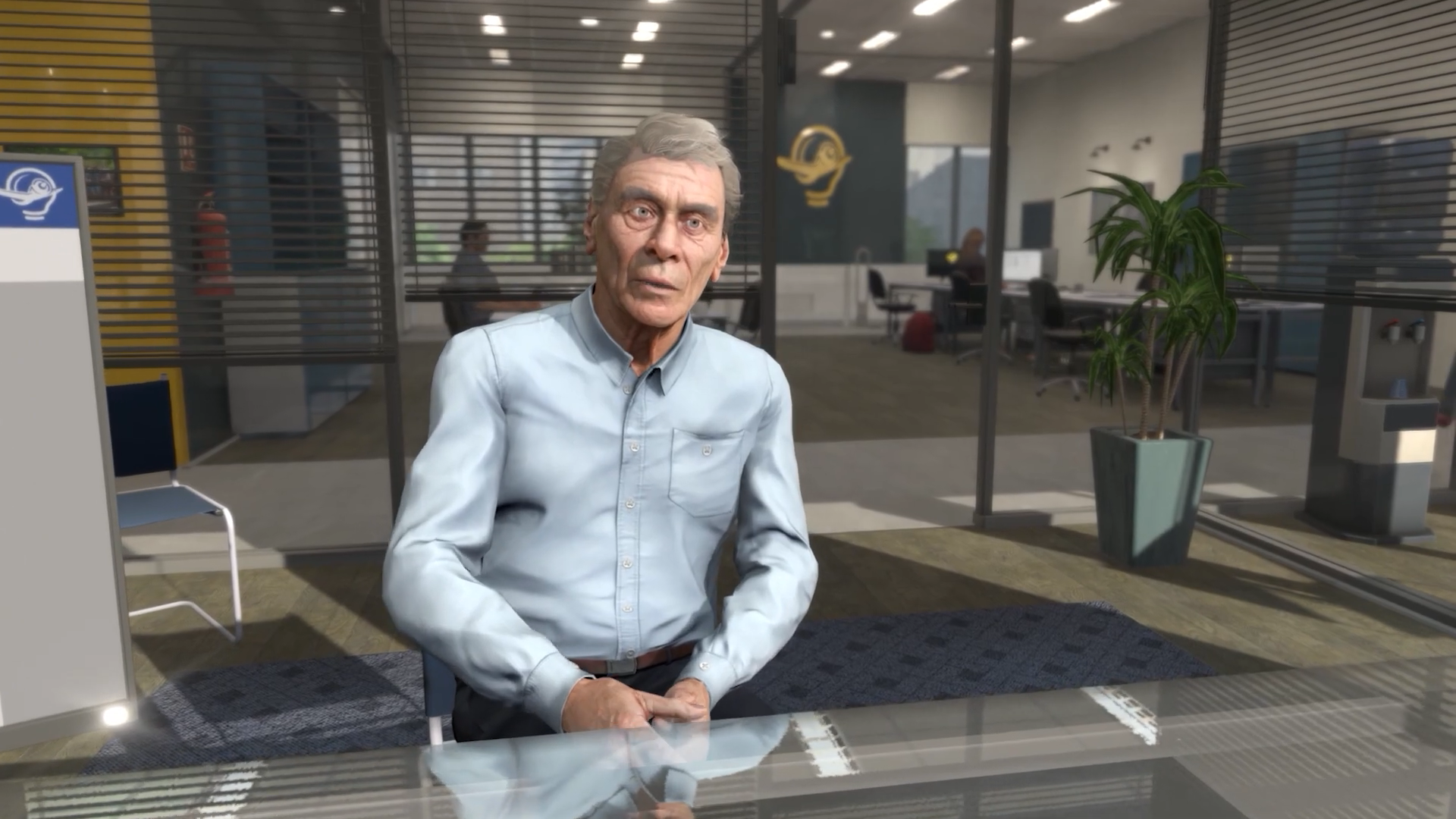
Yesterday, enterprise XR developer Talespin introduced a new training tool that utilizes an AI-powered virtual human to teach users “soft skills”– attributes that allow for effective communication and interaction between others — through realistic workplace scenarios.

Utilizing a combination of interactive elements, including speech recognition, AI, Natural Language Processing (NLP), and narrative branching, Talespin’s virtual character is able to simulate realistic speech patterns, body-language, and mannerisms to simulate lifelike conversations as if speaking to an actual human-being. The company hopes this virtual human will help various organizations with the training and development of employees, specifically in areas regarding negotiation, communication, even conflict resolution.

“Improved workplace communication and empathy are the most critical factors we’ve identified as we help organizations think about the future of work,” states Kyle Jackson, CEO and co-founder of Talespin, in an official release. “We’ve developed our virtual human technology to help people better prepare for a rapidly changing workplace dynamic and evolving technology by improving their interpersonal skills. With this platform, we’re empowering people to become better managers, colleagues, and communicators, and in turn, helping our customers unlock innovation and growth.”

Talespin’s AI-powered virtual human / Image Credit: Talespin

To demonstrate the educational potential of their AI-powered solution, Talespin has developed a VR simulation in which users play the role of an HR Manager tasked with handling an employee named Barry. Unfortunately, Barry has been slacking on his duties and it’s your job to terminate his employment.

By interacting with Talespin’s virtual human in the VR environment, users are faced with the stress and emotion they’d face during a real firing. Throughout the simulation the AI software provides feedback in real-time, allowing employees to track their interpersonal progress via gamified scoring, dynamic feedback, and enterprise integration.

By interacting with this lifelike AI, users gain better understanding of how to handle a difficult termination professionally, while still remaining empathetic to the effected party. Talespin’s proprietary virtual human technology is currently employed by several Fortune 100 customers who will be revealed sometime later this year. 

For more information visit Talespin’s official website.

The post AI-Powered Virtual Human Teaches Employees ‘Soft Skills’ appeared first on VRScout.


from VRScout https://ift.tt/2Ufmi1J
via IFTTT

Boneworks Is A Ridiculously Detailed Physics Sandbox VR Game From Stress Level Zero

https://ift.tt/2T6hBuF

boneworks holding gun

Boneworks looks really special. What began as a sort of bizarre testing ground for a VR physics engine has evolved into a pseudo-sandbox experience full of items, objects, and enemies to play around with. We first saw the original tech demo a year ago at GDC, then again when it resurfaced a few months later. But as it turns out, Stress Level Zero, creators of Hover Junkers and Duck Season, are actually gearing up to release this magical physics toybox publicly.

The level of interactivity and responsiveness looks absolutely unmatched in VR right now:

According to the Steam page quite a lot of work has gone into turning this into more of a game than we originally thought it’d be:

BONEWORKS Is a narrative VR action adventure using advanced experimental physics mechanics. Dynamically navigate through environments, engage in physics heavy combat, and creatively approach puzzles with physics…Designed entirely for consistent universal rules, the advanced physics mechanics encourage players to confidently and creatively interact with the virtual world however you want…Play through the game’s mysterious narrative and explore the deep inner workings of the Monogon Industries’ artificial intelligence operating system; Myth OS.

I remember when I tried it a year ago being blown away by turning on slow-mo and seeing individual bullet casings eject out of my gun, reaching out, and tapping them with my finger. There was even a gravity gun and based on the new footage above, a very prominent crowbar. Maybe Valve is partnering with them for their Half-Life VR game?

There isn’t a firm release date yet, but everything we’ve seen of Boneworks has us really excited. We’re getting vibes very similar to Blade & Sorcery, albeit with a much more modern militarized flair.

Boneworks is due out this year for Rift, Vive, and Windows VR and we’re aching to see more. Hopefully it will make a return to GDC this month and we can try it out again!

Let us know what you think down in the comments below!

Tagged with: ,

The post Boneworks Is A Ridiculously Detailed Physics Sandbox VR Game From Stress Level Zero appeared first on UploadVR.


from UploadVR https://ift.tt/2BYtf0a
via IFTTT

Viveport Infinity Subscription May Be $12.99, Take This Survey For A Free Month

https://ift.tt/2BZ8S2T

viveport infinity

Viveport Infinity, the unlimited VR subscription tier for HTC’s storefront that launches on April 5th, 2019, is offering an entire free month to anyone that fills out this super quick and simple survey. Viveport Infinity was announced at CES earlier this year as a way to expand its subscription service from just a handful of games to the entire store’s 600+ game and app catalog.

Once you fill out the survey and provide your email, it says redemption codes for a free month will be provided via email on March 30th, just a few days before Viveport Infinity launches. In the fine print at the bottom it states you must do the survey between today, March 1st, and March 17th and the code must be redeemed by April 15th giving you two weeks of wiggle room.

Then if you keep reading, the fine print at the bottom actually seems to reveal the price as well:

“If you cancel the subscription during the 1 month trial period you will not be charged, and you will lose access to VIVEPORT Infinity content that you accessed during the trial period once the trial ends. Unless you cancel the subscription during the trial period you will automatically be charged a monthly subscription fee, currently $12.99 or £12.52 (plus taxes, where applicable) a month after the end of the trial period, and each month thereafter until you cancel your subscription. If you redeem the code before April 2, 2019, you will be charged a monthly subscription fee of $8.99 per month through the end of 2019 or until you cancel your subscription. To cancel your subscription open your “Account Settings” menu and follow the instructions there.”

So, it sounds like if you redeem the code ASAP you get a bit of a discount for the rest of the year, but the current price sounds like it’s $12.99 for everyone else. On the blog post for the survey today it actually says that if you’re a current subscriber to the non-Infinity subscription, then you will be upgraded to Infinity at no additional cost. That’s a really, really awesome move that will likely keep all current subscribers invested.

That’s a really good price point if $12.99/month is accurate. Basically the same cost as Netflix for unlimited access to over 600 VR apps and games.

When contacted for comment a representative from HTC Vive had the following to say:

We’ll be able to confirm Infinity pricing near GDC. We’ll have multiple options for existing and new subscribers to take advantage and get into Infinity at promotional pricing. We want to reward our existing Viveport subscribers and will have some great promos in store. More soon.

Let us know what you think down in the comments below!

Tagged with: ,

The post Viveport Infinity Subscription May Be $12.99, Take This Survey For A Free Month appeared first on UploadVR.


from UploadVR https://ift.tt/2GSN0tT
via IFTTT
Related Posts Plugin for WordPress, Blogger...