Remember Soulpix’s Eden Tomorrow? No? Well, you’ll be able to play it soon all the same.
The developer’s official website confirms that a demo for the PSVR game is coming this month. There’s no final date or details of what the demo will entail, but we’re intrigued. Eden Tomorrow is a game that wowed me when I first saw it at Gamescom nearly four years ago now. Back in 2017, it was confirmed that the game would be coming to PSVR but we haven’t heard from it since. A trailer (seen below) did say it was coming in spring 2018 but obviously that didn’t happen. It looks like 2019 is finally the year we’ll get our hands on it, then.
Soulpix describes Eden Tomorrow as an adventure puzzle game in which players crash land on a strange alien planet. The world is inhabited by giant dinosaurs, some friendly, some less so. You’ll explore the landscape, solving brain teasers and marveling at your new friends. When we played it on an Oculus Rift DK2 we fell in love with the visuals and the experience of meeting some of these beasts up close. You could control three characters, including a human, drone and I think a dog (it may have been an alien dog, it was four years ago).
But we’ve got a lot of questions. How much of the game we played in 2015 is still intact? Why has it taken this long to come out? What controllers will we use – Move or DualShock 4? There’s a lot for us to learn, so we’ve reached out to Soulpix to find out more about the demo. We’ll let you know if we hear back.
inXile Entertainment is being true to its word. Back in November 2018 we reported that the developer was still working on a PSVR port of its excellent VR RPG, The Mage’s Tale, despite being bought by Xbox maker Microsoft earlier in the month. This week, the studio shared the first trailer for that port, seen below.
The video is comprised of a 45-second gameplay montage that popped up somewhat randomly. We could be wrong but it seems to be taken from the PSVR version of the game; the quality of textures seems to be just a touch blurrier than they were on PC. If it is the console version, though, it looks like a competent port. Most PC VR ports, including games like Arizona Sunshine and Superhot, take a hit in the visuals department in order to squeeze onto PS4.
The Mage’s Tale has you raiding dungeons, fighting mythical monsters and brewing your own potions. We loved it on Rift and Vive and can’t wait to see PSVR players get their hands on it.
Sadly the video doesn’t include a release date. Hopefully its arrival isn’t too far off; the first Rift version came out all the way back in 2017.
This isn’t the only thing inXile is working on in VR right now. We also know that the studio is developing a second, bigger VR project that’s set in an open world. Just like the PSVR version of The Mage’s Tale, we know that the game wasn’t canceled in the Microsoft deal. It also looks like it could be a Wasteland VR game. Here’s hoping we find out plenty more about it as the year rolls on.
For the full list of all of our livestreams scheduled for this week, as well as archived footage after the stream has happened, check out the schedule right here.
When we first heard about Vengeful Rites the GIFs and footage made it look like a true spiritual successor to Vanishing Realms and the longer it’s in development the more accurate that appears to be. With an immersive combat system, richly detailed world, and great VR-focused mechanics, this is definitely one of the most promising VR RPGs we’ve seen in quite some time.
We’ll be playing Vengeful Rites on Rift using a two Touch controllers. We’re starting right around 1:00 PM PT and we’ll aim to last for about an hour and a half or more. We’ll be livestreaming to the UploadVRTwitch page where you can interact with us directly and chat among yourselves. Streaming is something we’re going to double down on doing more often very soon so you should get in on the ground floor of our Twitch community early! You can see the full stream once it’s live right here:
We’ve finally reached the very end of 2018 and it’s been quite the eventful year for the VR industry. If you want to see the original nominees post, you can check that out here, otherwise keep reading for our full list of winners with details on each decision and the pick for the overall best VR game of 2018.
Let us know your picks down in the comments below and tell us why we’re wrong!
Best VR/AR Hardware
Magic Leap One
Mirage Solo *WINNER* Oculus Go
Samsung Odyssey+
Vive Focus
Vive Pro
It’s been an odd year for VR hardware with little to truly push the industry forward. But Oculus Go stands out as a device that genuinely achieves what it set out to accomplish; deliver a low-cost, accessible VR device for the masses. Go has its fair share of issues but at the $199 price point and a huge library of apps right off the bat, it’s an easy choice for best overall VR/AR hardware this year.
Best PSVR Game
Astro Bot: Rescue Mission
Beat Saber *WINNER* Firewall Zero Hour
The Persistence
Tetris Effect
WipEout Omega Collection VR
Astro Bot and WipEout put up some serious competition but we ultimately decided Firewall should take the PSVR prize. True, there’s still some work to be done to improve First Contact’s online shooter but there’s no denying that this is one of the first VR games to truly embody the goal of the platform; to make you believe you’re someone else, somewhere else, becoming the hero of your own action movie. Take a good look at Firewall; it could truly be the future of gaming.
Best PSVR Experience
Crow: The Legend
Electronauts *WINNER* Titanic VR
‘Immersive VR Education’ continues to prove itself as the leading company in, well, VR education with this amazing exploration of the legendary vessel. Titanic VR isn’t simply a digital recreation of the sunken ship but instead a fully gamified experience with a campaign that uses interaction and story to engage your brain in an entirely new way. This is another important stride of a pivotal area of VR development
Best PC VR Game
*WINNER* Beat Saber
The Elder Scrolls V: Skyrim VR (PC)
The Exorcist: Legion VR
Hellblade: Senua’s Sacrifice VR
Moss
Transpose
Beat Saber is, without a doubt, the most popular VR game of the year and perhaps even of all-time so far for our young immersive industry. It’s a viral sensation that took the world by storm and has likely been responsible for directly selling more VR headsets than any other app. The developers have crafted an insanely polished rhythm game that’s dead simple to pick up and play but incredibly difficult and rewarding to master. Easily the best and most important PC VR game of the year, no doubt.
Best PC VR Experience
Crow: The Legend *WINNER* Spheres
The Great C
Titanic VR
Vestige
While Titanic VR on PC is great as well, just like it is on PSVR, we have to give the nod to Spheres here. This is a remarkable experience that is part educational, taking you through the explosive life of a black hole, but also part pure wonder as the colors and sounds engulf you. Narration is incredible and the talent behind it all elevates this to unreal heights.
Best Mobile VR/AR Game
*WINNER* Anshar Online
Arca’s Path
Catan VR
The Walking Dead: Our World
This was a slow year for mobile VR/AR gaming. After the immense success of Pokemon Go a couple of years ago and a few copy cats this year, not even the VR market has really hit a stride again for the limited headsets. But despite that, the third entry in the Anshar War series, Anshar Online, is a bright spot. The excellent space dogfighting is better than ever, now with full co-op, and intense PvP multiplayer. Plus, it’s cross-play with Rift as well.
Best Mobile VR Experience
Crow: The Legend *WINNER* Nothing To Be Written
Shattered State
Few VR experiences this year demonstrated as firm a grasp on the platform as Nothing To Be Written, Unit 59’s surreal exploration of the use of Field Post Cards in WW1. This is a fascinating new angle on war in VR, one that’s equal parts harrowing and moving, using some of the most striking imagery you’ll see inside a headset all year.
Best Location-Based VR Experience
*WINNER* Dave & Buster’s Jurassic World
Dreamscape’s Alien Zoo
Nomadic’s Arizona Sunshine
Sandbox VR’s Davy Jones Adventure
SPACES’ Terminator
The Void’s Nicodemus
The Void made huge headlines last year with its Star Wars: Secrets of the Empire experience and now Dave and Buster’s restaurants/arcades are jam-packed with VR experiences of their own. We haven’t tried out their new, custom IP in Dragonfrost, but the Jurassic World experience is excellent. It’s a perfect blend of a good price, great format, tons of locations, and pure immersion that show the world VR is much more than just a gimmick and more than just at-home entertainment.
Best Visuals
Age of Sail
Hellblade: Senua’s Sacrifice VR
Seeking Dawn
The Elder Scrolls V: Skyrim VR (PC) *WINNER* Tetris Effect
Whoever knew Tetris could be so hypnotic? We don’t mean in that captivating loop of intently watching ever-falling blocks but instead on the visual side. Each level in Tetsuya Mizuguchi’s transcendent take on the classic puzzler is packed full of visual splendour. On a standard display it shines but in VR Tetris Effect is an irresistibly compelling tour of the wide world around us and beyond. A true feast for the senses
Best Ongoing Support For A VR App
Bigscreeen
Onward
Pavlov VR *WINNER* Rec Room
Rec Room is literally the gift that keeps on giving. Not only is the main experience free and supported by a raft of user-generated environments and games, but developer Against Gravity continues to set the bar by adding its own modes and cosmetic items around the clock. Whether it’s the PUBG-influenced Rec Royale or the latest co-op mission inspired by Castlevania, there’s always something new to check out in one of VR’s most important apps.
Best Multiplayer/Social
Brass Tactics
Echo Combat *WINNER* Firewall Zero Hour
Marvel: Heroes United V R
WipEout: Omega Collection VR
We’ve already picked it as our favorite PSVR game of the year, but it deserves another nod for being the absolute best new multiplayer game of the year as well. Working together with your squad is a thrill and the no-respawns format ensures that you feel the intensity of every firefight. It’s a game that’s all about teamwork and even now, months later, new people are joining the fight and matches are always full no matter the time of day.
Most Immersive Moment
Killing the police in Accounting+ *WINNER* Meeting Astro Bot
Stealing time in Deracine
Suiting up as a Marvel hero
Swirling around a black hole in Spheres
True, Astro Bot might not put you in the body of an elite solider or ace pilot, but the connection you form with your little robot buddy in the opening minutes of Sony Japan’s incredible adventure make for some of the most memorable moments in VR this year. Seeing Astro frantically wave at you with his impossibly adorable eyes is one of the most jaw-dropping, heartwarming experiences you can have inside a headset.
Most Active VR Game
*WINNER* Beat Saber
Creed: Rise to Glory
Knockout League
Sprint Vector
From a single two-hour session of Beat Saber I burned over 1,000 calories and my heart rate approached 180 beats-per-minute. If that isn’t a great cardio workout then I don’t know what is. Plus, with custom mods on the PC version you can find most of your favorite songs to slash boxes with when you want to extend out beyond the core set of original tracks. Other games on this list try to emulate real-life sports, but only Beat Saber feels extremely active while also being uniquely only available in VR.
Developer of the Year
3rd Eye Studios
Beat Games
First Contact Entertainment
Secret Location *WINNER* Survios
Vertigo Games
There are a handful of developers out there that have released two well-received VR apps thus far. Fewer still have released three. Survios, on the other hand, has launched four VR games over the past few years, three of which were in 2018. And these aren’t just rushed follow-ups to the shooter success that was Raw Data; Sprinter Vector, Electronauts, and Creed: Rise to Glory are all completely original, high-quality experiences that explore VR in fascinating new ways. Not to mention the debut of their VR arcade line! We’re not quite sure how Survios does it, but they have our kudos.
Most Anticipated App Of 2019
Defector *WINNER* Dreams
A Fisherman’s Tale
Star Wars: Vader Immortal
Stormland
Untitled Respawn Game
There’s a reason why we’ve called Dreams PSVR’s most-important game that’s capable of making the metaverse a reality: it’s something truly special. It puts a tremendous amount of power and potential in the hands of otherwise every-day gamers allowing them to craft entire levels, games, worlds, and even inter-connected stories and universes. Then, you can even edit and experience much of them in VR as well. We’re dying to see this VR-supported follow-up to LittleBigPlanet finally hit PS4s this year.
This has been a big year for VR games. On the PSVR front alone there have been tons of amazing exclusives, such as Astro Bot, WipEout, and Tetris Effect, while PC VR has a fully-moddable viral sensation in Beat Saber along with the visual and audio masterpiece that is Hellblade. But at the end of the day the overall best VR game we’ve seen this year that combines extreme polish, great replay value, fantastic gameplay, and an overall big effort to push VR forward is undoubtedly Firewall Zero Hour. There simply wasn’t a better VR game this year that we felt deserved the recognition over Firewall.
Let us know your picks or other nominations down in the comments below!
Featured image collage created by David Jagneaux for UploadVR.
Pimax is a China-based company making VR headsets with significantly higher field of view than those available on the consumer market today.
In late 2017, the company launched a Kickstarter campaign for the ‘Pimax 8K’ and ‘Pimax 5K’ headsets. Each boasted a diagonal field of view of 200 degrees (roughly 170 horizontal) and horizontal pixel counts of 8000 and 5000, respectively. The Kickstarter campaign exceeded its goal in a matter of hours and Pimax added stretch ones like a wireless add-on and eye tracking.
Around 5700 people pledged enough to receive a Pimax headset. The campaign ended in November 2017 with backers originally given a shipping expectation of January 2018.
A year later, when will backers receive their headset?
We reached out to Pimax for clarity about its status and a company representative claimed in an email, through Dec. 27, 2018, “we have already produced 3900 units and shipped 1515 units to Kickstarter backers.”
Asked for an explanation of the large gap between shipped headsets and units produced, the Pimax representative wrote “to ensure every headset in a good quality, every product needs to pass additional QA testing eg. sanity testing to double check before shipping.”
The claims from Pimax came after we dug deep into the previous explanations and production targets produced by the organization. Here’s a brief rundown of the last 16 months:
September-November 2017 Pimax conducts the Kickstarter campaign. 5946 backers pledge, of which 5663 backers pledge enough for a headset. The company states headsets will ship in January 2018 and controllers & base stations in February 2018. The company also states: “We will not move on to launch 8K outside of Kickstarter until ALL of our Kickstarter backers have received their rewards on June, 2018.“
December 27 2017 Pimax announces the headset is delayed to ‘Q2 2018‘. When a backer asks if this means they’ll have to wait until after an issue with the refresh rate is solved (which Pimax stated would be “in March“), Pimax responds “We can still provide the option to ship the headset earlier“. Additionally, they claim “We will update the shipping plan on Jan“.
January 2018 Pimax repeats “we are now looking at a delivery window of Q2” estimate from December.
April 2018 Pimax announce they will ship around 8 pre-production units to “testers“. When asked when the consumer version will ship, the company responds “The purpose of the M1 closed beta is to learn from testers whether the M1 is good enough to ship.”
June 2018 The last month of Q2, Pimax delivers pre-production headsets (10 in total) to “testers”. Four of these testers are VR YouTubers, which use the headset to produce Pimax related videos throughout 2018.
July 2018 Pimax fails to meet the Q2 shipping window. In a Kickstarter update, the company claims they are “assembling” ~230 revised pre-production headsets. They further claim that 700 headsets will be produced the next month, providing the following cumulative monthly production plan image:
August 2018 Pimax hosts “backer meetups” to let backers try the headset. The company promotes “testers” YouTube channels to backers who can’t attend.
September 2018 YouTube streaming partners share “reviews” of pre-production headsets. Pimax claims “The Kickstarter shipping will start by the end of September.” Pimax send some backers a “shipping soon” email. The CEO of Pimax states there is a 90 percent chance all backers will have their headset by Christmas.
October 2018 First Pimax headsets arrive with backers. Pimax also opens preorders for the 8K and 5K+ headsets with the cheapest model priced at $699.
December 2018 Pimax claims to have fulfilled around 25% of Kickstarter backer orders.
Pimax Targets
On the front page of the Pimax website is a countdown timer working down to February 1. On this date, Pimax claim, non-backer orders will begin to ship.
“We plan to finish shipping in late January,” a company representative wrote in an email in response to the question of when the last backer will receive their headset.
Also stated on this page is when an order placed today will ship — currently listed as the third week of February. Clicking ‘More Info’ brings us to the company’s public production targets. The infographic was first posted just over four weeks ago:
The chart shows the planned headset production rate on a weekly basis, as well as how they plan to ramp up production across 3 lines to fulfill their backer orders.
If the claims are true, Pimax currently has enough headsets to fulfill nearly 70 percent of Kickstarter rewards. But based on Pimax’ claimed figures, roughly half of the rewards are held in a quality assurance process the same month they are supposed to ship.
Meanwhile, pre-orders continue.
Since early November, after pressure from backers, Pimax started disclosing its production and shipping figures. The data is not directly on the website, or the Kickstarter page, but buried in the Pimax website’s forums. The information is spread across multiple spreadsheets and fairly difficult to read, so we converted it into a bar chart:
What immediately stands out is that shipping seems to be far lower than the production figures being claimed. The data indicates the company goes days or weeks without shipping a single headset.
So how does this production and shipping data compare to Pimax’s targets stated on the front page of their website? Here’s a graph showing the cumulative target production, claimed production, and claimed shipping:
This shows the enormous difference between claimed production and shipping. Some backers speculated that the company was prioritizing enterprise orders. Pimax wrote in an email no more than 100 headsets were shipped to non-backer customers in December.
So if you’re a backer, when will you receive your Pimax headset?
A Pimax representative wrote in an email that they plan to have all backer orders shipped by the end of January. This would require a significant increase in the shipping rate outpacing anything we’ve seen the company accomplish previously.
The biggest problem with the shipping situation seems to be the company’s lack of clear communication. Among the issues is Pimax sending out “shipping soon” style emails to backers who then receive no further communication for many weeks.
Also, despite the company claiming that headsets will be shipped in order of backer number, many early backers with low order numbers are still waiting. When asked for an explanation, Pimax told us this is caused by the length of time certain backers took to respond to the initial shipping emails, as well as production time differences between the 8K and 5K+ models.
Kickstarter backers on Reddit’s /r/Pimax subreddit have been using a public Google Docs spreadsheet to attempt to crowdsource shipping progress. In the Kickstarter comments (the place where Pimax provides the least information) many backers have turned to shock and anger. Despite backing the project over a year ago, many have no clear sign from Pimax of when to expect a shipment.
The launching of pre-orders before clearly communicating the timeline for Kickstarter fulfillment seemed to even further add to this discontent. Pimax stated at the time that this was a necessary decision due to “the lead time of the key components”. When we asked the company about this decision as well, a representative repeated their original statement and told us “pre-order customers are free to cancel their orders any time before shipping starts.”
Pimax sent us a 5K+ headset which we intend to review on its merits later this month. We’ll update this post with a link to that review — likely after CES — along with any updates we get from Pimax or reports from backers. If you’re a backer who has received the headset, please email tips@uploadvr.com with photos of your unit as verification and let us know what your experience has been like. As of right now, though, the company’s repeated inability to meet self-defined deadlines means that we strongly recommend not ordering a headset until they completely fulfill backer orders, clear their current backlog, and demonstrate the ability to consistently ship at scale.
Virtual catwalks could remove the limitations of conventional models.
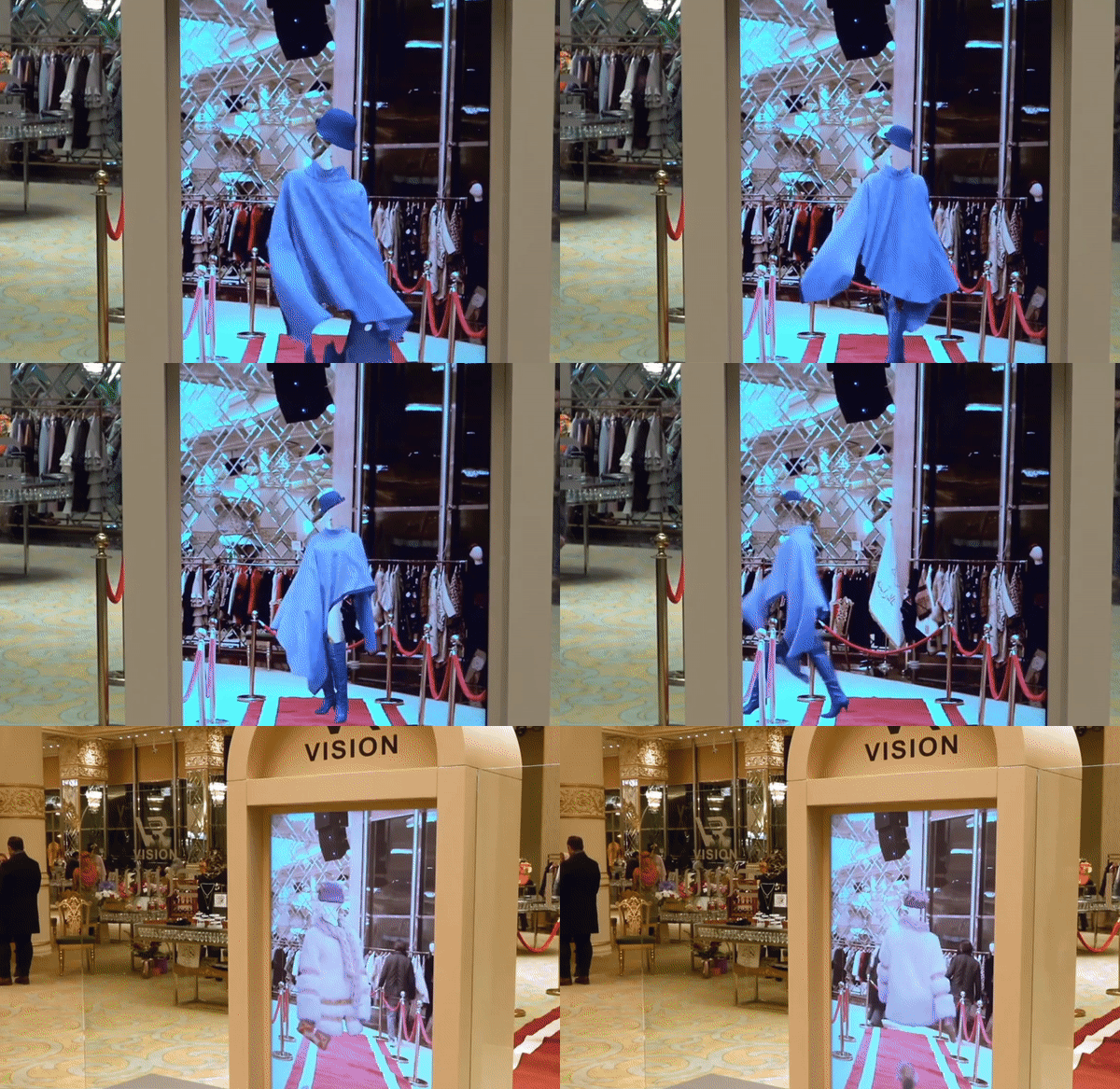
December was an important month for the Iranian fashion scene as the city of Tehran played hosted to an augmented reality fashion show; complete with digital models and a virtual catwalk.
Created with the support of Lotus, Iran’s first fashion & art magazine, the event featured computer-generated models strutting their invisible stuff up and down of a real runway in some of Iran’s hottest clothing and apparel. Passerbys could view all the action via a VR Vision portal located at the end of the runway, or stand beside the runway and join the show as a high-class spectator. In reality you’ll be staring at nothing, but no one said being classy would be easy.
The portal was provided by VR Vision, an immersive technologies provider for enterprise and business, with the actual AR technology itself developed by a foreign firm which chose to remain anonymous in order to avoid possible sanctions.
“We have some limitations,” spoke the expos director, Vida Jannesar, in a video posted by RT Play. “Our limitation is using a model in fashion shows. We have solved this problem with this company and we could have the virtual catwalk here for the first time. Now you see it in this event in the form of AR (augmented reality) and when you see it, it is like the models are walking; but the limitations of models have actually been deleted and there are no models there.”
The real question, however, is whether or not this can provide a positive impact on Iran’s fashion scene. On one hand, the AR fashion show could provide designers with an easier method for showcasing their female product lines within the country. However, one could also see this as further female suppression, removing woman from the equation entirely.
Outside of Iran, the concept of deleting a model entirely could do wonders for various other designers looking to better advertise their products. Removing the model, male or female could theoretically destroy any distractions from the clothing itself, making it even easier for prospective customers to imagine themselves in those sweet threads.
It’ll be fascinating to see just how VR/AR technology continues to impact the fashion scene.
A number of VR developers are quietly working on projects for this year and beyond, while 2018 saw 17,000 standalone $200 Oculus Go VR headsets purchased by Walmart and deployed at stores everywhere to train employees.
Also in 2018, the United States Army awarded Microsoft a contract worth nearly half a billion dollars to augment U.S. service members with enhancements in “lethality, mobility, and situational awareness” derived from the $3,000 HoloLens AR standalone headset.
Microsoft’s HoloLens as seen on the International Space Station.
Magic Leap One
Magic Leap reportedly lost out on the contract won by Microsoft.
The company launched its $2,300 Magic Leap One AR headset development kit in August after revealing earlier in the year it passed $2 billion in total investment, with a huge amount from Saudi Arabia. Magic Leap’s CEO Rony Abovitz suggested in our first face-to-face interview (you can read the entire transcript) that “big” players like Microsoft and Apple are going to spend ten times that amount investing in this technology. We don’t follow the logic, but he claimed those larger efforts will be “much more inefficient” compared to Magic Leap.
Magic Leap One first shipped to developers in August 2018.
China
U.S.-based companies like Facebook and Valve are partnering with China-based counterparts to either tap the vast market in that country or manufacture hardware. For example, Facebook shipped Oculus Go in the United States and elsewhere around the world as the identical Mi VR standalone from manufacturing partner Xiaomi shipped in China without the Oculus Store. Valve, meanwhile, partnered with a Chinese company to launch a version of its Steam PC games store tailored specifically for the Chinese market.
HTC’s Alvin Wang Graylin on the runway with a VR headset.
HTC Vive Focus
HTC launched its Vive Focus VR standalone first in China in 2018. The company also launched the Vive Pro and the Vive Wireless Adapter and these two very expensive pieces of PC VR hardware provided some of best VR experiences available in 2018, but only when they work right.
Valve
Valve shipped multiple iterations of its next-generation “Knuckles” hand controllers in 2018.
Valve’s Knuckles controllers developer kit.
Late in year, photos of a VR headset leaked featuring “Valve” on its exposed circuit board. If this finished head-mounted display is paired with the “Knuckles” controllers, and one or more Valve games, it could be exactly what the PC VR market needs for renewed growth.
Valve’s leaked head-mounted display.
The leak came as both HTC and Google started showing the Vive Focus and Mirage Solo standalone VR headsets featuring a pair of “6DoF” point-and-reach hand controllers. While we haven’t gone hands-on with these kits yet, we did try the upcoming $400 Oculus Quest extensively and came away pretty impressed by its tracking performance in highly controlled demos at Facebook’s Oculus Connect VR developers conference.
Transitional Year For Mixed Reality Technology
Overall in 2018, VR developed on private and public tracks.
While some companies shipped standalone headsets publicly, they did so with limited 3DoF pointer-only hand controllers which handcuffed many developers and buyers. Privately, some of these same companies secured new partnerships and worked on more compelling 6DoF developer kits that could spur software design for bigger launches ahead in 2019 and 2020.
Experimental 6DoF controller tracking faceplate for the Lenovo Mirage Solo.
This meant that in 2018 many innovative VR developers were gagged by non-disclosure agreements, acquisitions (like Microsoft or EA) and marketing timelines from funding partners like Facebook or Sony. Some developers closed up shop for lack of funding, too, but many of VR’s most innovative developers were relatively quiet throughout the year as they put their heads down, cut down costs as much as possible and built for the next generation of VR hardware which have fewer of the compromises that were necessary to ship headsets before 2019.
Controller tracking developer kit for Vive Focus.
With augmented reality, Google and Apple improved upon ARCore and ARKit technologies so phones understand the world better. For AR headsets, though, Magic Leap won’t ship two controller support for its AR headset until sometime this year while another long-time AR company called ODG is lining up an asset sale for patents.
Terminator, Star Wars and our visits to both an alien zoo and a haunted world’s fair showed us just how far location-based VR attractions need to go to justify a $20 or $30 ticket. We also tried an experience based around the Alien franchise and an installation from Neurogaming that seemed to be military-grade in its overall execution. We’re still not convinced these types of locations will see enough foot traffic in the United States to cover the cost of their high-rent locations and costly operations, but that is why we were so impressed by the Dave & Busters roll out in 2018 of multiple VR attractions at more than 100 locations. For only $5 per person, up to four visitors to the restaurant chain can take a trip to Jurassic World together in a motion simulator wearing HTC Vive VR headsets.
It is somewhat bad timing that Steven Spielberg’s big screen adaptation of Ernest Cline’s 2011 novel about a VR “OASIS” arrived during a relative lull in adoption of VR by home buyers.
The underlying message of that movie was one of warning — not just of addiction — but the way our drive to escape to virtual worlds could erode our desire to improve the real one. The movie depicted a world in which the global population was hooked on VR to such an extent corporations could use drones and AR to operate with impunity in the real world.
While that may seem far-fetched, it also speaks to concern around the role technology plays in our lives. Huge investigations in 2018 by the New York Times and other news organizations drew ire from Facebook’s executives for the overall depiction of the company’s business model and practices, while Facebook CEO Mark Zuckerberg appeared before Congress to answer questions from lawmakers about its role and influence.
When it comes to VR, leaders at Facebook spoke to me in stark terms about how important it is they handle personal data “right.”
“It’s an existential crisis for us,” said Max Cohen, head of product for the Oculus Platform, during a phone interview.
To bridge the gap between the future we could have from the one we will have, here’s what Jaron Lanier, one of VR’s true pioneers, said in 2018 about the risks related to how we use this technology:
Back in the ’80s when I had the first VR startup I was profoundly concerned with this question of this knife edge between technology going good or going bad. Like, to what degree is it about dreams and connection and to what degree is it about manipulation and trickery given that the technology is good for both those things. What makes it go one way or the other? Back then I had a belief about it, which is that if you just said the right things, if you got people excited about it on the right terms, then you could set it on a course where the good stuff would happen instead of the bad stuff. But…I came to decide that wasn’t true. I decided that ultimately the most powerful force is economics and what incentives people have in the system immediately that influence their actions. I don’t think creating a system with good incentives is all you need to do to have a pleasant world. There’s a lot of other factors on different levels. But having a bad economic system can definitely ruin a world.
Also ponder the following questions when considering the future of mixed reality: Is it possible to maintain a shared view of the real world that spans different government censorship regimes and propaganda campaigns when AR and VR filters are built and managed by faceless corporations? If that’s not possible, what does that mean for the world in which our kids grow up?
VR Developers Quietly Build For 2019 and Beyond
Though some VR developers in 2018 spent their time working on projects which were pushed quietly into 2019, like Owlchemy’s Vacation Simulator, others continued to iterate on their early access titles. H3VR, for instance, crossed 100,000 units sold over the course of two years because its creators are in a tight communication loop with fans and they deliver constant content updates.
Beat Saber, in comparison, sold more than 100,000 copies in just one month when its debuted in 2018, anchored by its incredible combination of original music and satisfying cuts. After its PC debut, the game went on to join Astro Bot, Tetris Effect, Wipeout Omega Collection, The Persistence, Moss, Firewall: Zero Hour, Deracine and more in delivering an incredible year of content on PlayStation VR headsets.
Rec Room kept its community together across all platforms in 2018 and, as a result, we saw all sorts of interesting creations, including an acting troupe which delivered an entire production of The Prince Bride performed entirely on a virtual stage.
Kite and Lightning’s co-founder Cory Strassburger took performance capture a step further with an Xsens motion capture suit and the iPhone’s face-sensing camera mounted on a helmet. He worked out a full-body motion capture system for a fraction of the cost of traditional pipelines.
What Will Drive VR And AR Adoption In 2019 And Beyond?
Concept HMD shown by Michael Abrash at OC5.
We also saw some groundwork set down for the next generation of PC-based VR headsets in 2018. For example, the VirtualLink USB-C standard for VR headset cords was supported on some new graphics cards while Valve spent time developing tools so that games made for Windows can run without it on Linux. Meanwhile, the OpenXR standard achieved a milestone showing the same Unreal Engine content running on VR headsets with widely varying specifications.
We also saw demonstrations of light field displays in 2018 while LG and Google showed an 18.1 megapixel panel. A true light field display could one day deliver a multi-user glasses-free experience like the Holodeck while the ultra high resolution display from LG/Google could be key to fully eliminating the sense that VR headsets only deliver a low-resolution version of reality. Both solutions are years from being feasible in a form factor you might encounter in the real world, but nonetheless showed promise.
The two key drivers of PC VR’s first generation, Facebook and Valve, are under increased pressure to deliver a substantial source of revenue from VR hardware and software. We know the Oculus Quest standalone is coming early in the year, and that Valve is building its own HMD, but beyond that we don’t have solid expectations for VR and AR in 2019. We believe that is partially because companies like Microsoft, Valve, Sony and Facebook are playing their cards close, bringing trusted developers into the fold and keeping them quiet until the time is right.