Tuesday, 24 March 2026

‘PAYDAY: Aces High’ VR Game Announced for Quest & PC VR, Reveal Trailer Here

https://ift.tt/VDCS42u

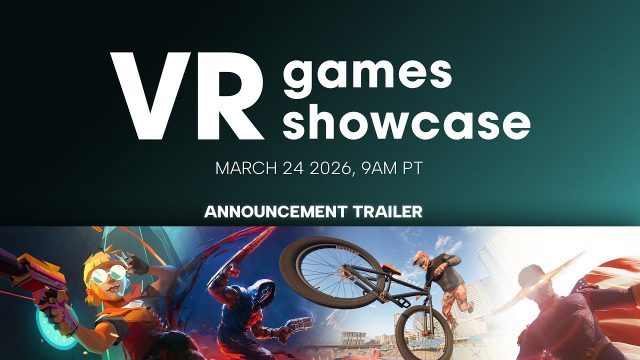
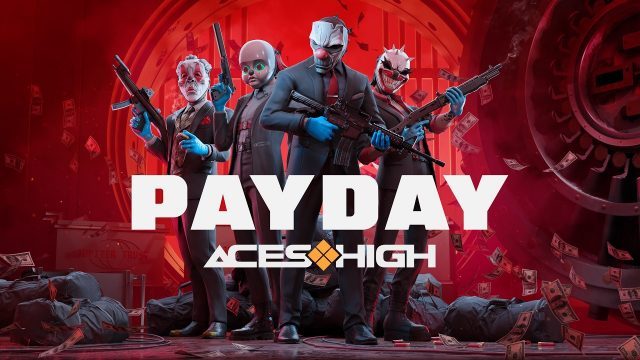
During the VR Games Showcase today, Fast Travel Games revealed PAYDAY: Aces High, an upcoming VR co-op heist game set in Starbreeze Entertainment’s PAYDAY universe.

Slated to launch sometime this year on Quest and SteamVR headsets, PAYDAY: Aces High promises to bring some frenetic four-player co-op action, letting you take on the role of different ‘Aces’.

Here’s how Fast Travel describes the action:

After being framed by business titan Warren Jupiter, players team up to take revenge through the signature chaos of a PAYDAY heist. Design your own unique loadout, mixing weapons, gadgets and skills to become the ultimate, high-caliber heister.

Infiltrate banks, museums, and even a luxury penthouse apartment, surveying each scene before choosing the perfect moment to go loud and secure your payday.

While the reveal trailer only showcased a few weapons, the studio says Payday: Aces High is coming with a full arsenal of ARs, SMGs, shotguns, pistols, and a host of gadgets, including grapple and sentry guns.

And just like the broader Payday series, each mission earns you cash and rep, which lets you successively unlock better skills, gear, and gadgets.

It also seems that teams will need to get pretty tactical when planning out missions, as the game offers up four Aces to choose from, each with their own gameplays style:

  • Ace of Hearts: The Mastermind – The brain behind the chaos. Lines up every angle, every fallback, every escape.
  • Ace of Clubs: The Ghost – Silent, surgical, gone before anyone knows they’ve been fooled.
  • Ace of Diamonds: The Technician – Gadget freak. Orchestrating the theater of destruction.
  • Ace of Spades: The Enforcer – The hammer that keeps hitting when things get loud.

Payday: Aces High doesn’t have a release date yet, with Fast Travel saying it’s coming sometime in 2026. The in the meantime, you can wishlist PAYDAY: Aces High for Quest on the Horizon Store and for PC VR headsets on Steam.

The post ‘PAYDAY: Aces High’ VR Game Announced for Quest & PC VR, Reveal Trailer Here appeared first on Road to VR.


from Road to VR https://ift.tt/TxLKf1F
via IFTTT

Watch The VR Games Showcase Right Here at 9AM PT

https://ift.tt/EK6lyjF

The next edition of the VR Games Showcase is nearly here, bringing another heaping dose from VR’s leading Direct-style digital showcase dedicated to revealing high-quality VR games and showing updates on some of your most anticipated projects.

We’ve lined up one of our best shows yet, featuring over 20 games. That includes fresh looks at some of the biggest upcoming releases, including The Boys: Trigger Warning from ARVORE and Wrath: Aeon of Ruin VR from Flat2VR Studios, as well as updates on hits like Triangle Factory’s ForefrontBootstrap Island from Maru VR, and Dimensional Double Shift from Owlchemy Labs.

We’ll also have one of our biggest game announcements to date, as well as previews from the team at Creature and top VR studios including Innerspace, Spectral Games and more. And there’s over 10 titles in our pre-show, highlighting some of the best independent games.

Watch the latest reveals right here, today at 9AM PT (your timezone here):

When Is The Next VR Games Showcase?

Our Spring 2026 edition of the show airs Tuesday, March 24th at 9AM PT (your timezone here). We’re expecting a roughly 30 minute core show filled with game announcements and fresh looks.

For early birds, the VRGS Pre-Show will offer yet more game reveals and exclusive trailers from some of our favorite independent and mixed reality developers. Tune in 20 minutes ahead of the 9AM kickoff to see a host of game reveals (your timezone here).

Where Can I Watch The VR Games Showcase?

There are a few good ways to watch the show. First and foremost will be the VR Games Showcase YouTube channel, where you can get everything direct from the source. But we’ll also be co-streaming with our partner IGN.

We can’t wait to show you what’s in-store for the event. If you happen to miss the show, don’t worry! We’ll be recapping up every game and trailer reveal in a handy article right here on Road to VR.

The post Watch The VR Games Showcase Right Here at 9AM PT appeared first on Road to VR.


from Road to VR https://ift.tt/jJwv4sc
via IFTTT

Monday, 23 March 2026

‘Microsoft Flight Simulator’ PSVR 2 Gameplay Revealed Ahead of April Update

https://ift.tt/y4tLcFC

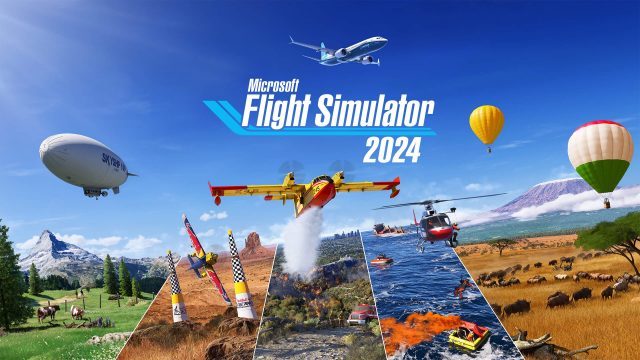
Microsoft Flight Simulator 2024 is getting its ‘Sim 5’ update soon, which is slated to bring PSVR 2 support to the PS5 version of the game.

MFS ’24 has been available on PC with full VR support since late 2024. Late last year though, developer Asobo Studio revealed that the PS5 version of the game would be getting PSVR 2 support some point after launch.

Now, the studio revealed PSVR 2 support is slated to arrive with the free Sim 5 update coming in April.

Note: the video below is a compilation of clips revealed in the PS blog post.

In a PS blog post, Head of Microsoft Flight Simulator Jorg Neumann details just what went into creating the PSVR 2 mode:

“Cockpit interactions in Microsoft Flight Simulator 2024 are complex. There are so many different instruments, knobs, and switches to interact with. Every interaction model had to be redesigned to fit the PS VR2 Sense controllers to action them in a natural and intuitive manner,” says Neumann.

While Sense controller-supported cockpits add a layer of complexity, Neumann explains that maintaining a smooth framerate for such a visually demanding game was a challenge in its own right.

“Getting foveated rendering with Flexible Scaled Rasterization right was quite a challenge,” says Neumann. “It impacts the entirety of the rendering pipeline, and subtle off-by-on-pixel bugs during development could result in dramatic quality issues.”

The PSVR 2 mode, which is said to support the game’s 125 different aircraft, also relies on frame duplication to increase perceived frame rate, Neumann says.

“Another tech developed specifically for PS VR2 support was frame duplication, where the render thread would iterate twice for one frame of the main thread, updating the camera position in-between. This technical approach was another key in achieving the framerate needed for PS VR2 support.”

The studio says Sim 5 should launch as a free update sometime in April, although there’s no exact release date yet.

Simulation Daily got a chance to go hands-on with a beta version over the weekend at the MSFS 2024 booth during FSWeekend 2026 in Lelystad, Netherlands, which includes a 10-minute video of their impressions.

“I wasn’t expecting the level of spectacle you’ll see in Microsoft Flight Simulator 2024 on a $4000 PC, but the PS5 version absolutely punches above its weight when paired with PlayStation VR2, likely in part due to the headset’s technological prowess,” Simulation Daily’s Giuseppe Nelva notes.

You can check out Nelva’s hands-on below, which notably was shown working with the standard DualSense gamepad.

The post ‘Microsoft Flight Simulator’ PSVR 2 Gameplay Revealed Ahead of April Update appeared first on Road to VR.


from Road to VR https://ift.tt/eVM6gIr
via IFTTT
Friday, 20 March 2026

Meta Shows Confidence in EMG Input for Wearables by Funding Six External Studies

https://ift.tt/JoNuIdY

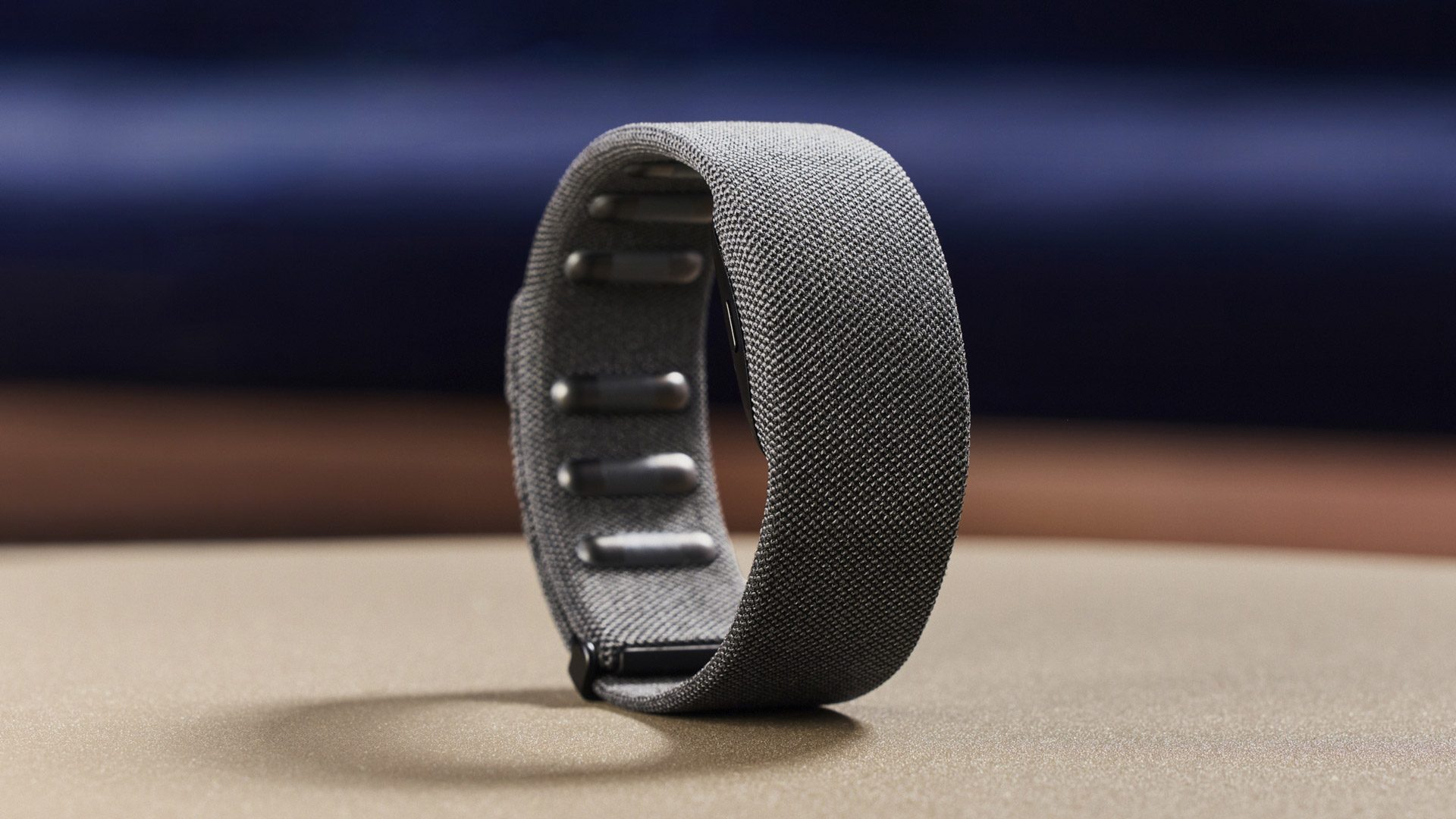
Meta announced it’s tapped six external teams to receive a research grant in order to advance work on its surface electromyography (sEMG) based wristband controller.

Meta revealed in a blog post it’s launched a research funding initiative focused on improving how users learn and interact with sEMG systems, having chosen six universities out of 70 global submissions.

Each research group is set to receive $150,000 in funding, which includes teams at the University of Central Florida, University of South Florida, University of California, Davis, Newcastle University, University of British Columbia, and Northwestern University.

Meta’s wrist-worn neural interface relies on sEMG, which detects electrical activity in the wrist and hand and translates it into digital commands. As Meta Ray-Ban Display’s main input device, the company hopes to answer a few questions with the studies, namely: how do people learn new sEMG-based controls, and how can onboarding be streamlined?

Wrist-worn XR Controller seen with Orion | Image courtesy Meta

The funded projects explore a range of challenges. Some focus on improving learning methods, such as comparing gamified training with step-by-step instruction, or developing systems that adapt to individual users over time.

Others aim to expand what sEMG can do, like enabling silent speech generation by translating muscle signals into synthesized voice, or increasing the ‘bandwidth’ of communication so users can issue more complex commands without disrupting natural hand movement.

A number of the proposed research topics include assistive applications, such as helping stroke survivors regain muscle control, or improving prosthetic limb operation through co-adaptive systems that learn alongside the user. You can see more about each study here.

This follows the release of Meta Ray-Ban Display last September, the company’s first pair of smart glasses with a built-in display. Priced at $800 and only available in the US for now, the smart glasses make use of the same input scheme first paired with Meta’s Orion AR prototype, which was revealed in late 2024.

This ostensibly shows Meta is pretty confident in the control scheme, viewing it as reliable enough for future (likely AR) devices. We’re looking forward to learning more as the research projects progress. Typically, we see papers either highlighted or released during SIGGRAPH, which is taking place in Los Angeles, California this year on July 19th – 23rd.

The post Meta Shows Confidence in EMG Input for Wearables by Funding Six External Studies appeared first on Road to VR.


from Road to VR https://ift.tt/8qrjeFT
via IFTTT
Ubisoft Ends Game Development at Studio Behind ‘Assassin’s Creed VR’

https://ift.tt/Odg7pFl

Ubisoft is ceasing game development at Red Storm Entertainment, the long-running studio behind Assassin’s Creed Nexus VR (2023).

According to an internal memo viewed by GamesIndustry.biz, Ubisoft is shutting down game development at Red Storm Entertainment, which includes the loss of 105 jobs.

While the studio is technically staying open, it’s no longer developing games, as remaining staff will be tasked with working on Ubisoft’s Snowdrop game engine, along with IT and customer relations.

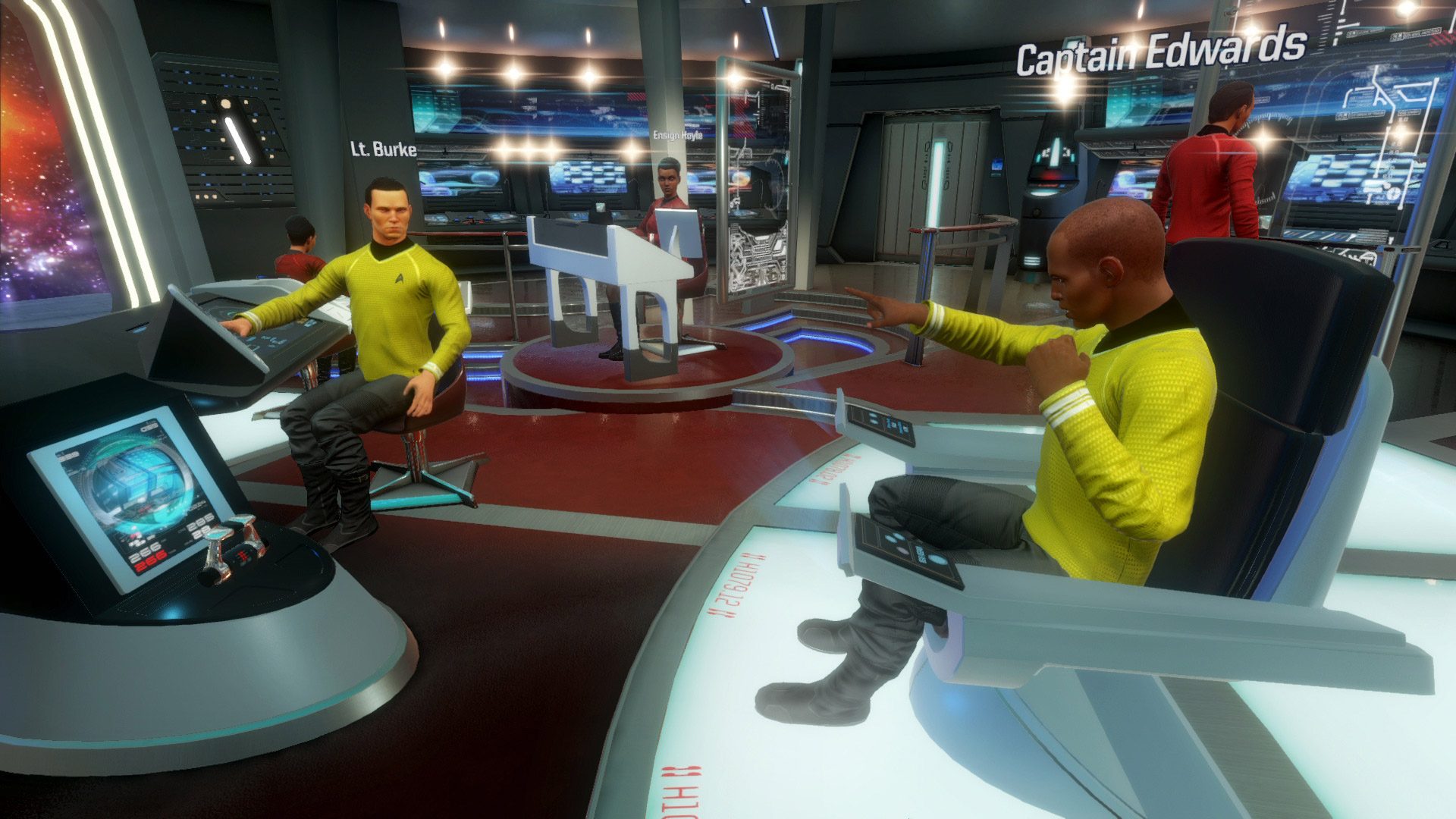
Star Trek: Bridge Crew | Image courtesy Ubisoft

Founded in 1996 by Tom Clancy and Doug Littlejohns, the North Carolina-based studio is best known for developing the original Tom Clancy’s Rainbow Six (1998), which helped define the modern tactical first-person shooter genre.

Acquired by Ubisoft in 2000, Red Storm went on to release Ghost Recon (2001) along with a long list of Rainbow Six and Ghost Recon titles in the following years—its last being Tom Clancy’s Ghost Recon: Future Soldier (2012).

Notably, Future Soldier was the studio’s last flatscreen game as well, as Ubisoft seemingly re-geared Red Storm to begin producing VR titles, which included the release of VR party game Werewolves Within (2016), co-op space sim Star Trek: Bridge Crew (2017), and Quest exclusive Assassin’s Creed Nexus VR (2023).

While we don’t know precisely what Red Storm was working on before Ubisoft pulled the plug, at least two games were publicly cancelled over the past few years, including a Splinter Cell VR game for Quest, cancelled in 2022, and Tom Clancy’s The Division Heartland, a free-to-play shooter, which was cancelled in 2024.

The post Ubisoft Ends Game Development at Studio Behind ‘Assassin’s Creed VR’ appeared first on Road to VR.


from Road to VR https://ift.tt/G6BND0z
via IFTTT

Thursday, 19 March 2026

Meta to Keep Existing ‘Horizon Worlds’ VR Experiences on Life Support for Time Being

https://ift.tt/cEFp7Lw

Meta previously announced it was shuttering the VR version of Horizon Worlds, but now it seems the company has changed course, revealing that some experiences will still be accessible on Quest moving forward.

Meta said earlier this week that it was removing Horizon Worlds and Events from the Store on Quest on March 31st, and shutting down VR access to the app entirely by June 15th—essentially making it a flatscreen-only experience for mobile and PC.

Meta CTO Andrew Bosworth took to Instagram yesterday in one of his usual Q&A sessions though to announce that some worlds will, in fact, remain VR-accessible for the time being.

Image courtesy Andrew Bosworth

“We have decided, just today in fact, that we will keep Horizon Worlds working in VR for existing games to support the fans that’ve reached out […], who really care about that,” Bosworth says.

According to Bosworth’s statement, it appears Horizon Worlds legacy worlds will be VR-only, suggesting that it’s going to be a hard platform split.

“The Horizon Unity runtime games—they’re not going to work on mobile, they’ll just be working in VR. We’re not bringing new games. Again, most of our energy is going towards mobile and the Meta Horizon Engine there. The reason for that is that’s where most of the consumer and creator energy already was, and so we’re kind of leaning into that,” Bosworth says, noting that the legacy version of Horizon Worlds app will be VR-accessible for “the foreseeable future.”

Notably, all of Horizon Worlds was based on the Unity game engine from its 2021 launch up until very recently. At Connect 2025 last September, Meta announced that its own Horizon Engine would be replacing Unity, which is said to speed up loading times and allow “well over 100” users in a single space.

At the time of this writing, Meta hasn’t released more detailed plans on how it’s going to accomplish the platform split. We’ll update this article as soon as we know more.

The post Meta to Keep Existing ‘Horizon Worlds’ VR Experiences on Life Support for Time Being appeared first on Road to VR.


from Road to VR https://ift.tt/XFdywGC
via IFTTT

Wednesday, 18 March 2026

Meta is Permanently Shuttering the VR Version of ‘Horizon Worlds’ in June

https://ift.tt/yoTCvLt

Last month, Meta announced Horizon Worlds was going “almost exclusively mobile”, which included removing Worlds suggestions and generally deemphasizing the immersive social platform on Quest. Now, the company says it’s pulling the plug on Quest support entirely in June.

Released in 2021, Horizon Worlds was meant to be Meta’s flagship metaverse app, essentially serving as the impetus for its rebranding away from Facebook and Oculus. The platform struggled early on with low retention though, which translated to limited appeal among VR users, prompting Meta to open it up to mobile users in 2023.

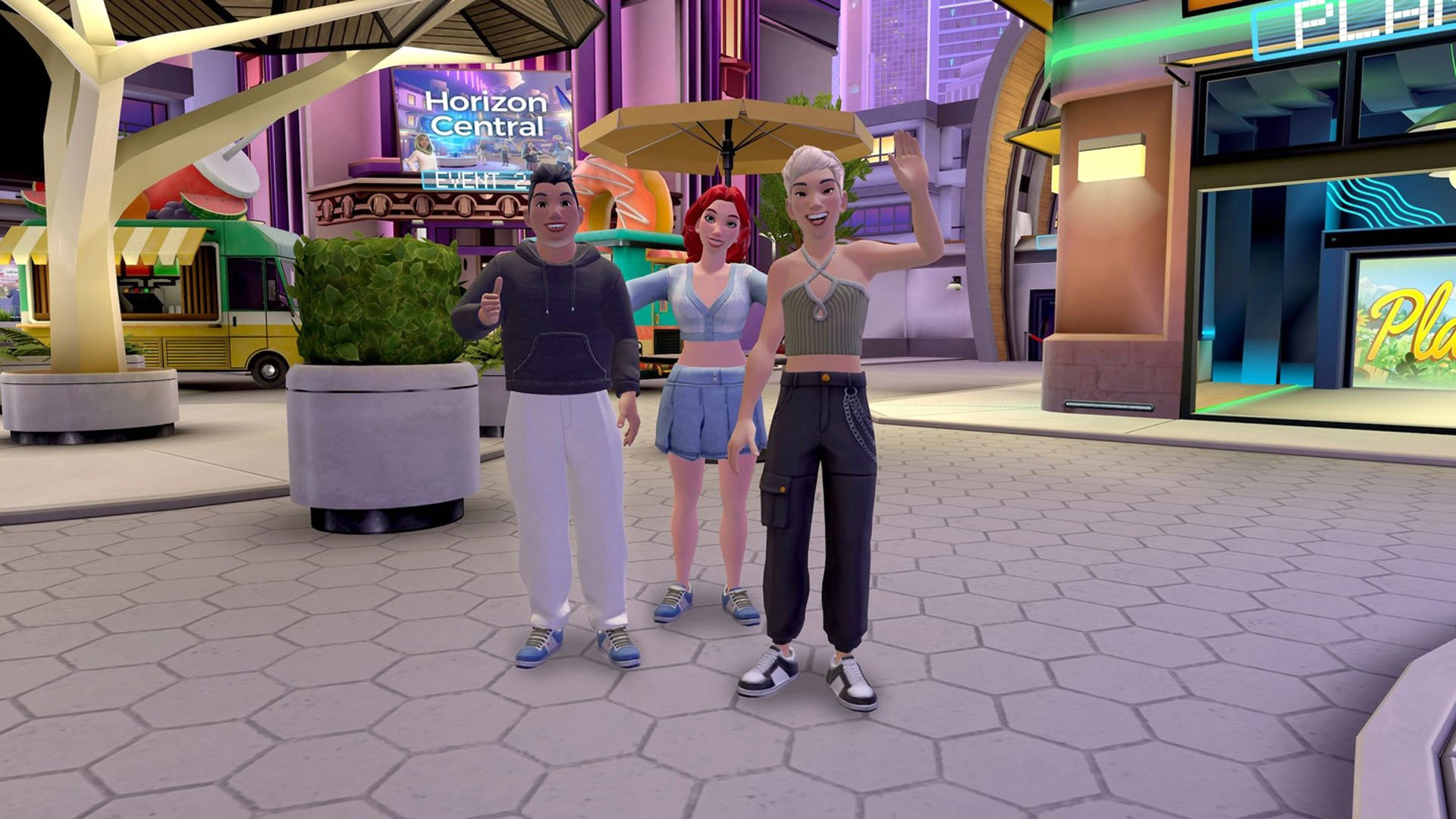
Now, Meta announced via its official Discord (invite) that come March 31st, Horizon Worlds and Events will no longer appear in the Store on Quest. This is said to include the removal of Horizon Central, Events Arena, Kaiju, and Bobber Bay worlds from Quest access.

Image courtesy Meta

What’s more, come June 15th, Meta is removing the Horizon Worlds app entirely from Quest, which means that worlds will no longer be available in VR in any capacity after that date.

Additionally, Meta is removing its spatial ‘Hyperscape’ captures from Horizon Worlds come March 24th. “Your existing captures will remain viewable within the Hyperscape Capture (Beta) app, which is available in your Quest app library,” Meta says. “You can continue capturing new Hyperscapes, but sharing, inviting, and co-experiencing Hyperscapes with others will no longer be supported.”

Notably, Meta shuttered its work-focused Horizon Workrooms platform last month, which allowed Quest and non-Quest users to interact in an immersive environment.

This comes amid a wider shift in Reality Labs, which recently saw layoffs affecting 10 percent of the XR division in addition to the closure of three first-party XR studios which resulted in multiple game cancellations.

Meta has said it’s still funding third-party titles in addition to its current plans to release two new VR headsets, which include a possible successor to Quest 3 as well as a thin and light headset that tethers to a compute puck.

The post Meta is Permanently Shuttering the VR Version of ‘Horizon Worlds’ in June appeared first on Road to VR.


from Road to VR https://ift.tt/mSXkiOV
via IFTTT

Tuesday, 17 March 2026

VR Games Showcase Returns March 24th With ‘The Boys: Trigger Warning’, ‘Wrath: Aeon of Ruin VR’, and More

https://ift.tt/GU4fDHR

The VR Games Showcase is returning for its first show of 2026! Our Direct-style celebration of new games, trailers, and updates goes live on YouTube and right here on Road to VR on March 24th, 9am PT (convert to your timezone), with our indie pre-show kicking off shortly beforehand at 8:40am PT (convert to your timezone).

We’re lining up one of our best shows yet, featuring over 20 games. That includes fresh looks at some of the biggest upcoming releases, including The Boys: Trigger Warning from ARVORE and Wrath: Aeon of Ruin VR from Flat2VR Studios, as well as updates on hits like Triangle Factory’s Forefront, Bootstrap Island from Maru VR, and Dimensional Double Shift from Owlchemy Labs.

We’ll also have one of our biggest game announcements to date, as well as previews from the team at Creature and top VR studios including Innerspace, Spectral Games and more. And there’s over 10 titles in our pre-show, highlighting some of the best independent games.

In other words, it’s a packed show. Plus, our continuing partnership with the team at Road to VR will bring you expanded coverage of the show, including a wrap up of everything announced, and potentially some in-depth guest articles focusing on specific games after launch too.

So, once again, that’s March 24th, 9am PT (convert to your timezone) for the core VRGS show, with the pre-show returning at 8:40am PT (convert to your timezone). We’re looking forward to showing you what’s in store for VR in the coming weeks and months!


Road to VR is proud to be the official media partner of VR Games Showcase

The post VR Games Showcase Returns March 24th With ‘The Boys: Trigger Warning’, ‘Wrath: Aeon of Ruin VR’, and More appeared first on Road to VR.


from Road to VR https://ift.tt/LlUB90K
via IFTTT

PSVR 2 Reportedly “jailbroken” for PC, Hackers Claim Eye-tracking and Haptics Unlock

https://ift.tt/ybDMp5N

A hardware hacker group previously behind the PSVR2Toolkit says it’s effectively “jailbroken” PSVR 2 for PC.

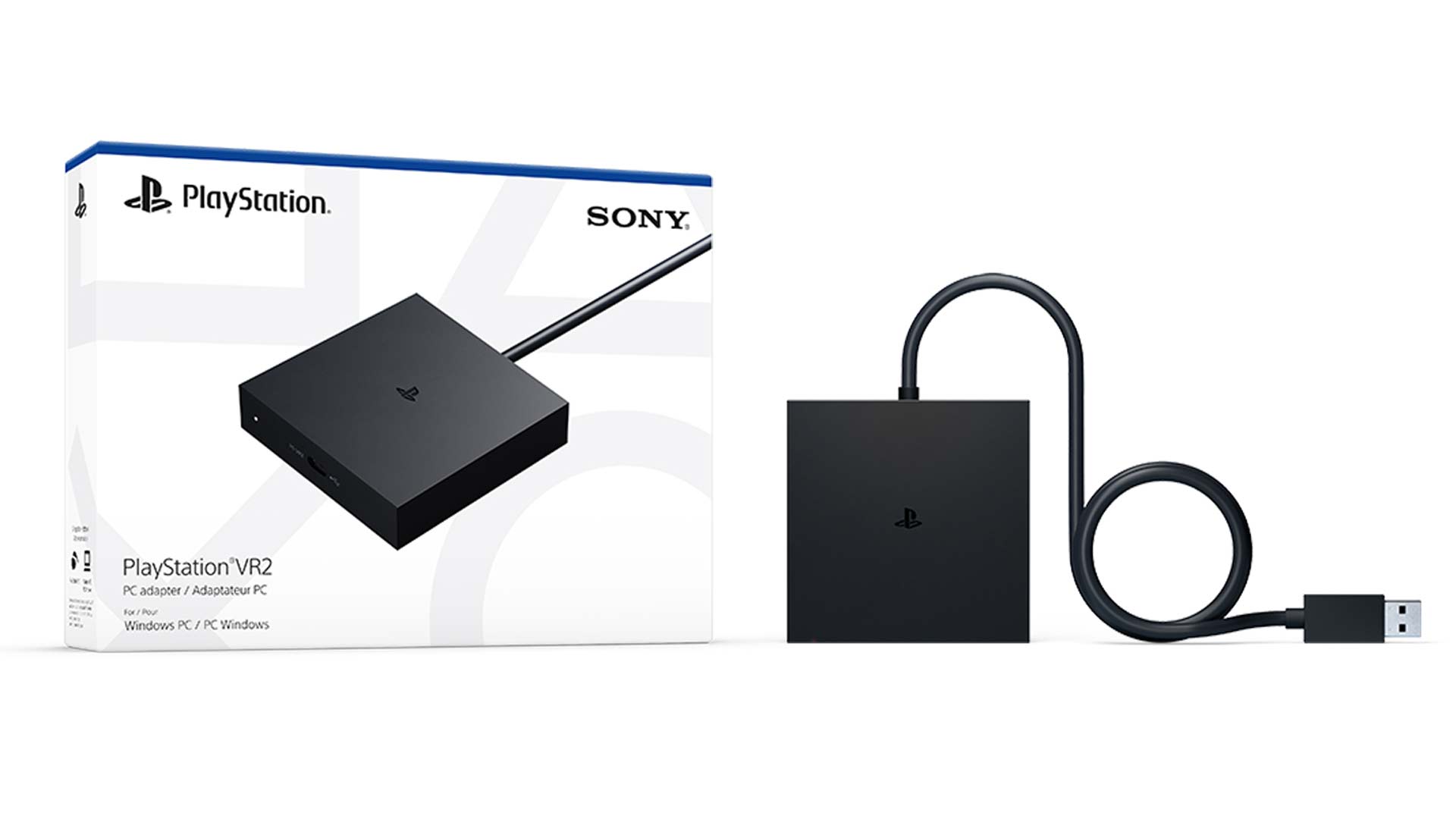
When Sony released its PC adapter for PSVR 2 in 2024, it released the headset from PS5 exclusivity, allowing users to play SteamVR games on VR-ready PCs for the first time.

Still, Sony didn’t release enable every hardware capability, with tethered PC gameplay notably lacking features such as eye-tracking, HDR, and headset rumble.

Now, the hardware hacker group previously associated with the PSVR2Toolkit—an open source driver toolkit interfacing with Sony’s PSVR 2 PC support—claims to have “jailbroken” the PSVR 2.

IPSVR 2 PC Adapter | mage courtesy Sony

“[W]e can enable HMD vibration and eye tracking camera feed on PC,” says group member ‘tinybnuuy’, who also credits fellow programmers ‘supremium’, ‘tomoeko’, and ‘ShinyQuagsire’.

“[T]his has been 5 months in the making, we hope to release this soon so that everyone can play with it,” tinybnuuy says.

Sony’s official PC support for PSVR 2 (via SteamVR) disables key features like eye-tracking, HDR, and haptics. Early efforts however managed to pull eye-tracking data in some respect, but it was notably uncalibrated and not broadly usable.

By mid-2025, tools like PSVR2Toolkit enabled eye-tracking and controller haptics through a modified driver layer, although it still didn’t feature proper OpenXR integration (i.e., no universal foveated rendering), as mentioned previously by UploadVR.

Provided the team’s work truly is a ‘jailbreak’, we would expect to see full access to cameras, headset haptics, and possibly even an HDR pipeline sometime in the near future.

That is, provided Sony doesn’t see the jailbreak as a threat, as the company appears to have intentionally disabled those features on PC, effectively keeping them exclusive to PS5.

The post PSVR 2 Reportedly “jailbroken” for PC, Hackers Claim Eye-tracking and Haptics Unlock appeared first on Road to VR.


from Road to VR https://ift.tt/JrmfsSY
via IFTTT

Monday, 16 March 2026

Quest Reached Record Number of Users in 2025, Pushing 100 VR Apps Over $1M in Gross Revenue

https://ift.tt/lu9LakJ

Meta’s Director of Games Chris Pruett revealed that Quest usage hit an all-time high in 2025, which helped over 100 games to generate more than $1 million in gross revenue last year.

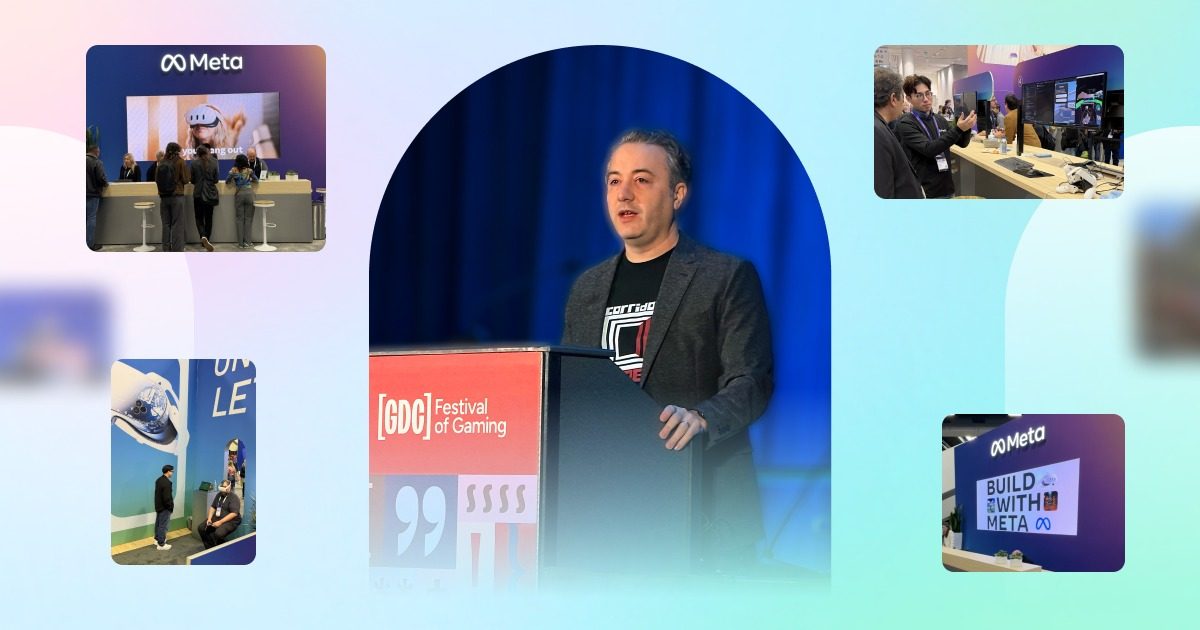
Pruett announced in his ‘State of VR’ talk at Game Developers Conference (GDC) that not only has Quest usage grown year-over-year, but that Horizon Store developer revenue was also up “very slightly compared to 2024.”

“Similar to the overall games industry (Circana estimates 1% industry growth⁠), the gross revenue generated by the Meta Horizon Store was up very slightly year over year,” Pruett says in a blogpost recapping the talk.

“While this might sound like a humdrum outcome, it’s important to note that 2025 did not (unlike the year we’re comparing it to) benefit from a hardware launch. As you might imagine, hardware launches tend to spike Store revenue, and holding steady in a no-launch year is a strong signal that ongoing Store investments are paying off.”

Chris Pruett | Image courtesy Meta

Pruett also revealed that premium app sales are still the largest revenue driver, although in app purchases (IAP) grew “significantly in 2025, by over 10%.”

“The trend points to further diversification of monetization techniques on the platform, and better aggregation of success across titles,” Pruett says. “While most IAP revenue went to a small handful of titles in 2024, it was distributed more broadly in 2025. The number of IAP apps that reached $500k or more in revenue was up 20%.”

As for gross revenue—which is notably before Quest’s 30% platform fee—Pruett says over 100 titles generated more than $1 million in 2025. While he didn’t offer a breakdown of which monetization models were most successful, Pruett did reveal that subscription revenue represented “a relatively small part of the overall ecosystem and is mostly not associated with video games.”

Some of of those games include UG⁠, a free-to-play early access title popular with teens, HARD BULLET⁠, a physics-based sandbox shooter ($20), and The Thrill of the Fight 2⁠, a realistic boxing simulator ($20).

While the company has since shutdown multiple first-party studios in addition to laying off 10% of its Reality Labs XR division at the start of the year, Pruett says its Oculus Publishing arm will have “more [games] shipping this year” following over 140 games shipped last year.

The post Quest Reached Record Number of Users in 2025, Pushing 100 VR Apps Over $1M in Gross Revenue appeared first on Road to VR.


from Road to VR https://ift.tt/K7bCiBj
via IFTTT

Friday, 13 March 2026

Bandai Namco’s Hit Puzzle Platformer Series ‘Little Nightmares’ Comes to VR in April, Trailer Here

https://ift.tt/vAkr8XJ

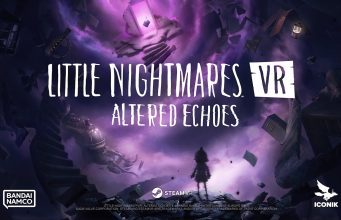
Bandai Namco announced that its hit puzzle-platformer franchise Little Nightmares is coming to VR in April.

Little Nightmares VR: Altered Echoes is slated to land on Quest, PC VR headsets, and PSVR 2 on April 24th.

Little Nightmares VR is set to connect with both Little Nightmares 1 and in what developer Iconik Studio calls “a dark atmospheric adventure‑puzzle game where you embody Dark Six, a mysterious figure with the shape of a little girl.”

In it, you’ll navigate “a disturbing world, solve intricate puzzles, and escape terrifying giant foes in a desperate search to become whole again,” the studio says.

The single-players game is also set to be chock-full of disturbing environments filled with echoes of past events, whispers of hidden connections, and “signs that your journey is part of something larger,” the studio says, noting that confronting these mysteries means facing not only external threats but also the haunting reality of your own transformation.

You can now wishlist Little Nightmares VR ahead of its April 24th release on all major headsets: the Horizon Store for Quest 2 and above, the PlayStation Store for PSVR 2, and Steam for PC VR headsets.

The post Bandai Namco’s Hit Puzzle Platformer Series ‘Little Nightmares’ Comes to VR in April, Trailer Here appeared first on Road to VR.


from Road to VR https://ift.tt/YJdxA87
via IFTTT
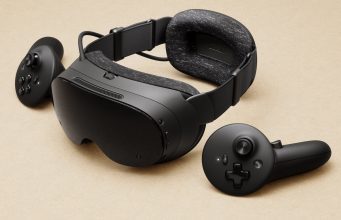
Former Oculus CTO Calls Meta’s 30% VR Dev Fee “wasteful churn” in Face of Subsidizing Individual Apps

https://ift.tt/x2D8duQ

Legendary programmer and former Oculus CTO John Carmack doesn’t think Meta’s developer incentive structure is healthy for the Horizon Store ecosystem, calling it “wasteful churn.”

The News

While Carmack departed Meta in 2022, concluding his “decade in VR,” the one-time Oculus CTO has never been one to mince words when it comes to virtual reality.

In a recent X post, Carmack lays out what appears to be a pretty clear inequity: why does Meta fund third-party titles when they’re just going to turn around and tax them 30% on every transaction?

“Companies like Meta subsidize third party developers in various ways to help grow their platforms, then take 30% of the developer revenue right back with the platform tax, which is a wasteful churn,” Carmack says.

John Carmack at Oculus Connect (2018) | Image courtesy Meta

To avoid unnecessarily circulating money between platform and developer, Carmack points to Epic Games’ fee structure, which doesn’t take anything from developers for the first $1 million per year in revenue.

“You would still need explicit subsidies to get certain types of games / apps created at all, but it perfectly rewards what you actually want: increased economic activity, versus a biased pre-selection process,” Carmack continues.

Tagging Epic CEO Tim Sweeney, Carmack muses whether Meta could even actually pay developers extra for early revenue instead of charging an initial platform fee—something radically different from directly hand-picking projects and applying its usual 30% cut.

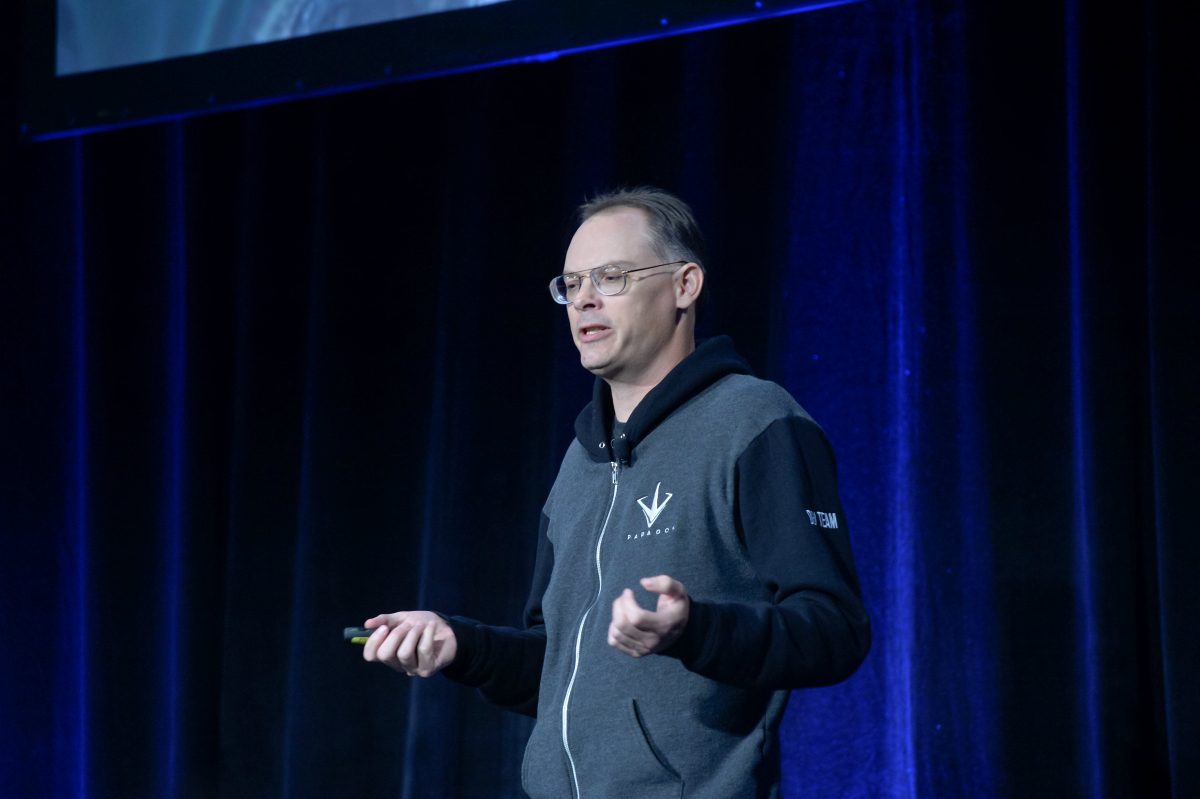
Tim Sweeney at GDC 2016 | Image courtesy Wikimedia Commons

“If it wasn’t so easily exploited by buying your own app, a negative rate ‘earned income tax credit’ for initial revenue would actually be a good incentive for a platform like Quest.”

In response, Sweeney says the $1 million no-fee threshold works and hasn’t been abused, although that’s partly because Epic’s fees are relatively low to begin with—a meager 12% cut.

“There hasn’t been significant gaming of the system. Thankfully there are enough benefits to curation and reputation in having one >$1M app than to breaking it up into a near-duplicate set of <$1M apps. But this assumes a modest take rate. At 30% behavior may change,” Sweeney says.

My Take

PC gaming is much more flexible than Quest when it comes to sourcing games; PC users can choose from any number of store, including Steam, Epic Games Store, or GOG. This is unfortunately not the case for Quest.

But let’s not conflate the two too much though. Meta subsidizes Quest hardware to make back money with app sales—basically what console manufacturers have always done.

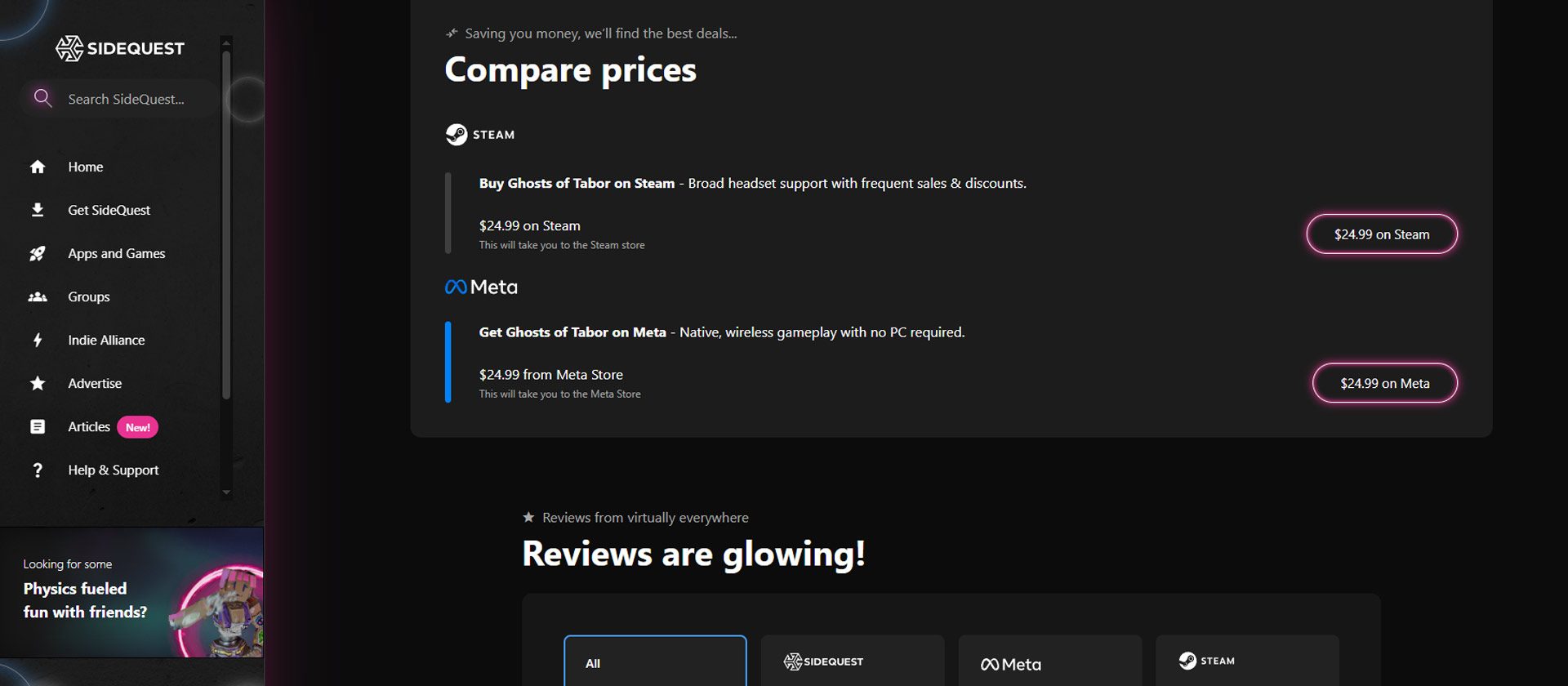
The wrinkle is that Quest users can download and install alternate app stores, like SideQuest, which uses Quest’s ability to sideload Android APKs. But it’s no real competitor to the Horizon Store, and I don’t expect it ever will be.

SideQuest | Image captured by Road to VR

It’s unlikely Meta would disable sideloading, although would-be competitors are probably still cautious from incurring Meta’s wrath. In SideQuest’s case, it’s now mostly an app discovery layer and installer, with many of its app listings now linking directly to Horizon Store.

And from what I’ve seen, I just don’t think Meta would allow real app store competition anywhere near Quest—similar to how Apple doesn’t allow Epic to bring its Games Store to the iPhone ecosystem—the subject of a massive 2021 lawsuit that Apple mostly won.

No competition means no incentive to change. And more importantly, it means nobody can swoop in and by flaunt a better fee structure (and free games) like Epic Games Store seems to be doing as it attempts to pry away users from Steam. Notably, Steam features a 30% platform fee that then descends to 25% after $10 million revenue, and 20% after $50 million.

The post Former Oculus CTO Calls Meta’s 30% VR Dev Fee “wasteful churn” in Face of Subsidizing Individual Apps appeared first on Road to VR.


from Road to VR https://ift.tt/othI0Db
via IFTTT

Tuesday, 10 March 2026

Niantic’s WebAR Creation Platform ‘8th Wall’ Goes Open Source as Hosted Services Go Offline

https://ift.tt/EGCq8ne

Niantic Spatial has now made its WebAR creation platform ‘8th Wall’ free and open source, which also comes alongside a shutdown of hosted services.

Previously a paid service, 8th Wall allows users to create Web-based XR content for a variety of target devices, including smartphones, computers and XR headsets.

Now, as a part of releasing the underlying codebase, the company has officially shut down hosted services, including user logins, the cloud editor, and the web-based XR Studio.

The transition has been rolled out in stages, the company says in a recent blog post. In January, the team released the Distributed Engine Binary, which includes simultaneous localization and mapping (SLAM) under a binary-only license for both commercial and noncommercial use. However, certain capabilities, such as VPS, Maps, and Hand Tracking, were not included.

Now, the newly released open source version of the engine framework is available under an MIT license, though this does not include SLAM. Instead, it provides the core architecture and major AR modules, including Face Effects, Image Targets, and Sky Effects, the company says.

The team behind 8th Wall says we can expect further releases to include documentation, desktop tools, and runtime components the coming weeks as the project continues its transition to a community-driven open source model.

Niantic acquired 8th Wall in 2022 as part of its push to build a broader AR developer ecosystem around its Lightship ARDK platform. At the time, the company said it was its “largest acquisition to date.” Shortly after the deal went through, 8th Wall became part of Niantic’s developer stack, integrating into its Lightship as a standalone product.

Since then, Niantic sold off of its gaming division for $3.85 billion to Saudi Arabia-owned mobile game developer Scopley, which included the transfer of the company’s most well-known titles, including Pokémon GOPikmin Bloom, and Monster Hunter Now.

In turn, this has left Niantic Spatial to operate as a separate, independently-owned spin-off focused on geospatial AI and XR technologies.

The post Niantic’s WebAR Creation Platform ‘8th Wall’ Goes Open Source as Hosted Services Go Offline appeared first on Road to VR.


from Road to VR https://ift.tt/jQ6EtF7
via IFTTT

Meta Faces Lawsuit Claiming Ray-Ban Smart Glasses Sent Private Footage to Overseas Reviewers

https://ift.tt/rlXR7vO

Meta is facing a class action lawsuit in the US over privacy concerns tied to its Ray-Ban smart glasses. The company is accused of sending private camera footage to a Kenya-based subcontractor for manual review to train its AI models.

Allegations stem from an investigative report from Sweden’s Svenska Dagbladet and Göteborgs-Posten, which is said to have uncovered a subcontractor in Kenya tasked with reviewing and labeling images and videos uploaded from the glasses.

Sources within the subcontractor report seeing videos of everything, from sexual activity, handling of financial information, to a host of other private activities inside homes.

“In some videos you can see someone going to the toilet, or getting undressed. I don’t think they know, because if they knew they wouldn’t be recording,” a facility worker told Svenska Dagbladet.

Array of Meta smart glasses | Image courtesy Brad Lynch

These so-called ‘data annotators’ are said to manually process and tag images: “draw boxes around flower pots and traffic signs, follow contours, register pixels and name objects: cars, lamps, people. Every image must be described, labelled and quality assured,” the report maintains.

Following these revelations, a class-action lawsuit (via TechCrunch) was filed in a US federal court accusing Meta of misleading consumers about the product’s privacy protections.

“Meta chose to make privacy the centerpiece of its pervasive marketing campaign while concealing the facts that reveal those promises to be false,” the lawsuit states, further noting that Meta’s own “face anonymization” layer does not work to obscure the private nature of the transmitted videos.

Meta did not offer a comment to TechCrunch on the litigation itself, however, spokesperson Christopher Sgro provided the following statement:

“Ray-Ban Meta glasses help you use AI, hands-free, to answer questions about the world around you. Unless users choose to share media they’ve captured with Meta or others, that media stays on the user’s device. When people share content with Meta AI, we sometimes use contractors to review this data for the purpose of improving people’s experience, as many other companies do. We take steps to filter this data to protect people’s privacy and to help prevent identifying information from being reviewed.”

While many use Meta’s smart glasses as Ai-assisted sunglasses, its Ray-Ban smart glasses line can be specifically fit with a variety of prescription lens types, which allows users to wear them all-day as corrective glasses.

The post Meta Faces Lawsuit Claiming Ray-Ban Smart Glasses Sent Private Footage to Overseas Reviewers appeared first on Road to VR.


from Road to VR https://ift.tt/kV8OpaB
via IFTTT

Monday, 9 March 2026

Valve Confirms Steam Frame is Still Coming This Year, Now Marked as “coming soon”

https://ift.tt/P8JYftx

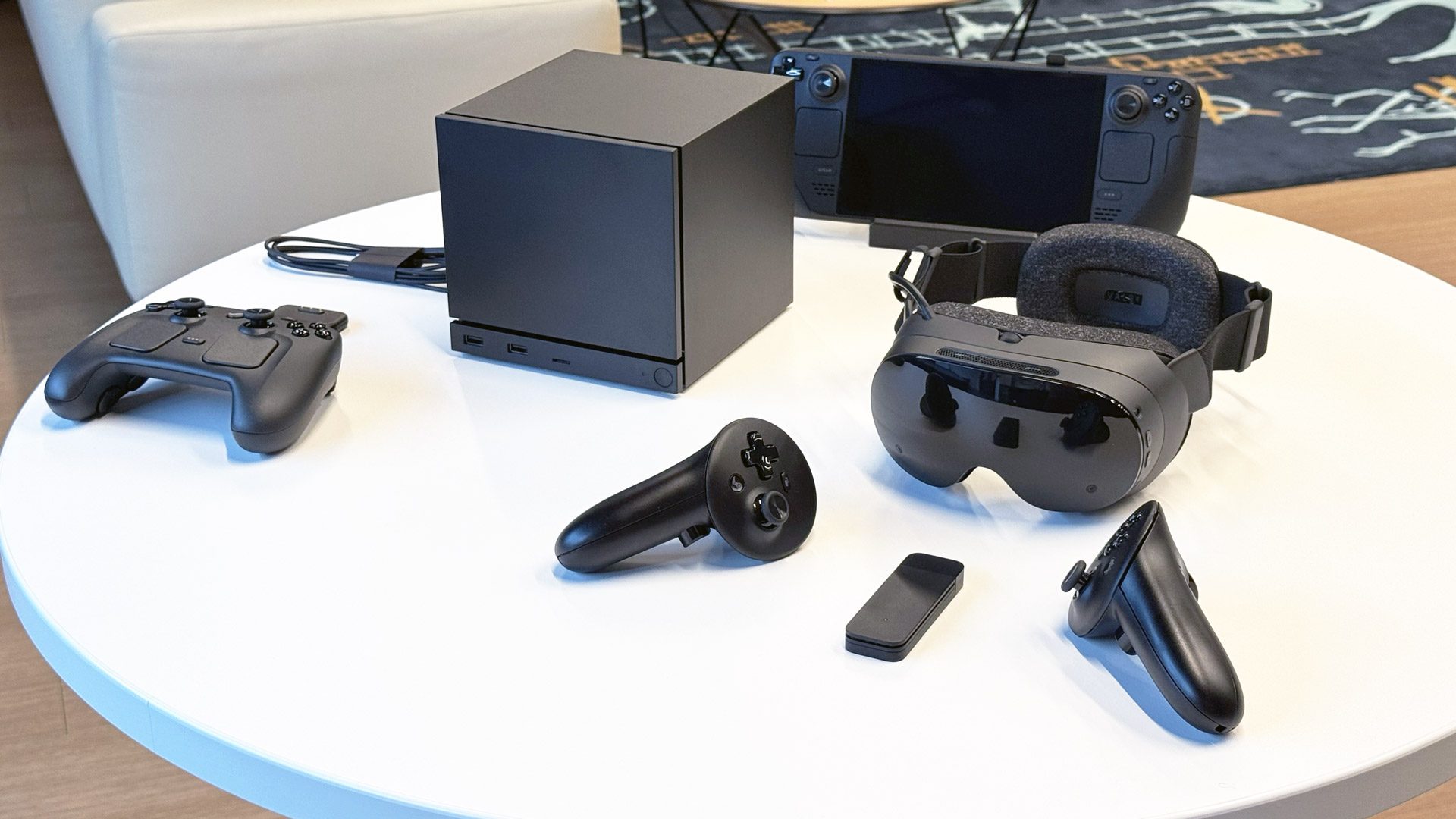
Valve’s upcoming standalone VR headset Steam Frame is still shipping sometime this year, the company says, as it is now marked as “coming soon” on the Steam backend.

In a hardware news update last month, Valve announced that Steam Frame, Steam Machine, and Steam Controller are all being affected by the wider RAM and storage component shortage. Parts woes notwithstanding, Valve said in February that its goal was still to ship in the first half of 2026.

Now, according to the Steam backend (via SteamDB), Valve ha marked all three of its forthcoming products as “coming soon.”

Whether that means “soon soon” or “Valve soon” remains to be seen, although the company gave another vote of confidence in release plans in last week’s 2025 Year in Review.

Photo by Road to VR

“We shared recently that there have been challenges with memory and storage shortages, but we will be shipping all three products this year. More updates will be shared as we finalize our plans,” the company says.

Notably, Valve still hasn’t indicated prices for Steam Frame, Steam Machine, or Steam Controller. At its November reveal, Valve told Road to VR that it expects Steam Frame to be ‘cheaper than Index’, although the company didn’t qualify its pricing logic. This could put it somewhere between $1,000 (Index headset, controllers, SteamVR trackers) and $500 (Index headset only).

As for Steam Machine, YouTuber ‘Skill Up’ confirmed with Valve back in November the PC won’t be subsidized like a console. Alternatively, Linus Tech Tips has suggested the lowest configuration could fetch somewhere around $700, which was based on a custom PC built on comparable parts.

Whatever the case, we expect a ‘buy now’ button to unceremonious appear on the Steam Frame page at some point, as Valve isn’t exactly known for the typical sort of fanfare seen with other companies.

Looking for more Steam Frame news?

Valve Unveils Steam Frame VR headset to Make Your Entire Steam Library Portable: Valve shows off Steam Frame, the standalone headset that can stream and natively play your entire Steam library—with only a few caveats right now.

Hands-on: Steam Frame Reveals Valve’s Modern Vision for VR and Growing Hardware Ambitions: We go hands-on with Valve’s latest and greatest VR headset yet.

Valve Says No New First-party VR Game is in Development: Valve launched Half-Life: Alyx (2020) a few months after releasing Index, but no such luck for first-party content on Steam Frame.

Valve is Open to Bringing SteamOS to Third-party VR Headsets: Steam Frame is the first VR headset to run SteamOS, but it may not be the last.

Valve Plans to Offer Steam Frame Dev Kits to VR Developers: Steam Frame isn’t here yet; Valve says it needs more time with developers first so they can optimize their PC VR games.

Valve Announces SteamOS Console and New Steam Controller, Designed with Steam Frame Headset in Mind: Find out why Valve’s new SteamOS-running Console and controller will work seamlessly with Steam Frame.

Steam Frame vs. Quest 3 Specs: Better Streaming, Power & Hackability: Quest 3 can do a lot, but can it go toe-to-toe with Steam Frame?

Steam Frame vs. Valve Index Specs: Wireless VR Gameplay That’s Generations Ahead : Valve Index used to be the go-to PC VR headset, but the times have changed.

The post Valve Confirms Steam Frame is Still Coming This Year, Now Marked as “coming soon” appeared first on Road to VR.


from Road to VR https://ift.tt/SZDw34k
via IFTTT

Friday, 6 March 2026

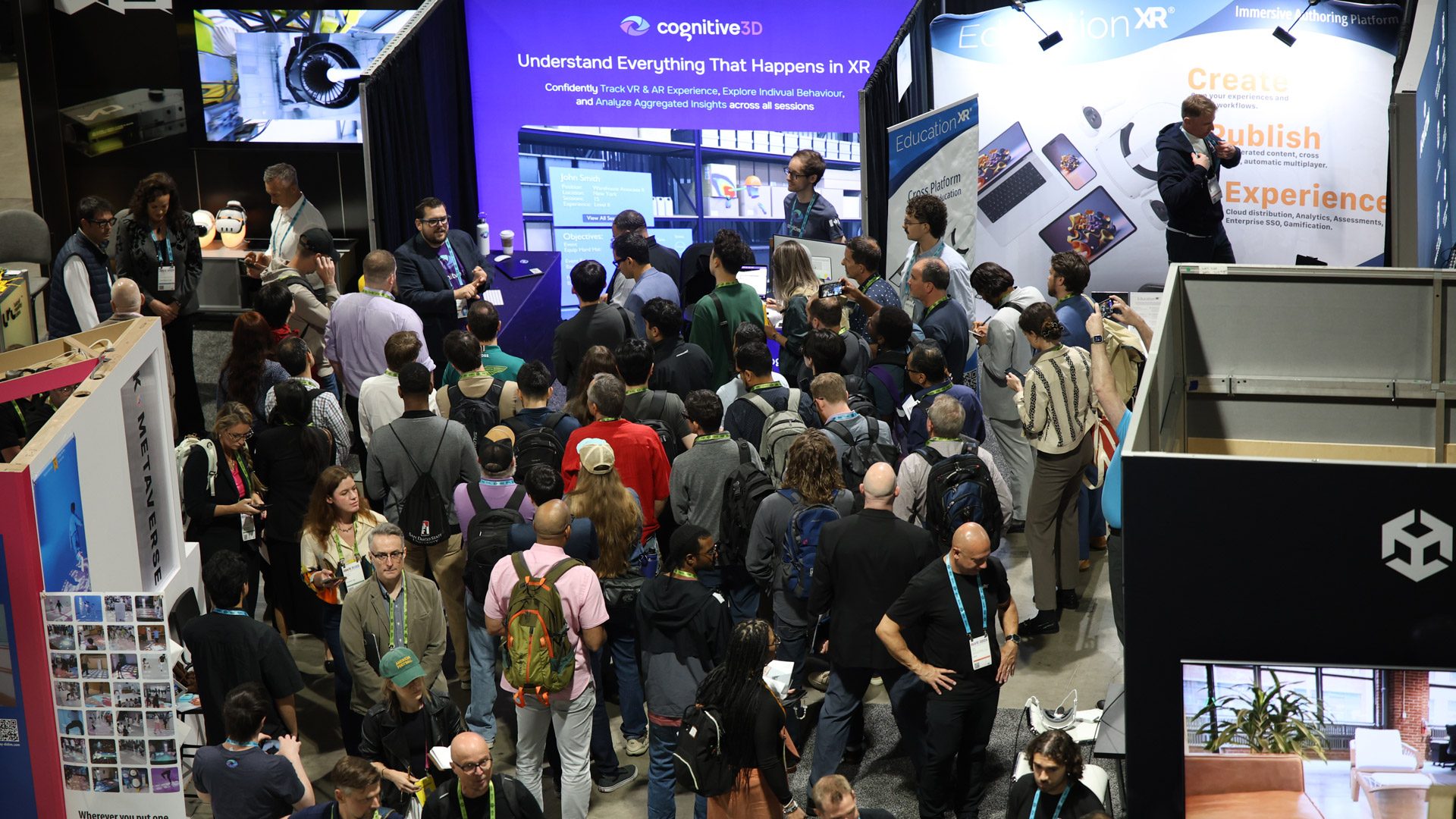
XR’s “Must-go” Conference Expands Gaming & LBE Focus for 2026

https://ift.tt/zQjplrb

AWE USA 2026 is returning to the Long Beach, CA on June 15–18. As the most important annual XR event on our calendar, we’re excited to once again be able to offer an exclusive 20% discount on tickets as the event’s Premiere Media Partner.

Since I started attending AWE USA in 2018, the conference has grown in scale and scope, offering increasingly more interesting and valuable sessions, exhibitors, and networking. It has steadily evolved into what I consider the must-go event for the XR industry. It carries the torch of passion that ignited the XR space back when it was little more than kickstarters, meetups, and those crazy enough to believe that immersive tech was not only possible to build, but worth building.

That’s why I’m proud to announce that Road to VR is once again joining AWE USA 2026 as the event’s Premiere Media Partner.

In addition to our usual reporting from the event, we’ll be highlighting the most interesting sessions and exhibitors ahead of the show, and offering an exclusive 20% discount on tickets to AWE USA 2026. Super Early Bird passes are available until March 19th—there won’t be a better deal!

AWE USA 2026 will be held at the Long Beach Convention Center in California from June 15th to 18th, and it’s expected to draw more than 5,000 attendees, 3,250 exhibitors, 400 speakers, and feature a 150,000 sqft expo floor.

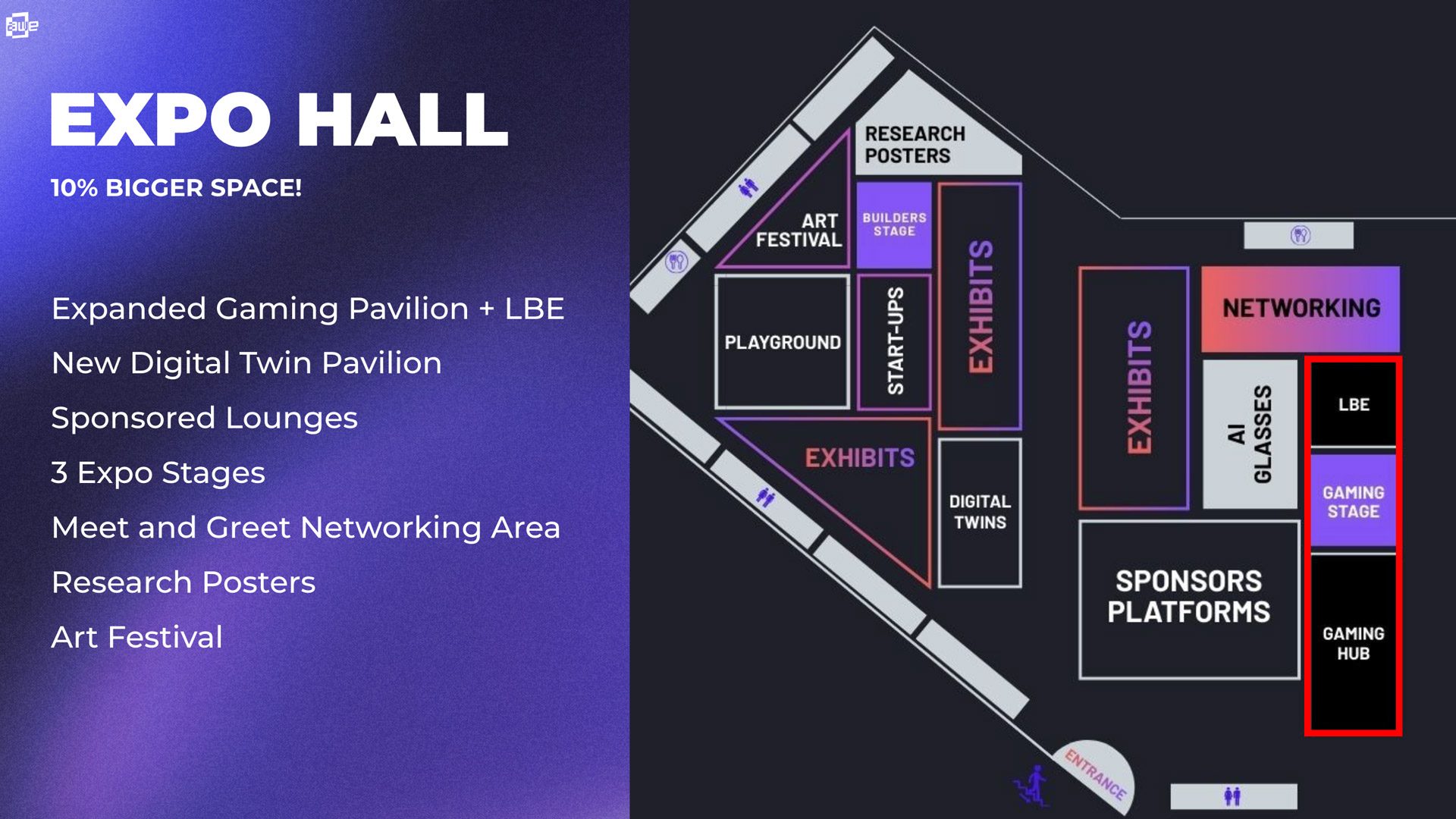
This year the conference is further growing its gaming and location-based entertainment (LBE) segments.

The gaming section of the show floor is not only growing to accommodate more exhibitors and attendees, but there’s a brand new LBE space dedicated to VR attractions, arcades, and activations.

Alongside the extra show floor real estate attendees can also expect a broader range of presentations and panels in the gaming & LBE track, with a full agenda coming soon. If you’re interested in featuring your game or LBE experience at AWE USA 2026, be sure to check out the upcoming webinar to learn more about the opportunities at the event.

The post XR’s “Must-go” Conference Expands Gaming & LBE Focus for 2026 appeared first on Road to VR.


from Road to VR https://ift.tt/PVDzb9n
via IFTTT

VR Pioneer nDreams Announces Studio Closures & Layoffs Amid “challenging” Games Market

https://ift.tt/DPm3iO5

nDreams, one of VR’s most senior game studios, announced plans to close two internal studios responsible for some of its most forward-thinking VR projects, which could also include a sizable number of layoffs.

While nDreams hasn’t officially shuttered Near Light or Compass at this point, the company says in a LinkenIn post that it could soon see a reduction of 78 roles across “all levels and multiple teams, including senior leadership.”

“Despite every effort to make our existing structure a success and avert this outcome, the VR games market remains challenging, making further changes necessary to ensure a commercially viable and sustainable future,” nDreams says.

nDreams spun up Elevation in 2022 to produce ‘AAA’ quality VR games. Elevation released its debut solo title Reach (2025) across all major VR headsets last year, making for a strong opening bid as the company’s remote-first studio.

That same year, nDreams acquired Near Light, a Brighton, UK-based studio known for virtual travel experience Perfect (2016) and single-player arcade shooter Shooty Fruity (2018). More recently, Near Light released PvP shooter Frenzies, which launched into early access in Quest in 2024.

In early 2025, nDreams opened internal an additional internal studio called ‘Compass’, which melded staff from both its nDreams Studio Orbital and nDreams Studio after a layoff round in late 2024 that affected 17.5% of the company.

Founded in 2013, nDreams has released a host of VR games over the years as both developer and publisher, including Phantom: Covert Ops (2020)Fracked (2021), Ghostbusters: Rise of the Ghost Lord (2023), and Vendetta Forever (2024).

This follows wider turmoil in the VR games industry, most recently precipitated by Meta’s reorganization of its Reality Labs XR division and rash of first-party studio closures, which included the shuttering of Armature Studio (Resident Evil 4 VR), Twisted Pixel (Deadpool VR), and Sanzaru Games (Asgard’s Wrath).

Here’s nDreams’ full statement below:

Our team was today informed of proposals to restructure nDreams, including a significant reduction in overall staffing levels. These changes would impact all levels and multiple teams, including senior leadership.

Since 2024, our staff have been divided across three internal studios: Elevation, Near Light, and Compass. At the core of the restructured business will be Elevation, which currently has around 120 staff engaged on unannounced projects. nDreams will also retain a lean group dedicated to XR R&D. Together, we will remain focused on delivering world-class VR and XR games.

Regrettably, the proposals include the closure of the Near Light and Compass studios, and a reduction in our Facilities, Talent, Shared Technology, and Executive teams, with 78 roles at risk of redundancy. Despite every effort to make our existing structure a success and avert this outcome, the VR games market remains challenging, making further changes necessary to ensure a commercially viable and sustainable future.

We’re committed to exploring every option to retain talent and will now enter a collective consultation process with the people impacted by these proposals. We recognise that this will be stressful and challenging for everyone affected and will be offering support throughout the process.

The post VR Pioneer nDreams Announces Studio Closures & Layoffs Amid “challenging” Games Market appeared first on Road to VR.


from Road to VR https://ift.tt/8z7rIdv
via IFTTT

Thursday, 5 March 2026

Upcoming ‘Project Helix’ Xbox Will “Play Xbox and PC Games,” But PC VR Support is Unconfirmed

https://ift.tt/THBqDt5

Microsoft today announced the codename of its next Xbox gaming console: Project Helix. Details are very light, but the company says Project Helix will “play your Xbox and PC games.” Naturally that’s got us curious about whether or not PC VR games could be in the mix, but there’s no word yet.

Xbox’s newly minted CEO Asha Sharma today teased the company’s next-gen Xbox. She confirmed the device is codenamed ‘Project Helix’.

“Project Helix will lead in performance and play your Xbox and PC games. Looking forward to chatting about this more with partners and studios at my first GDC next week!” she said on X.

Aside from this brief tease, it seems there’s no other official info being revealed, though we’ve reached out to the company for comment. The line about the company seeking to chat with “partners and studios” suggests this is the first time Project Helix is even being mentioned outside of internal conversations. Rumors suggest the console will launch in 2027.

So we have essentially no details yet on what the company means when it says Project Helix will be able to ‘play PC games’. But the possibility at least exists that this could open the door to compatibility with PC VR games too.

Granted, PC VR lives almost exclusively within the Steam ecosystem thanks to Valve’s ongoing support for the SteamVR platform. And while it’s technically possible that VR games could run on Project Helix without Steam (thanks to OpenXR), VR on Project Helix would be largely a non-starter if the console can’t somehow access the Steam library, because that’s the only active marketplace for the distribution of PC VR content.

If Project Helix can be ‘fully unlocked’ and operate like any normal Windows PC, there’s no reason to think that Steam and SteamVR content wouldn’t be able to run on the console. But if Microsoft plans to keep the system’s PC support locked down in some way, then practical support for PC VR content is unlikely without the company’s express interest in allowing it.

Microsoft has a storied history when it comes to VR. Not only did the company make a significant attempt at entering the market with its Windows Mixed Reality platform (only to abandon that project after several years), but back in 2016 the company officially said that its upcoming Xbox One X would include support for “high fidelity VR” gaming. By the time the console actually reached the market in 2017, those plans had been scrapped.

While we don’t expect an about-face on VR support from Xbox itself, it will be interesting to see if Project Helix retains full PC capabilities, and thus the ability to run PC VR content.

The post Upcoming ‘Project Helix’ Xbox Will “Play Xbox and PC Games,” But PC VR Support is Unconfirmed appeared first on Road to VR.


from Road to VR https://ift.tt/WfDYL8p
via IFTTT
Related Posts Plugin for WordPress, Blogger...